In 1889 New York City, a young Italian immigrant named Paolo pushes his dying mother in a cart, and when they seek help at a hospital, they speak only Italian and are cruelly dismissed by staff. An older boy, Enzo, offers the two a fragile shelter in the sewers, where life remains perilous but warmer than the streets they’ve known.
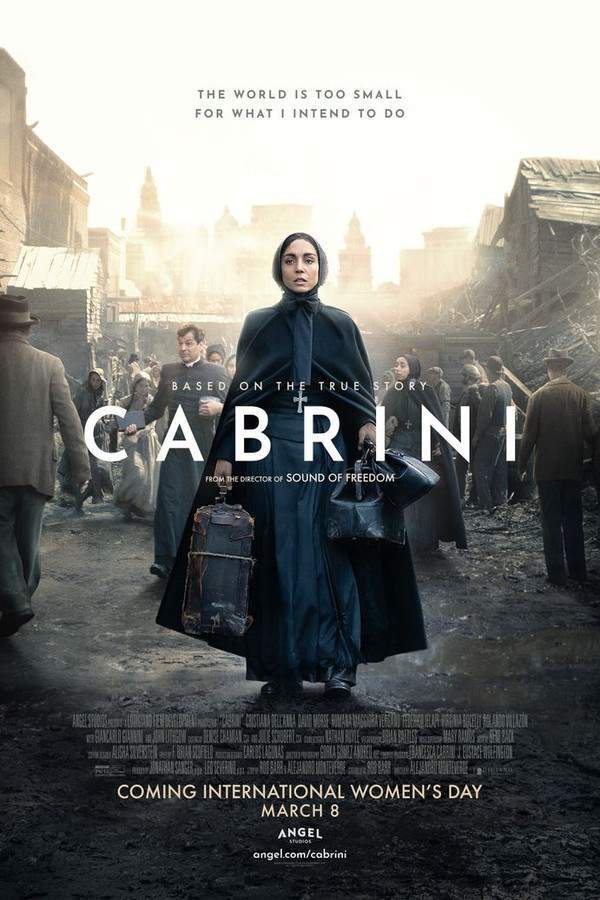
Mother Frances Xavier Cabrini, a tuberculosis-stricken nun, travels from the Vatican after a failed bid to found her own missionary order. As a girl, she folded paper boats by a river, imagining them sailing to missions across the world, and she carries vivid visions of those past riverside days. A cardinal rejects her plan, but she insists on meeting the Pope and shares a fierce, clear dream: to help the poor and to build an orphanage in China, insisting that the world is not large enough for what she wants to do. The Pope notes that no woman has led such an effort, yet he grants her permission, hinting she should go to New York where her reach might become global.
[Cabrini] and her Sisters migrate to New York to tend to poor Italian immigrants, offering care in a Five Points neighborhood that has been neglected by the local priest. On their first night, they find themselves with nowhere to stay but a brothel, where a sympathetic prostitute, [Vittoria], welcomes them and urges them to bar their door. The Sisters begin to establish charity work and hospital care, bringing light to children who are forgotten, even as they face constant pressure from the rough streets and its operators.
Archbishop Corrigan is initially unhelpful, but when Cabrini presents him with a papal letter, he reluctantly allows her to continue. Her order grows, and the work expands to shelter and medical aid. Cabrini often must go underground at night to search for missing children, risking her own health, until a physician, [Patch Darragh], begins assisting her mission and offering professional support. Paolo and [Enzo] briefly consider a future in crime, but Cabrini welcomes them to dinner with the Sisters, planting the seed of a different path. When [Geno] tries to reclaim Vittoria, Paolo uses a gun to cripple him, a moment that later leads Cabrini to persuade Paolo to destroy the weapon, which his father had used to die by suicide. In a separate violent encounter, Vittoria defends herself and fatally stabs Geno.
[Cabrini] purchases an Upper West Side property to establish a home for children, but the mayor’s hostility and a city inspector’s eviction order threaten the project. Yet [David Morse] as Archbishop Corrigan pushes aside this resistance, locating a former Jesuit property the Sisters can use, with the condition that they dig water wells on the land. [Enzo] and [Paolo] join the effort to raise funds, and a pump-station accident tragically takes Enzo’s life—an event that underscores Cabrini’s belief that a better-equipped hospital could save more lives. Dr. Murphy shares a sobering assessment, urging the creation of a first-rate hospital, and Cabrini commits to buying an old building with the help of wealthy donors from Irish, Italian, and Polish immigrant communities.
To rally support among Italian immigrants, Cabrini plans a fundraiser with Enrico DiSalvo, a celebrated singer who ultimately refuses to perform. Undeterred, she brings together a choir of Italian immigrants who sing under his window, and [Virginia Bocelli] lends her voice to a moving rendition of Va, pensiero, a chorus inspired by longing for homeland roots from Verdi’s Nabucco. The gesture touches the famed singer, who then agrees to contribute in his own way.
When Cabrini hosts an Italian-American festival fundraiser with the renowned singer, police, spouting racial slurs, shut it down and Cabrini is arrested. [Pope Leo XIII] overrules the local authorities and supports Cabrini, though he recognizes the tension between faith and ambition; Cabrini explains she desires an “empire of hope.” She also persuades the Italian Senate to fund the hospital, but violence and arson strike the new hospital site. Cabrini confronts the mayor, insinuating his possible involvement, and a New York Times reporter—who had previously helped shed light on the Five Points—helps win the mayor’s reluctant consent.
Despite a frail lung—she endures to the age of 67 and becomes widely celebrated. Her canonization as the first American saint crowns a life of service, naming her the patron saint of immigrants, with her order expanding across the world, including to China.