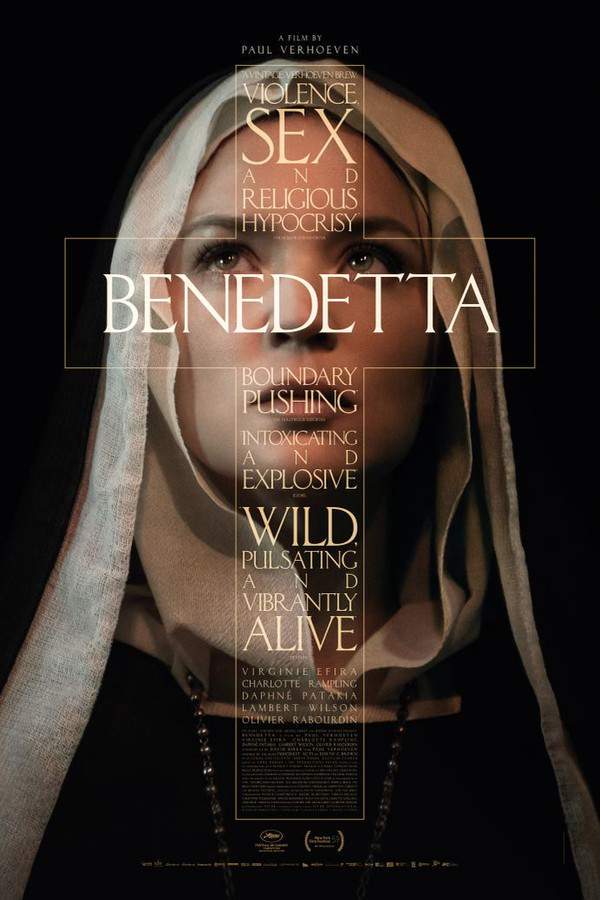
Benedetta

Benedetta

Year: 2021

Runtime: 131 min

Language: French

Director: Paul Verhoeven

Echo Score: 69
BiographyDramaHistoryRomance

Set in 17th-century Italy, this film follows a devout nun whose intense spiritual journey leads to a forbidden and passionate relationship with a young novice. As her visions and experiences become increasingly vivid, Benedetta’s revelations challenge the established doctrines of the Church. Her actions and beliefs provoke a crisis that threatens her position and exposes hidden truths within the religious order, forcing her to confront the consequences of her desires and convictions.

Warning: spoilers below!

Haven’t seen Benedetta yet? This summary contains major spoilers. Bookmark the page, watch the movie, and come back for the full breakdown. If you're ready, scroll on and relive the story!

Benedetta (2021) – Full Plot Summary & Ending Explained

Read the complete plot breakdown of Benedetta (2021), including all key story events, major twists, and the ending explained in detail. Discover what really happened—and what it all means.

In 17th-century Pescia, Italy, a young girl named Benedetta Carlini is brought by her parents to a Theatine convent overseen by Abbess Felicita (Charlotte Rampling). After 18 years of devoted life, during a play where she plays the Virgin Mary, the adult Benedetta (Virginie Efira) experiences a profound vision of Jesus calling her name.

Things take a turn when Bartolomea (Daphné Patakia), a teenage peasant girl, seeks refuge in the convent from her abusive father. Benedetta is tasked with guiding Bartolomea as she adjusts to convent life. That night, a passionate kiss from Bartolomea ignites something deeper within Benedetta. As time passes, Benedetta begins having vivid visions of Jesus. After a traumatic vision where a man she believes to be Jesus saves her from a brutal attack, she falls gravely ill. Abbess Felicita assigns Bartolomea to care for her during this distressing time.

During further visions, Christ urges Benedetta to undress and touch His hands. To her bewilderment, she wakes up the following morning with stigmata on her hands and feet, sparking an investigation into these miraculous occurrences. Abbess Felicita becomes skeptical, noting that Benedetta’s stigmata manifested while she was asleep, not in prayer, and her forehead lacks the marks of a crown of thorns. Shortly after, Benedetta collapses outside Felicita’s chambers and begins speaking in a commanding male voice, chastising those who doubt her while fresh wounds appear on her forehead.

Sister Christina (Louise Chevillotte), the abbess’s daughter, suspects foul play after discovering a shard of pottery nearby, raising concerns about Benedetta’s wounds. A conflict brews between Felicita and local church authorities regarding how to handle the looming fascination surrounding Benedetta’s visions, eventually leading to Benedetta’s rise to abbess, replacing Felicita. As Benedetta and Bartolomea take residence in Felicita’s former quarters, they begin a steamy romance, even resorting to using a dildo that Bartolomea crafts from Benedetta’s wooden Virgin Mary statuette.

During confession, Christina lies to a priest, claiming she witnessed Benedetta inflicting her own wounds, forcing the priest to compel her to speak publicly about her accusations. Nevertheless, Abbess Felicita defends Benedetta, revealing that Christina previously admitted she hadn’t seen the acts occur. In a twisted turn of fate, Benedetta, seemingly inhabited by Jesus’s spirit, orders Christina to flagellate herself while Felicita spies on Benedetta and Bartolomea engaging in their passionate affair.

In despair from her humiliation, Christina tragically jumps to her death from the convent’s roof. As a deadly plague sweeps through the area, Benedetta proclaims that Pescia will be spared, ordering the abbey to be closed to avoid contamination. In a covert mission, Felicita journeys to Florence to disclose Benedetta’s indiscretions to the papal nuncio, while Benedetta succumbs to a mysterious ailment.

Upon Felicita’s return with the Nuncio (Lambert Wilson), Benedetta miraculously revives, claiming she experienced heaven and learned the fates of all present. As a representative of the Pope, the Nuncio launches an investigation into Benedetta’s behavior. Initially, Bartolomea denies any sexual involvement but eventually breaks under torture, leading the Nuncio to uncover the wooden dildo hidden within a Bible. He orders Benedetta’s arrest, during which she again speaks in a male tone, prophesying the Nuncio’s impending illness.

Chaos ensues in the town square when Benedetta is set to be executed by burning at the stake. Just before the flames engulf her, she reveals new stigmata, asserting that the Angel of Death is near. In a dramatic revelation, Felicita, afflicted by the plague, blames the Nuncio for bringing calamity upon Pescia. The townspeople revolt, preventing Benedetta’s execution and leading to the Nuncio’s demise at their hands.

In the midst of the upheaval, Bartolomea frees Benedetta, discovering a bloody potsherd beside her. Escaping the chaos, the two women flee the town, while Felicita chooses to end her life by self-immolation upon the pyre meant for Benedetta.

The film concludes with Benedetta, after a night spent with Bartolomea, resolutely returning to the convent despite her companion’s pleas for her to stay and confess the truth about her stigmata. A title card notes that Benedetta lived until 1661 in the abbey, outlasting the plague that spared Pescia.
Last Updated: November 07, 2024 at 23:21

Ending Explained – What Happens at the End of Benedetta?

Still wondering what the ending of Benedetta (2021) really means? Here’s a spoiler-heavy breakdown of the final scene, major twists, and the deeper themes that shape the film’s conclusion.

In the film’s final scenes, Benedetta faces a choice between her spiritual life and her personal feelings. Although she briefly reunites with Bartelomew, she ultimately decides to return to her convent, believing that her future under God’s protection will be better and safer. This decision reflects her deep commitment to her faith and her belief that her divine calling takes precedence over her personal desires. Meanwhile, Bartelomew is left heartbroken, pleading with Benedetta not to leave her. The ending leaves viewers contemplating the complex relationship between faith, love, and power. It hints that Benedetta’s return to her previous life might seem like the safer, more righteous choice in her eyes, but it also raises questions about the oppressive nature of the religious system that allowed her to be manipulated and her feelings to be dismissed. Ultimately, the story seems to emphasize the importance of questioning where one’s sense of morality and righteousness originates. Benedetta’s rejection of her love and her choice to re-enter the convent suggest that she genuinely believes she is following God’s will, even if that may mean sacrificing genuine connection for institutional authority. The film leaves us with a haunting reflection on the ways faith can be intertwined with control, and how personal liberation often demands questioning the very systems that claim to uphold righteousness.

Last Updated: June 25, 2025 at 08:44

Mobile App Preview

Coming soon on iOS and Android

The Plot Explained Mobile App

From blockbusters to hidden gems — dive into movie stories anytime, anywhere. Save your favorites, discover plots faster, and never miss a twist again.

Sign up to be the first to know when we launch. Your email stays private — always.

Explore Movie Threads

Discover curated groups of movies connected by mood, themes, and story style. Browse collections built around emotion, atmosphere, and narrative focus to easily find films that match what you feel like watching right now.

Historical Dramas of Repression and Rebellion like Benedetta

Historical stories where characters break stifling societal rules at great personal risk.For viewers who liked the tense, claustrophobic atmosphere of Benedetta, this list features movies set in repressive historical periods where characters defy strict societal or religious norms. These films explore the dangerous intersection of personal desire and institutional power, often featuring transgressive relationships and ambiguous, heavy endings.

claustrophobictensetransgressiveforbiddenharrowingrebellioushistorical

Narrative Summary

The narrative typically follows a protagonist trapped within a rigid system—religious, social, or domestic. Their inner life, whether it's desire, doubt, or a unique talent, creates a secret world that conflicts with public expectations. This leads to a crisis of exposure, investigation, and a final, costly act of rebellion that questions the very foundations of the system.

Why These Movies?

These movies share a specific, oppressive historical setting that acts as a pressure cooker for character drama. They are united by a dark tone, high emotional intensity, and a steady pacing that methodically builds tension between private transgression and public conformity, resulting in a deeply resonant and often harrowing viewing experience.

Movies Exploring Faith and Desire like Benedetta

Stories where spiritual ecstasy and earthly passion become dangerously intertwined.If you liked Benedetta's exploration of the ambiguous boundary between religious ecstasy and physical passion, you'll find similar themes here. These movies focus on characters whose intense spiritual journeys are complicated by forbidden desires, creating crises of faith and authority, often culminating in ambiguous and thought-provoking endings.

spiritualpassionatetransgressivepsychologicaltenseforbiddenambiguousharrowing

Narrative Summary

The plot revolves around a character, often in a position of piety or devotion, who experiences powerful visions or sensations that defy easy categorization. Their journey forces a re-examination of the nature of faith, hypocrisy, and the body itself. The narrative thrust comes from the collision of their inner world with external dogma, leaving the truth of their experiences purposefully unresolved.

Why These Movies?

These films are linked by their central thematic focus on the conflict—and potential fusion—of the sacred and the profane. They share a high intensity, a heavy emotional weight, and an ambiguous ending feel, creating a coherent vibe of psychological and spiritual unease that challenges both the characters and the audience.

Unlock the Full Story of Benedetta

Don't stop at just watching — explore Benedetta in full detail. From the complete plot summary and scene-by-scene timeline to character breakdowns, thematic analysis, and a deep dive into the ending — every page helps you truly understand what Benedetta is all about. Plus, discover what's next after the movie.

Benedetta Timeline

Track the full timeline of Benedetta with every major event arranged chronologically. Perfect for decoding non-linear storytelling, flashbacks, or parallel narratives with a clear scene-by-scene breakdown.

Benedetta Timeline

Characters, Settings & Themes in Benedetta

Discover the characters, locations, and core themes that shape Benedetta. Get insights into symbolic elements, setting significance, and deeper narrative meaning — ideal for thematic analysis and movie breakdowns.

Characters, Settings & Themes in Benedetta

Benedetta Ending Explained

What really happened at the end of Benedetta? This detailed ending explained page breaks down final scenes, hidden clues, and alternate interpretations with expert analysis and viewer theories.

Benedetta Ending Explained

Benedetta Spoiler-Free Summary

Get a quick, spoiler-free overview of Benedetta that covers the main plot points and key details without revealing any major twists or spoilers. Perfect for those who want to know what to expect before diving in.

Benedetta Spoiler-Free Summary

More About Benedetta

Visit What's After the Movie to explore more about Benedetta: box office results, cast and crew info, production details, post-credit scenes, and external links — all in one place for movie fans and researchers.

More About Benedetta