Plot Explained Spoilers guaranteed!
Plot Explained

Browse by genre

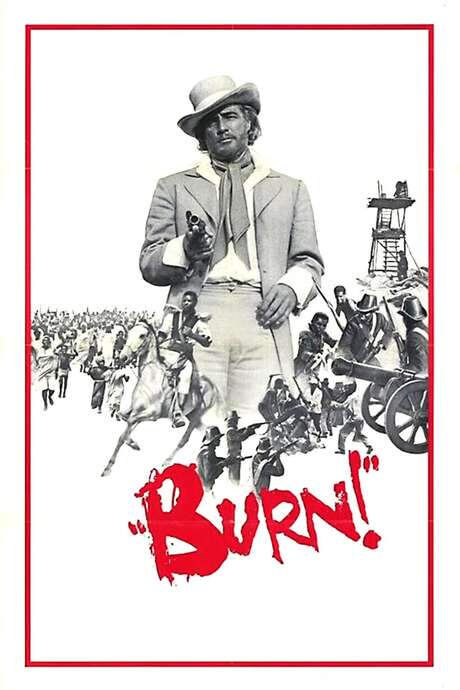
Burn! (1969) movie poster

Characters & Themes

Burn! (1969) Characters, Setting & Themes Explained

Release, runtime and language
1969 · 129 mins · Italian
Loading streaming availability…
Directed by
Gillo Pontecorvo
Starring
Marlon Brando, Renato Salvatori, Turam Quibo, Giampiero Albertini, Enrico Cesaretti, Thomas Lyons

The man who sells war. Professional mercenary Sir William Walker incites a slave revolt on the Caribbean island of Queimada to further the British sugar trade. Years later the Empire dispatches him again, this time to crush the very rebels he raised, whose newfound power now endangers the same sugar interests.

On this page (8)
  1. 1 Where to watch
  2. 2 Characters explained (4)
  3. 3 Where & when it takes place
  4. 4 Themes & meaning (3)
  5. 5 Character & meaning questions
  6. 6 Movie threads
  7. 7 Movies like Burn!
  8. 8 Every angle
Loading streaming availability…

4 main characters · contains spoilers

Burn! Characters Explained: Who Is Who

The main characters of Burn! (1969), heroes and villains: what drives them, how they change over the course of the story and what each of them reveals about the film's bigger ideas.

  • Sir William Walker (Marlon Brando)

    A British agent provocateur who infiltrates Queimada and orchestrates the island's political chaos. He entices Dolores to lead the revolt, coerces landowners to reject Portuguese rule, and arranges a nighttime coup to topple the governor. Walker then installs a puppet regime beholden to the Antilles Company and later returns to quell the next uprising, driven by a complex mix of ambition and guilt.

    • 🎭 Manipulation
    • 🗺️ Strategy
  • José Dolores (Evaristo Márquez)

    A charismatic enslaved leader who becomes Walker's instrument to spark the first rebellion. He leads the uprising with passion, but is later disillusioned by the puppet regime's cooperation with external interests. Dolores reemerges as a central figure in the second revolt, ultimately facing execution.

    • 💪 Leadership
    • 🧭 Charisma
  • Teddy Sanchez (Renato Salvatori)

    An idealistic yet ineffectual revolutionary who heads the initial regime installed by Walker. He embodies the dream of liberation but struggles to translate ideals into effective governance amid competing interests. Sanchez is sidelined as Walker consolidates power under the company's influence.

    • 🎯 Ideology
    • 🏛️ Governance
  • Gen. Alonso Prada (Thomas Lyons)

    A military figure aligned with the colonial regime, tasked with maintaining order and suppressing revolts. He embodies the persistence of imperial authority in the face of rebellion and economic exploitation. Prada's forces clash with Dolores' followers as the conflict escalates.

    • ⚔️ Military
    • 🏰 Authority

Last updated: October 04, 2025 at 14:57

Was this helpful?

Setting

Where and When Does Burn! Take Place?

The setting of Burn! (1969): the year and time period, the places and locations, and how they shape the characters, the mood and the tension of the story.

Time period

1844–1854

The action unfolds in the mid-19th century, a period of colonial empires and slave economies in the Caribbean. It traces a decade of uprisings, coups, and counter-revolutions that reshape ruler-ship on the island. The timeline culminates with a brutal suppression and a fatal end for the rebel leader.

Location

Queimada

Queimada is portrayed as a tropical Caribbean island under Portuguese rule. The setting centers on a colonial society built on slavery and land ownership, ripe for manipulation by external interests. The island's economic ambitions are driven by the Antilles Royal Sugar Company, highlighting the extractive nature of colonial economics.

  • 🏝️ Caribbean island
  • 🏛️ Colonial history

Last updated: October 04, 2025 at 14:57

Was this helpful?

3 major themes

Burn! Meaning: Themes & Message Explained

What is Burn! (1969) really about? The emotional, social and philosophical themes the film keeps returning to, its symbolism and the message beneath the surface.

  • Colonial Power

    The film examines how external powers manipulate local populations to secure economic interests. Walker uses deception and political theater to engineer a slave revolt that serves the British and corporate agenda. The puppet regime demonstrates how power can be manufactured to maintain control over resource-rich lands. The narrative questions the morality of engineering freedom when it serves exploitation.

  • Rebellion

    Rebellion animates both the first and second uprisings led by Dolores, born from the enslaved population's demand for autonomy. The initial success exposes the fragility of revolutionary gains when co-opted by corporate interests. A second, longer rebellion arises from discontent with the regime's collaboration with the Antilles Company. The cycle shows how resistance persists despite countermeasures.

  • Betrayal

    Betrayal threads through the relationships between rebels and their would-be liberators. Dolores agrees to surrender arms in exchange for abolition, a pact that betrays the ideals of freedom for pragmatic stabilization. Walker’s actions, though framed as anti-colonial, ultimately align with corporate domination. In the end, the execution of Dolores and the murky moral aftermath reflect the cost of political manipulation.

Last updated: October 04, 2025 at 14:57

Was this helpful?

Character & theme questions

Burn! Characters & Meaning: Your Questions Answered

The questions people ask about Burn! (1969): who the characters really are, their relationships, what the symbols mean, where it takes place and what the movie is really about. Each answer contains spoilers.

Q1

Where is the movie Burn! set?

Burn! takes place on the fictional Caribbean island of Queimada, portrayed as a tropical colony under Portuguese rule. The island is depicted as a society built on slavery and sugar production, where the Antilles Royal Sugar Company dominates economic life. This setting represents the extractive nature of colonial economics in the mid-19th century Caribbean.

  • queimada
  • caribbean
  • colonial island
  • setting
  • slave colony
Q2

When does the story take place?

The film spans 1844 to 1854, set in the mid-19th century during the height of colonial empires and slave economies in the Caribbean. This decade covers the initial slave revolt, the establishment of a puppet regime, and the subsequent uprising that leads to brutal suppression.

  • 1844
  • 1854
  • mid-19th century
  • colonial era
  • timeline
Q3

What does the film say about colonial power?

The film examines how external powers manipulate local populations to serve economic interests. Walker engineers a slave revolt that appears to free the enslaved but actually serves British corporate goals. The puppet regime that results demonstrates how power can be manufactured to maintain control over resource-rich lands, questioning whether freedom can ever be genuine when it serves exploitation.

  • colonialism
  • british empire
  • manipulation
  • exploitation
  • corporate power
Q4

What role does rebellion play in the story?

Rebellion drives both major uprisings in the film. The first rebellion, led by José Dolores, succeeds initially but is co-opted by corporate interests. A second, longer rebellion emerges when the puppet regime's collaboration with the Antilles Company becomes intolerable. The film shows how the cycle of resistance persists despite countermeasures, illustrating the persistent desire for autonomy even when repeatedly betrayed.

  • rebellion
  • slave revolt
  • uprising
  • revolution
  • resistance
Q5

How does betrayal function as a theme in Burn!?

Betrayal threads through all key relationships in the film. Dolores agrees to surrender arms in exchange for abolition, betraying revolutionary ideals for pragmatic stabilization. Walker, despite framing himself as anti-colonial, ultimately serves corporate domination. The execution of Dolores and Walker's subsequent moral destruction reflect the devastating cost of political manipulation, where liberation becomes just another form of control.

  • betrayal
  • manipulation
  • politics
  • trust
  • consequences
Q6

Who is Sir William Walker in the film?

Sir William Walker is a British agent provocateur who infiltrates Queimada to orchestrate political chaos for British commercial interests. He entices the enslaved leader José Dolores to lead a revolt, manipulates landowners to reject Portuguese rule, and arranges a coup to install a puppet regime. Later, he returns to suppress the very rebellion he created, driven by a complex mix of ambition and guilt.

  • sir william walker
  • british agent
  • provocateur
  • mercenary
  • protagonist
Q7

Who is José Dolores?

José Dolores is a charismatic enslaved leader who becomes Walker's instrument to spark the first rebellion. He leads the uprising with passion and conviction, but becomes disillusioned when the new regime cooperates with the Antilles Company. He later reemerges as a central figure in the second revolt, ultimately facing execution, symbolizing the betrayal of genuine revolutionary ideals.

  • jose dolores
  • enslaved leader
  • rebel
  • revolutionary
  • freedom
Q8

What is the Antilles Royal Sugar Company's role in the story?

The Antilles Royal Sugar Company drives the economic exploitation of Queimada, representing corporate colonialism. Walker installs a puppet regime specifically to serve the company's interests. When that regime's corruption sparks a second rebellion that threatens the company's profits, the British dispatch Walker again to crush the uprising, revealing that the initial 'liberation' was merely a means to maintain corporate control.

  • antilles company
  • sugar
  • corporation
  • colonial economics
  • exploitation
Q9

Who is Teddy Sanchez in Burn!?

Teddy Sanchez is an idealistic but ineffectual revolutionary who heads the initial regime installed by Walker after the coup. He embodies the dream of liberation but struggles to translate ideals into effective governance amid competing interests. Sanchez is gradually sidelined as Walker consolidates power under the company's influence, representing how revolutionary figures are often peripheralized in manufactured revolutions.

  • teddy sanchez
  • revolutionary
  • idealist
  • puppet leader
  • governance
Q10

Who is General Alonso Prada?

General Alonso Prada is a military figure aligned with the colonial regime, tasked with maintaining order and suppressing revolts. He embodies the persistence of imperial authority in the face of rebellion and economic exploitation. Prada's forces clash with Dolores' followers as the conflict escalates, representing the violent enforcement of colonial control.

  • general prada
  • military
  • colonial authority
  • oppression
  • suppression
Q11

What are the main themes explored in Burn!?

Burn! explores three interconnected themes: Colonial Power (how external forces manipulate local populations for economic gain), Rebellion (the persistent cycle of resistance against oppression), and Betrayal (the moral corruption that occurs when revolutionary ideals are co-opted by exploitative interests). The film presents a cynical view of colonialism, showing how 'liberation' can be manufactured to serve the same exploitative systems it appears to challenge.

  • themes
  • colonialism
  • rebellion
  • betrayal
  • meaning
  • message
Q12

How does the Caribbean setting influence the story's themes?

The Caribbean setting is essential to the film's examination of colonial exploitation. Queimada's sugar economy, built on enslaved labor, represents the historical reality of Caribbean colonies as extractive enterprises. The island's vulnerability to external powers, Portuguese, British, and corporate, mirrors the real history of colonial manipulation in the region. This setting allows the film to explore how economic interests drive political intervention regardless of stated moral justifications.

  • caribbean
  • colonialism
  • sugar economy
  • slavery
  • setting
  • economics

Movie threads

More Movies Like Burn!, by Mood & Story

Curated lists built around what makes Burn! tick: the same mood, the same kind of story or the same emotional payoff. Each list explains why these movies belong together.

Cynical Political Movies like Burn!

Stories of cold, calculated power plays that consume their architects. If you enjoyed the ruthless political games in Burn!, you'll find similar stories here. These movies, from historical dramas to thrillers, feature intricate plots of manipulation, foreign intervention, and the heavy moral cost of playing with human lives for geopolitical gain.

  • cynical
  • tense
  • thought-provoking
  • grim
  • fatalistic
  • oppressive
  • Tone: dark, cynical, tense
  • Pacing: steady, deliberate
Why these movies?

The story pattern: Stories in this thread typically follow a powerful outsider or agent who enters a volatile situation to orchestrate a political outcome. Their initial success gives way to unforeseen consequences, forcing them to confront or become part of the very chaos they created, often in a bleakly ironic conclusion.

Why they belong together: They are grouped by their shared dark tone, high-stakes political intrigue, and a focus on the moral conflict inherent in realpolitik. The pacing is usually steady, building tension through strategic dialogue and inevitable betrayals rather than constant action.

Movies about Doomed Revolutions like Burn!

Epic tales of rebellion born from hope and crushed by harsh reality. Looking for more movies with the heavy, tragic feel of the revolution in Burn!? This list features epic historical and war dramas where the fight for freedom is depicted with grim realism, exploring themes of betrayal, exploitation, and the high cost of resistance.

  • grim
  • melancholic
  • fatalistic
  • oppressive
  • tense
  • thought-provoking
  • Tone: bleak, grim, melancholic
  • Pacing: steady, epic
Why these movies?

The story pattern: The narrative follows a group or leader fighting against an oppressive system. The initial spark of hope and righteous anger is methodically extinguished by the brutal realities of power, often highlighting the personal betrayal and martyrdom of the revolutionaries.

Why they belong together: These films share a bleak ending feel, heavy emotional weight, and an oppressive, melancholic mood. They are united by their serious treatment of revolution as a tragic, rather than triumphant, process, grounded in themes of colonialism and economic exploitation.

If you liked this

Movies Like Burn!

Similar movies to Burn!: the same genre, themes or kind of story. Each one comes with its own plot summary, timeline and ending explained.

Browse all movie summaries

Every angle

Burn! (1969) Explained: Plot, Timeline & Characters

Everything about Burn! in one place: what happens in the plot summary, the timeline in chronological order, the characters and meaning and a spoiler-free summary. What's After the Movie adds the cast, box office and post-credit scenes.

Coming soon on iOS and Android

The Plot Explained Movie Summary App

Plot summaries, endings explained and timelines on your phone. Catch up on any movie in minutes, save your favorites and never miss a twist again.

Be the first to know when we launch. Your email stays private, always.

Learn more about the app