Plot Explained Spoilers guaranteed!
Plot Explained

Browse by genre

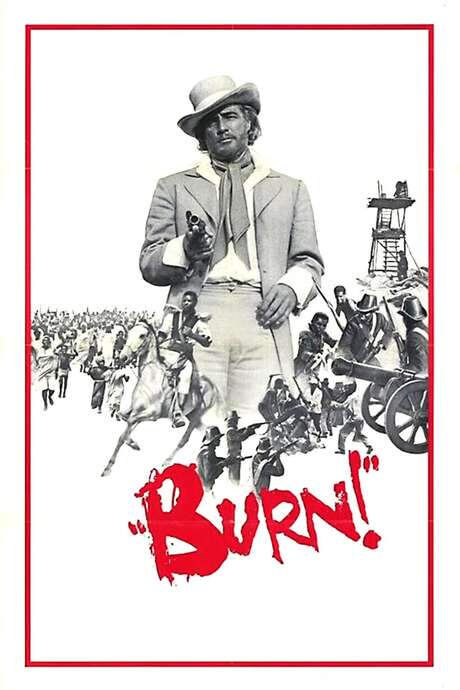
Burn! (1969) movie poster

Plot Summary

Burn! (1969) Plot Summary Explained

Release, runtime and language
1969 · 129 mins · Italian
Loading streaming availability…
Directed by
Gillo Pontecorvo
Starring
Marlon Brando, Renato Salvatori, Turam Quibo, Giampiero Albertini, Enrico Cesaretti, Thomas Lyons

The man who sells war. Professional mercenary Sir William Walker incites a slave revolt on the Caribbean island of Queimada to further the British sugar trade. Years later the Empire dispatches him again, this time to crush the very rebels he raised, whose newfound power now endangers the same sugar interests.

On this page (6)
  1. 1 Where to watch
  2. 2 What happens: full plot
  3. 3 Plot questions answered
  4. 4 Movie threads
  5. 5 Movies like Burn!
  6. 6 Every angle
Loading streaming availability…

Full plot summary · contains spoilers

What Happens in Burn!: Full Plot Summary

The whole story of Burn! (1969) explained, from the opening scene to the final frame: every key event, every twist and what it all adds up to. Read it as a quick recap before the sequel, to check a scene you missed, or to finally understand what really happened.

Sir William Walker, an agent provocateur, is dispatched by the British Admiralty in 1844 to the island of Queimada—a Portuguese colony in the Lesser Antilles—where the empire hopes to unlock the island for the Antilles Royal Sugar Company. His mission is to ignite an uprising of enslaved Africans against the Portuguese regime, paving the way for a government that would be friendly to white planters and British economic interests.

Upon his arrival, he forges a bond with the charismatic José Dolores, and subtly steers him to lead the slave rebellion. Walker also influences prominent landowners to withdraw their loyalty from the Portuguese crown. Dolores’s leadership proves powerful and effective, culminating in a nighttime coup that eliminates the Portuguese governor. In the aftermath, Walker sets up a puppet regime, headed by the idealistic yet ultimately ineffectual revolutionary Teddy Sanchez, and ensures that the new government remains indebted to the Antilles Company. Dolores is persuaded to recognize this regime and, in exchange, to surrender his arms as a symbolic step toward the abolition of slavery. Having achieved his objective, Walker moves on to a new assignment in Indochina, leaving Queimada momentarily stabilized under foreign interests.

The story then moves forward to 1848, when Dolores—now disillusioned by the regime’s collaboration with the Antilles Company—rises again to challenge the lingering British influence. He aims to erase foreign control from Queimada, and his second uprising lasts six long years, shaping the island’s ongoing struggle for autonomy. In 1854, the Company returns Walker to Queimada, having located him in Plymouth, England, and collaborates with the Admiralty to suppress the renewed revolt and pacify the island. The regime led by Sanchez is toppled in a coup engineered by Walker, who installs a government that is wholly subservient to the company. British forces descend on the island, guided by Walker, and they quickly quash the rebellion and capture Dolores.

Walker, moved by a sense of guilt and the weight of his actions, seeks to spare Dolores’s life because of their shared past. Dolores, however, rejects any saving grace, declaring that freedom must be earned rather than granted. The regime condemns Dolores to hang, delivering a stark statement about autonomy and power. As Walker prepares to depart Queimada, a haunting moment returns: a man greets him in the same way Dolores once did, and then stabs him to death. In his final breath, Walker looks out over the port and is met with the accusing or resigned stares of the island’s impoverished people, a stark image of the cost of conquest and the hollow victory of control.
Last updated: October 09, 2025 at 12:35

Was this helpful?

Plot questions answered

Burn! Plot Explained: Your Questions Answered

The questions people ask most about Burn! (1969): what happens in the confusing scenes, why the characters do what they do, the twists, hidden details and what the ending means. Each answer contains spoilers.

Q1

Why does the British agent support a slave revolt on Queimada?

Sir William Walker is an agent provocateur dispatched by the British Admiralty. His mission is to incite enslaved Africans to revolt against Portuguese rule, not out of humanitarian concern, but to create chaos that allows Britain to install a government friendly to the Antilles Royal Sugar Company. The plan is to replace Portuguese colonialism with a regime that will serve British economic interests and white planters.

Foreshadowing: Walker's true intentions are hidden from Dolores from the moment they meet, with Walker presenting himself as an ally of the oppressed.

  • agent provocateur
  • british colonial policy
  • slave revolt
  • antilles company
  • economic interests
Q2

Why does José Dolores surrender his weapons after the rebellion succeeds?

After successfully toppling the Portuguese regime, Walker convinces Dolores that surrendering his arms is a necessary symbolic step toward abolishing slavery. Walker promises that the new regime, led by Teddy Sanchez, will emancipate the enslaved population. Dolores, trusting Walker due to their personal bond, agrees to disarm in exchange for this promise, not realizing it will leave his people vulnerable and powerless.

Foreshadowing: Walker's earlier manipulation of Dolores's trust makes this surrender possible.

  • jose dolores
  • disarmament
  • slave emancipation
  • betrayal
  • teddy sanchez
Q3

Why is William Walker sent back to suppress the rebels?

In 1854, the Antilles Company locates Walker in Plymouth, England and recalls him to Queimada because his second uprising threatens British economic interests. After six years of rebellion led by Dolores, the Company needs someone who understands the island and can effectively crush the resistance. Walker is chosen for his knowledge and his previous relationship with Dolores, which the British believe can be exploited to end the revolt quickly.

Foreshadowing: The timeline earlier shows Walker building relationships with landowners and understanding the island's power structure.

  • william walker
  • company recall
  • rebell suppression
  • british imperialism
  • colonial intervention
Q4

Why does Walker attempt to save Dolores from execution?

Walker experiences a profound change of heart upon seeing Dolores captured. Despite having orchestrated the entire situation that led to Dolores's capture, Walker is consumed by guilt over his manipulation of a man he once considered a friend. He intervenes with the regime to try to spare Dolores's life, moved by their shared history and the moral weight of what he has done.

Foreshadowing: The bond formed between Walker and Dolores in 1844 creates the emotional foundation for Walker's later guilt.

  • guilt
  • manipulation
  • personal relationship
  • execution
  • remorse
Q5

Why does Dolores reject Walker's attempt to save him?

Dolores refuses Walker's intervention because he believes freedom must be earned through struggle, not granted by the oppressor. He sees Walker's attempt to save him as another form of manipulation, using personal connection to maintain control over the narrative. By rejecting this final gesture, Dolores asserts that his people's liberation cannot come from the architect of their oppression, choosing death over a compromise that would render his sacrifice meaningless.

Foreshadowing: Dolores's earlier willingness to lead the rebellion demonstrates his commitment to earned freedom over granted concessions.

  • freedom
  • dignity
  • martyrdom
  • principle
  • liberation
Q6

Why does Walker order Teddy Sanchez's execution?

Walker orchestrates a coup that ousts and executes Teddy Sanchez because the idealistic revolutionary has become an obstacle to British corporate interests. Sanchez, while sympathetic to the people, is too ineffective and principled to serve the Antilles Company. Walker replaces him with a regime completely subservient to corporate control, consolidating British power over Queimada through a government that has no independent will.

Foreshadowing: Walker's initial installation of Sanchez was always intended as a temporary measure, with the puppet leader never truly aligned with corporate interests.

  • teddy sanchez
  • coup
  • execution
  • puppet government
  • company control
Q7

What triggers José Dolores's second uprising in 1848?

Dolores launches his second revolt because he becomes disillusioned with the regime he helped create. The Sanchez government, despite promising abolition, has collaborated with the Antilles Company and maintained foreign control over Queimada. The promised emancipation proves hollow, and Dolores realizes the revolution has been hijacked by the very interests he fought to overthrow. This betrayal motivates him to resume armed struggle to expel British influence entirely.

Foreshadowing: Walker ensured the new regime would remain indebted to the Antilles Company, guaranteeing future betrayal of revolutionary ideals.

  • disillusionment
  • second revolt
  • colonial betrayal
  • independence
  • foreign control
Q8

Who kills Walker at the port and why?

Walker is killed by an unidentified man who approaches him with the same greeting Dolores once used, 'Good morning, my friend.' The man then stabs Walker to death. This act represents the cyclical nature of violence that Walker himself set in motion. The killer is likely a follower of Dolores or a symbol of the oppressed population, exacting revenge for the betrayal and exploitation Walker orchestrated. Walker dies surrounded by the accusatory or resigned stares of Queimada's poor, symbolizing the consequences of colonial manipulation.

Foreshadowing: The cyclical greeting foreshadows this exact moment, connecting Walker's death directly to the cycle of violence he created.

  • assassination
  • revenge
  • cycle of violence
  • colonialism
  • poverty
Q9

How does the Antilles Company maintain control over Queimada?

The Company maintains control through a three-part strategy: installing puppet governments beholden to their economic interests, using military force when necessary, and creating dependencies that keep local elites aligned with British goals. Walker serves as the mechanism who both creates the initial revolution and then crushes it, ensuring whichever government exists serves Company profits. The pattern repeats, revolution is instrumentalized, then suppressed, with local leaders replaced when they become inconvenient.

Foreshadowing: Walker's initial mission explicitly involves creating a company-friendly government from the chaos of rebellion.

  • corporate colonialism
  • economic control
  • puppet government
  • military intervention
  • dependency
Q10

What happens to the Portuguese governor during the coup?

The Portuguese governor is assassinated during the nighttime coup orchestrated by Walker. This violent overthrow marks the end of Portuguese colonial rule on Queimada. Walker manipulates the slave rebellion to reach this exact moment, removing the old colonial power to immediately replace it with a regime favorable to British economic interests, specifically the Antilles Royal Sugar Company.

Foreshadowing: Walker's early work turning landowners against Portuguese authority prepares the ground for this coup.

  • portuguese governor
  • assassination
  • coup
  • colonial regime change
  • queimada

Movie threads

More Movies Like Burn!, by Mood & Story

Curated lists built around what makes Burn! tick: the same mood, the same kind of story or the same emotional payoff. Each list explains why these movies belong together.

Cynical Political Movies like Burn!

Stories of cold, calculated power plays that consume their architects. If you enjoyed the ruthless political games in Burn!, you'll find similar stories here. These movies, from historical dramas to thrillers, feature intricate plots of manipulation, foreign intervention, and the heavy moral cost of playing with human lives for geopolitical gain.

  • cynical
  • tense
  • thought-provoking
  • grim
  • fatalistic
  • oppressive
  • Tone: dark, cynical, tense
  • Pacing: steady, deliberate
Why these movies?

The story pattern: Stories in this thread typically follow a powerful outsider or agent who enters a volatile situation to orchestrate a political outcome. Their initial success gives way to unforeseen consequences, forcing them to confront or become part of the very chaos they created, often in a bleakly ironic conclusion.

Why they belong together: They are grouped by their shared dark tone, high-stakes political intrigue, and a focus on the moral conflict inherent in realpolitik. The pacing is usually steady, building tension through strategic dialogue and inevitable betrayals rather than constant action.

Movies about Doomed Revolutions like Burn!

Epic tales of rebellion born from hope and crushed by harsh reality. Looking for more movies with the heavy, tragic feel of the revolution in Burn!? This list features epic historical and war dramas where the fight for freedom is depicted with grim realism, exploring themes of betrayal, exploitation, and the high cost of resistance.

  • grim
  • melancholic
  • fatalistic
  • oppressive
  • tense
  • thought-provoking
  • Tone: bleak, grim, melancholic
  • Pacing: steady, epic
Why these movies?

The story pattern: The narrative follows a group or leader fighting against an oppressive system. The initial spark of hope and righteous anger is methodically extinguished by the brutal realities of power, often highlighting the personal betrayal and martyrdom of the revolutionaries.

Why they belong together: These films share a bleak ending feel, heavy emotional weight, and an oppressive, melancholic mood. They are united by their serious treatment of revolution as a tragic, rather than triumphant, process, grounded in themes of colonialism and economic exploitation.

If you liked this

Movies Like Burn!

Similar movies to Burn!: the same genre, themes or kind of story. Each one comes with its own plot summary, timeline and ending explained.

Browse all movie summaries

Every angle

Burn! (1969) Explained: Plot, Timeline & Characters

Everything about Burn! in one place: what happens in the plot summary, the timeline in chronological order, the characters and meaning and a spoiler-free summary. What's After the Movie adds the cast, box office and post-credit scenes.

Coming soon on iOS and Android

The Plot Explained Movie Summary App

Plot summaries, endings explained and timelines on your phone. Catch up on any movie in minutes, save your favorites and never miss a twist again.

Be the first to know when we launch. Your email stays private, always.

Learn more about the app