Plot Explained Spoilers guaranteed!
Plot Explained

Browse by genre

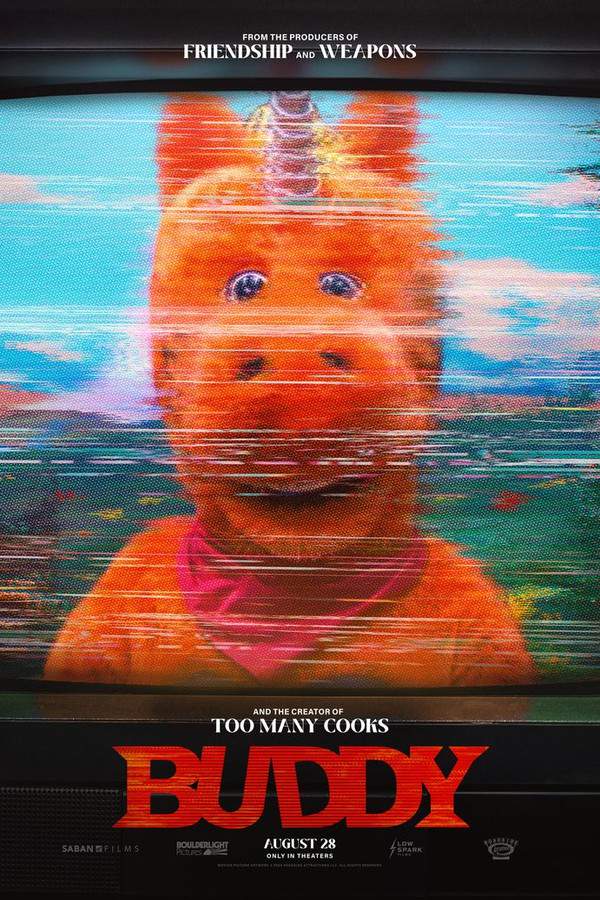
Buddy (2026) movie poster

Ending Explained

Buddy (2026) Ending Explained – Final Scene & Meaning

Release, runtime and language
2026 · 1 h 35 m · English
Echo score 76
Loading streaming availability…
Directed by
Casper Kelly
Starring
Topher Grace, Michael Shannon, Patton Oswalt, Cristin Milioti, Phuong Kubacki, Eric Bauza

Remember Buddy—the bright orange unicorn who starred in the classic children’s series, sharing joy and life lessons from the living‑room screen. In the vibrant world of “It’s Buddy!” a group of kids spend their days singing, dancing and helping Buddy spread happiness. When one child refuses to join the fun, Buddy’s cheer is threatened, prompting him to address the discord and bring the spirit of play back to the group.

On this page (6)
  1. 1 Where to watch
  2. 2 What happens at the end
  3. 3 Final events in order
  4. 4 Ending questions answered
  5. 5 Movie threads
  6. 6 Every angle
Loading streaming availability…

Ending explained · contains spoilers

What Happens at the End of Buddy?

How Buddy (2026) ends, what the final scene means, which earlier moments set it up and how to read the ending if the film leaves it open. The full ending explained, with every spoiler.

Freddy's escape comes at the cost of the comforting family reunion the television world seems to promise. Mother Grace enters that world, but the well sequence appears to sacrifice her rather than deliver a safe rescue. The final struggle ends when Strappy trips Buddy and the unicorn is impaled on the mailbox. Freddy reaches another home through the television portal, carrying his ordinary backpack, but he has not returned to a securely restored family. The chained yellow unicorn also leaves the larger origin of this nightmare unexplained.

The ending turns Buddy's compulsory affection into a form of captivity. Freddy can survive only by breaking away from a creature that treats obedience and dependence as love, even when escape means accepting uncertainty. His return to an ordinary-looking environment offers relief without proving that every danger has vanished or that Grace will reappear. The remaining unicorn imagery keeps the machinery behind the children's world unresolved. Freddy's achievement is therefore an escape from the immediate abuser, with the losses and unanswered questions still accompanying him.

Last updated: October 01, 2026 at 22:05

Was this helpful?

The last 4 events

How Buddy Ends: The Final Events in Order

The last events of Buddy (2026) in chronological order, the run-up to the ending explained above. The complete timeline has all 15 events, scene by scene.

Open the full timeline
  1. Escape Attempt

    The children unwittingly consume psychedelic flower petals and pass out, only to awaken to find George and Willie missing along with Strappy. Buddy's relentless pursuit has escalated, and they must now regroup and strategize.

  2. Confrontation at Diamond City

    When the children finally reach Diamond City, they are devastated to find it is merely a miniature model. Buddy arrives soon after, and the façade of safety is shattered as he attempts to reset the horrifying spectacle once more.

    Where
    Diamond City
  3. The Transformation

    As the children taunt Buddy with a mocking song, he transforms into a larger, more terrifying form called Dark Buddy. This transformation signals the culmination of his evil as he kills several other characters before targeting Freddy.

  4. Freddy’s Escape

    In a heartbreaking climax, Grace sacrifices herself for the children’s escape from Buddy’s wrath. When Freddy finds herself in a real-world living room and realizes the inanimate objects have turned lifeless, reality starts to collide with the realm of 'It's Buddy!'.

Ending questions answered

Buddy Ending: Your Questions Answered

The questions people ask most about the ending of Buddy (2026): what the final scene means, how the twist works, what happens to each character and how to read the ending. Each answer contains spoilers.

Q1

How does Buddy die in the ending?

Buddy is killed when Strappy trips the unicorn, causing it to be impaled on the mailbox. The impalement occurs during the final struggle after Freddy and his allies attempt to escape the television world, and it is the direct result of Strappy's intervention at a critical moment. The mailbox itself functions as a sharp, domestic object that contrasts with Buddy's cartoonish appearance, making the kill feel abrupt and brutal rather than whimsical.

Foreshadowing: Buddy's mutation into Dark Buddy earlier in the film foreshadows that the creature's invulnerability was tied to a performative, on-screen identity that real-world objects can break.

  • buddy death
  • mailbox impalement
  • dark buddy
  • strappy trip
  • final fight
Q2

What happens to Mother Grace in the well?

Mother Grace descends into the well in an attempt to reach the television world, but the sequence appears to sacrifice her rather than complete a safe rescue. Her fate is left deliberately unresolved, suggesting the pocket dimension consumed or trapped her instead of granting passage. The well functions as a one-way threshold: Freddy climbs out, but the adult who entered it does not return with him.

  • mother grace
  • well sequence
  • grace sacrifice
  • pocket dimension
  • rescue attempt
Q3

Where does Freddy end up after escaping?

Freddy exits the television portal into what looks like another home, but the environment is unfamiliar and not clearly his own. He carries only his ordinary backpack, indicating he did not retrieve anything meaningful from the TV world. The home resembles safety on the surface, yet the film never confirms that Freddy has returned to a restored family or a danger-free space.

  • freddy escape
  • television portal
  • new home
  • final scene
  • backpack
Q4

Why doesn't Freddy return to his real family?

The television world promises a comforting family reunion, but Freddy's escape routes him into a different home instead of his original one. The portal acts as a displacement device rather than a true homecoming, which mirrors how the show's creator absorbed children into the loop without reuniting them with their real lives. His arrival in a foreign household is the cost of breaking free of Buddy's control.

Foreshadowing: Early in Buddy, the children's parents are notably absent, hinting that the show itself replaces familial bonds with performative affection.

  • freddy family
  • reunion
  • displacement
  • television world
  • absent parents
Q5

What does the chained yellow unicorn mean at the end?

The chained yellow unicorn is left behind as the credits fade, and its presence suggests that other versions of Buddy or other absorbed children still exist within the larger nightmare. The chain implies captivity and continuity rather than a clean resolution, hinting that the origin of the pocket dimension is still active. Its unresolved state is the film's way of telling viewers the mechanism behind the children's world has not been dismantled.

  • chained unicorn
  • yellow unicorn
  • origin
  • pocket dimension
  • unresolved ending
Q6

Does Buddy's death actually end the cycle of violence?

Buddy's death frees Freddy from the immediate creature, but the chained yellow unicorn and Freddy's displacement to an unfamiliar home imply the cycle continues. The television portal still works, and another child in the new household could become a target. The film treats Buddy as one symptom of a larger system rather than the source of the nightmare itself.

Foreshadowing: The reveal that every child watcher is a potential victim foreshadows that killing one unicorn does not close the loop.

  • cycle of violence
  • buddy death
  • killing entertainment
  • new victims
  • loop
Q7

Why is Buddy's affection framed as a form of captivity?

Buddy treats obedience and dependence as love, demanding that children perform joy, dance, and loyalty on cue. When a child refuses, the unicorn retaliates, revealing that its affection is conditional on submission. By the ending, this compulsory cheerfulness becomes a cage Freddy must escape, and surviving means accepting the uncertainty of leaving the creature behind.

Foreshadowing: The child who refuses to join the fun early in the film triggers Buddy's first aggressive response, establishing that refusal is treated as a threat.

  • compulsory affection
  • captivity
  • obedience
  • dark buddy
  • love as control
Q8

What role does Strappy play in defeating Buddy?

Strappy is the one who trips Buddy at the climax, creating the opening that leads to the unicorn being impaled on the mailbox. Without that physical interruption, Buddy's size and mutation would have made the creature nearly impossible to stop. Strappy's small, practical action against an enormous monster is what tips the final struggle in Freddy's favor.

  • strappy
  • final fight
  • trip buddy
  • defeat buddy
  • ally
Q9

Why does Freddy carry only his ordinary backpack in the final scene?

The backpack is the only item Freddy brings out of the television world, and it grounds the ending in a mundane, real-world image. It signals that whatever Freddy lost inside the pocket dimension, his survival required abandoning everything that world offered, including the illusion of a restored family. The backpack's ordinariness is a quiet reminder that escape came with very little to show for it.

  • freddy backpack
  • ordinary backpack
  • escape
  • mundane
  • loss
Q10

Is Mother Grace dead or just trapped after the well?

The film does not confirm Grace's death, but the well sequence shows no return for her, which strongly implies she was sacrificed to power or open Freddy's exit. Because the pocket dimension absorbs children into the show, it is also possible that Grace was transformed into another component of the world rather than killed outright. Her absence from the final scene is the strongest evidence that the well took her permanently.

  • grace fate
  • dead or trapped
  • well sacrifice
  • mother grace
  • pocket dimension
Q11

Why is the ending so bleak if Buddy is killed?

Buddy's death removes one threat, but Freddy ends up in an unfamiliar home without his family, and the chained yellow unicorn confirms the nightmare's machinery is still running. Grace is missing, the sentient companions have gone lifeless, and a new child in the final household could be watched next. The bleakness comes from the realization that survival does not equal rescue, and the cost of escape is permanent loss.

Foreshadowing: The bleak tonal framing of the entire film prepares viewers for an ending that punishes as much as it liberates.

  • bleak ending
  • survival vs rescue
  • cost of escape
  • new victims
  • loss
Q12

Does the final home imply Freddy will be watched again?

Freddy arrives at a home with a television, and the chained yellow unicorn's continued presence suggests the broadcast system is intact. Because the film establishes that any child viewer is a potential victim, the implication is that Freddy has merely swapped one household for another inside the same loop. The ending deliberately leaves open whether this new home will become his prison or simply a stop along the way.

  • freddy new home
  • television
  • next victim
  • broadcast
  • loop continues

Movie threads

More Movies Like Buddy, by Mood & Story

Curated lists built around what makes Buddy tick: the same mood, the same kind of story or the same emotional payoff. Each list explains why these movies belong together.

Evil Mascot Horror Movies Like Buddy

Beloved childhood characters return as something far more sinister than memory promised. Movies like Buddy tap into evil mascot horror, where once-beloved children's characters become unstoppable killers and corrupted icons of lost innocence. If you liked Buddy's dark reimagining of cheerful television mascots, you'll find similar nostalgia-twisting horror stories here, including survival horror that targets children, body horror transformations, and brutal violence. Discover more disturbing films that turn childhood favorites into nightmarish threats.

  • nostalgic dread
  • disturbing
  • body horror
  • creepy
  • uncanny
  • childhood subversion
  • Tone: dark, unsettling, nostalgic dread
  • Pacing: fast and relentless
Why these movies?

The story pattern: Stories in this thread typically introduce a familiar, friendly figure from a child's world, then systematically dismantle that warmth through escalating violence, revealed malice, or grotesque transformation. The protagonist often begins as a fan or a caretaker of younger victims, making the betrayal of trust central to the horror. By the climax, the mascot is no longer a character but a force of nature, and survival depends on rejecting the comfort the icon once provided.

Why they belong together: They share a foundational trick: taking a piece of shared cultural nostalgia and inverting it into something monstrous. The pacing is fast, the tone is dark, and the violence is intense because the audience is supposed to feel the dissonance between memory and reality. Body horror, child endangerment, and bleak endings are common, since the genre thrives on maximum emotional contrast.
Haunted Pocket Dimension Horror Movies Like Buddy

The screen, the mirror, the room — somewhere the rules stop and the nightmare begins. If you liked Buddy's nightmarish pocket television dimension where children are absorbed into a killing entertainment loop, you'll love these trapped-in-another-world horror films. Expect layered realities, liminal spaces, sentient environments, and stories where the setting itself is the antagonist. Movies like Buddy blend survival horror with complex world-building, claustrophobic dread, and bleak conclusions that leave characters stranded in hostile alternate spaces.

  • claustrophobic
  • paranoid
  • nightmarish
  • liminal
  • dread filled
  • oppressive
  • Tone: dark, claustrophobic, paranoid
  • Pacing: fast once the trap is sprung
Why these movies?

The story pattern: Characters are pulled, glitched, or lured into a place that imitates their own world but twists every rule. Time loops, identity erasure, and shifting geography are common, and the characters must learn the strange logic of the space just to survive another hour. The arc usually moves from confused exploration to desperate confrontation, ending in either escape, absorption, or the bitter realization that the loop has already claimed the next victim.

Why they belong together: They share a fascination with settings that feel like a copy of reality gone slightly wrong, where hallways repeat, friendly faces wear hollow smiles, and the environment behaves like a thinking thing. Pacing tends to be fast once the trap is sprung, the tone is dark and paranoid, and the complexity comes from layering lore across the real world and the twisted mirror version. Emotional weight lands heavily because the victims are often stripped of identity before they even understand what is happening.

Every angle

Buddy (2026) Explained: Plot, Ending, Timeline & Characters

Everything about Buddy in one place: what happens in the plot summary, the timeline in chronological order, the characters and meaning, the ending explained and a spoiler-free summary. What's After the Movie adds the cast, box office and post-credit scenes.

Coming soon on iOS and Android

The Plot Explained Movie Summary App

Plot summaries, endings explained and timelines on your phone. Catch up on any movie in minutes, save your favorites and never miss a twist again.

Be the first to know when we launch. Your email stays private, always.

Learn more about the app