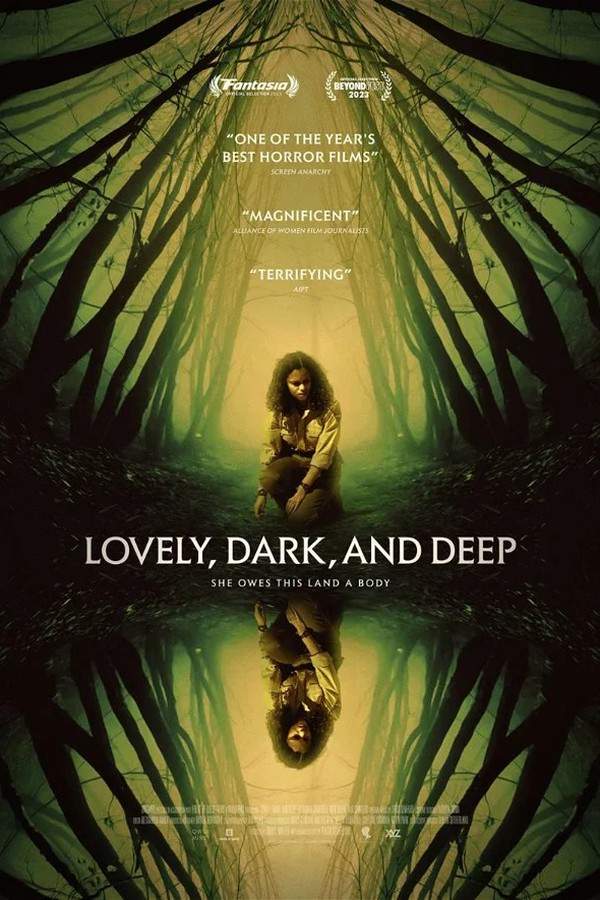
Alma and Alex are two young girls living with their mother in an abandoned hotel deep within a forest, a place that feels both secluded and watchful. Their world is carefully curated by the woman who raised them, a figure they know as Mami Caban Awilda Santana. She has woven a stark belief that humanity has vanished and that they must endure in isolation, teaching them about medicinal plants, how to read the land, and which sounds signal danger. Daylight itself becomes a threat in her telling, and the rulebook she writes out in faded ink is explicit: stay inside during the day, never draw attention to the outside world, and rely on the rituals she has set to keep them safe.
At first, the rhythm of their life seems to work for them. The sisters move in harmony, sharing small rituals and memories, while the old hotel creaks with the wind and the forest presses in from every window. Yet adolescence begins to tilt that equilibrium. Alma and Alex start to question the strict boundaries that have defined their lives, pushing back against the idea that civilization is extinct and exploring what it means to grow up, to feel desire, and to imagine a future beyond the shuttered halls they call home. The conversations turn sharper, and the air thickens with unspoken doubts as Alma begins to confront her own coming-of-age moment—the reality of her first period and what it might mean for their vanished world.
A spark of curiosity drives them toward a forbidden place their mother has warned them away from: a locked warehouse on the estate. Secretly, they slip inside and discover a jumble of unfamiliar objects—an old phone, a pornographic magazine, and other relics that introduce them to ideas about bodies, sexuality, and the humanity beyond their walls. The moment expands their inner landscape and unsettles the fragile balance their mother has maintained. Alex grows increasingly restless under her mother’s control, while Alma lingers between obedience and a longing for connection outside their self-imposed cage. The tension intensifies as their mother clings to childhood habits, including messages she writes to intercept any surviving humans, a practice that only deepens the sisters’ sense of being cut off from the world.
Strains fracture their bond. One morning Alma believes Alex has already left the house, but she discovers Alex is still there; Alma then ventures out during the day, challenging the rules in a bold act that backfires and draws anger from the mother. In the days that follow, Alex tries to persuade Alma that their mother cannot be trusted, urging them to break free of the controlled life and to send a signal—a “message in a bottle” tossed into the black river that marks the boundary she forbids. The mother intercepts them, and a punishment follows: the girls are locked in their room for days, a quiet, suffocating confinement that only strengthens their resolve to escape.
When the door finally opens, the two sisters seize the moment and retreat into the surrounding grounds. They explore corners of the estate that their mother had hidden from them, discovering small comforts and glimpses of a life outside the walls. The act of fleeing is not without consequence, and the sisters’ decision to run away is followed by a surge of regret. Alma longs to return home, while Alex withdraws, and a tense argument pushes them apart. In the chaos, Alma falls and injures her foot, a moment that the mother remedies, restoring a fragile sense of safety—at least for a time.
As days pass, the mother’s grip tightens, and Alma feels increasingly drained. Yet a shift begins to reveal itself. Alma suspects something is wrong, and when she dares to swap their teas, the mother slips into a deep sleep, granting Alma a rare opportunity to step outside again during the day. The world beyond the windows is suddenly less mythical, and Alma realizes that her mother’s stories may not be the entire truth. The moment of truth arrives when the mother awakens and confronts Alma in a heated moment that forces a decision: Alma must leave. A fierce struggle ensues, and Alma escapes into the woods. The mother pursues, but tragedy strikes when she falls into a hole and is fatally pierced. In her final moments, she directs Alma toward a truth she has hidden, guiding her to a path where Alma finds Alex, seemingly knowing what happened and offering a glimmer of guidance in a world that has suddenly become all too strange.
In the wake of the confrontation, the sisters stumble upon an abandoned car, a relic of the life that once existed beyond their forest fortress. It is here that Alma uncovers a buried memory of an accident from her earliest years, a memory she recalls with startling clarity: she was kidnapped by a woman who was not her mother. This recollection leads to a shocking realization—that Alma had created the alter ego Alex as a coping mechanism to endure childhood loneliness. The revelation lands with a quiet, devastating force: Alma is left to face a society she has never truly known, a society that may still be out there somewhere, waiting, watching, and perhaps reachable in ways she has yet to understand. The film ends on this ambiguous, contemplative note, inviting reflection on identity, memory, and the fragile line between protection and delusion.