Plot Explained Spoilers guaranteed!
Plot Explained

Browse by genre

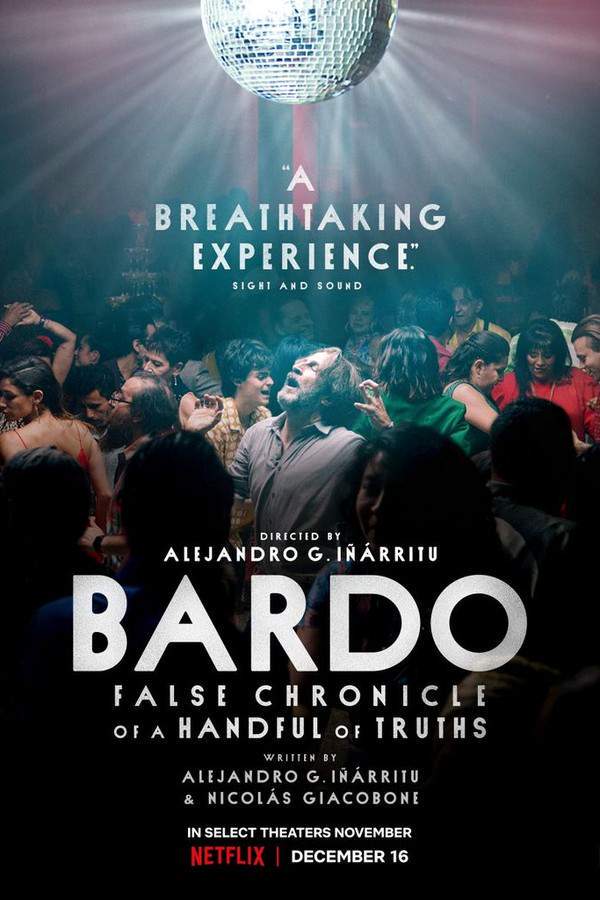
Bardo, False Chronicle of a Handful of Truths (2022) movie poster

Plot Summary

Bardo, False Chronicle of a Handful of Truths (2022) Plot Summary & Ending Explained

Release, runtime and language
2022 · 159 min · Spanish
Echo score 75
Loading streaming availability…
Directed by
Alejandro González Iñárritu
Starring
Daniel Giménez Cacho, Omar Leyva, Meteora Fontana, Edison Ruíz, Andrés Almeida, Armando Comonfort Santiago

Following a prestigious international award, renowned journalist Silverio returns to his native Mexico, triggering a profound personal upheaval. Alejandro G. Iñárritu’s visually striking film explores Silverio's journey as deeply buried memories and anxieties resurface, challenging his perception of reality. He grapples with existential questions about identity, success, and mortality, while navigating complex family relationships and reflecting on Mexico’s rich and sometimes turbulent history.

On this page (6)
  1. 1 Where to watch
  2. 2 What happens: full plot
  3. 3 Plot questions answered
  4. 4 How it ends
  5. 5 Movie threads
  6. 6 Every angle
Loading streaming availability…

Full plot summary · contains spoilers

What Happens in Bardo, False Chronicle of a Handful of Truths: Full Plot Summary

The whole story of Bardo, False Chronicle of a Handful of Truths (2022) explained, from the opening scene to the final frame: every key event, every twist and what it all adds up to. Read it as a quick recap before the sequel, to check a scene you missed, or to finally understand what really happened.

Silverio Gama, a seasoned journalist-turned-documentary filmmaker, finds himself navigating the complexities of life in Los Angeles with his wife, Lucía, and their teenage son, Lorenzo. As he ages, Silverio's work evolves into a deeply personal yet subjective journey, culminating in his latest film, False Chronicle of a Handful of Truths, which blurs the lines between documentary and fiction, infused with autobiographical elements. Despite the apparent harmony in their lives, Silverio and Lucía are still haunted by the sorrow of losing their firstborn son, Mateo, who tragically passed away just a day after birth. They keep his ashes close, struggling to find closure.

Silverio's daily existence unfolds in surreal moments where dreams, memories, and fantasies intertwine with reality. A striking encounter with the U.S. ambassador to Mexico at Chapultepec Castle leads him to envision a harrowing re-enactment of the 1847 Battle of Chapultepec, complete with the tragic suicides of the Niños Héroes, playing out in vivid detail around him.

Receiving the news that he will be the first Latin American to earn a prestigious American journalism award, Silverio grapples with the idea that this recognition may simply serve as a diplomatic gesture amidst strained U.S.-Mexico relations, fueled by stereotypes surrounding migration and current events involving companies like Amazon. Amidst increasing media scrutiny and the pressure to navigate his dual identity, he is torn between candid critiques of the Mexican state's inefficiencies and defending its people against pervasive stereotypes. Meanwhile, a nagging guilt over his emigration to the U.S. continues to shadow him.

At a celebratory party honoring him, Silverio reconnects with his indifferent siblings and extended family, while his attention is solely captured by his daughter, Camila. However, when faced with a harsh critique from a talk show host, his frustration boils over, prompting a heated personal insult in response. Seeking solace, he retreats to the restroom, where he imagines reconciling with his deceased parents. Upon exiting, he is confronted by haunting manifestations of historical atrocities in Mexico: crowds of individuals symbolize those lost to organized crime, and a figure resembling Hernán Cortés stands atop a mass grave, admonishing Silverio about the indigenous genocide.

Before returning to Los Angeles, Silverio and his family take a vacation in Baja California, coinciding with Amazon's acquisition of the region. In an unexpected turn, Camila expresses her desire to resign from her job in Boston and return to Mexico, a move Silverio cautiously welcomes. Together, they decide to scatter Mateo's ashes in the ocean, but their return to the U.S. is met with disdain from a Hispanic-American customs official.

After a poignant reminder from Lorenzo about their pet axolotls and their untimely deaths, Silverio impulsively purchases some as a surprise. However, during their ride on the L.A. Metro, a sudden and violent stroke lays him low, leaving him unattended for hours. In a coma, it becomes evident that everything witnessed thus far is merely a reflection of his mind processing experiences and memories. While Silverio lies in a hospital bed, Camila steps up to accept the award on his behalf, surrounded by family and friends who share stories and play music that resonated with him throughout his life.

In the vast expanse of his mind, Silverio encounters his deceased relatives, choosing to ignore the living family members who surround him. He catches a glimpse of a doppelgänger that mimics his movements for a fleeting moment before it departs. The film concludes as it began, with Silverio envisioning himself soaring through the desert, leaving the audience questioning whether he has transcended death, awakened anew, or simply learned to coexist with his past struggles.
Last updated: November 15, 2024 at 17:50

Was this helpful?

Plot questions answered

Bardo, False Chronicle of a Handful of Truths Plot Explained: Your Questions Answered

The questions people ask most about Bardo, False Chronicle of a Handful of Truths (2022): what happens in the confusing scenes, why the characters do what they do, the twists, hidden details and what the ending means. Each answer contains spoilers.

Q1

Why does Silverio have a stroke on the Metro?

Silverio suffers a sudden stroke while riding the L.A. Metro after purchasing axolotls as a surprise for his family. The stroke appears to be triggered by the accumulated physical and emotional stress from his journey, his intense grappling with grief over Mateo's death, the overwhelming cultural and identity tensions he experienced in Mexico, and the psychological weight of his surreal visions. He is left unattended for hours before being hospitalized.

Foreshadowing: The stroke follows Silverio's impulsive purchase of axolotls, which parallels his earlier memory of Lorenzo mentioning their deceased pet axolotls, suggesting his mind was already processing loss and mortality.

  • stroke
  • metro
  • silverio
  • coma
  • health crisis
Q2

Does Silverio die at the end of the film?

The ending remains ambiguous. After his stroke leaves him in a coma, Silverio's mind drifts between memories, deceased relatives, and surreal visions. The final image shows him soaring through the desert, which could represent transcendence after death, a metaphorical awakening from the coma, or simply a visualization of his ongoing struggle to process his past. The film never confirms whether he dies or survives.

Foreshadowing: The recurring image of Silverio flying through the desert, which opens and closes the film, suggests this is a liminal space between life and death.

  • ending
  • death
  • coma
  • silverio
  • ambiguous
  • transcendence
Q3

Why is Silverio still haunted by memories of Mateo?

Silverio and Lucía lost their firstborn son Mateo just one day after birth, and they have never properly grieved. They keep his ashes with them throughout the film, unable to find closure. The tragedy defines their marriage and permeates Silverio's work, which explores themes of loss, identity, and mortality. His entire journey in Mexico is essentially an attempt to process this unhealed wound.

Foreshadowing: The ashes Silverio and Lucía carry throughout their trip represent the unresolved grief that drives much of Silverio's emotional landscape.

  • mateo
  • son
  • death
  • grief
  • ashes
  • loss
  • silverio
  • lucia
Q4

What is the significance of the Battle of Chapultepec vision?

While meeting the U.S. ambassador at Chapultepec Castle, Silverio experiences a vivid hallucination of the 1847 Battle of Chapultepec, including the tragic suicides of the Niños Héroes (young military cadets who chose death over surrender). This vision represents his deep anxiety about Mexican identity, historical trauma, and the complex, often violent relationship between Mexico and the United States.

Foreshadowing: The vision occurs during Silverio's first major public appearance in Mexico, setting up the film's exploration of national identity and historical memory.

  • battle of chapultepec
  • ninos heroes
  • history
  • mexico
  • vision
  • ambassador
Q5

Why does Camila want to return to Mexico?

During the family vacation in Baja California, Camila reveals she wants to quit her job in Boston and return to Mexico. This decision represents a reversal of the immigrant journey, choosing to reconnect with her roots rather than pursue opportunity abroad. For Silverio, who emigrated to the U.S. and has felt guilty about leaving Mexico, this brings hope and a sense of reconciliation with his family legacy.

Foreshadowing: Camila's choice contrasts with Silverio's own path, suggesting a new generation redefining the immigrant experience.

  • camila
  • boston
  • mexico
  • return
  • job
  • family
Q6

What does the Hernán Cortés vision represent?

After the party, Silverio encounters a figure resembling Hernán Cortés standing atop a mass grave, admonishing him about the indigenous genocide. This vision represents Mexico's unresolved historical trauma, the violence of colonization and the ongoing guilt felt by modern Mexicans toward their ancestors' suffering. It also reflects Silverio's struggle with his own identity and complicity as an emigrated Mexican who has achieved success in the U.S.

Foreshadowing: This haunting manifestation follows Silverio's imagined reconciliation with his parents, suggesting his personal grief is intertwined with collective national memory.

  • cortes
  • indigenous
  • genocide
  • history
  • vision
  • mexico
Q7

Is the entire film happening in Silverio's mind?

The film employs a non-linear structure that blends dreams, memories, and reality throughout. Once Silverio suffers his stroke and enters a coma, it becomes clear that much of what viewers witness, from the ambassador encounter to the Cortés vision, exists within his mind processing memories and anxieties. However, the film deliberately blurs the line between objective reality and subjective experience even before the stroke, making it impossible to definitively separate what is 'real' from what is imagined.

Foreshadowing: The surreal elements, including the flying sequences and encounters with deceased relatives, establish early on that the film prioritizes psychological truth over literal reality.

  • dream
  • memory
  • reality
  • coma
  • mind
  • surreal
  • 幻觉
Q8

Why does Silverio buy axolotls?

Silverio impulsively purchases axolotls after his son Lorenzo reminds him about their pet axolotls that died. This act represents Silverio's attempt to reclaim joy and life after years of grief over Mateo's death. The axolotls, creatures known for their regenerative abilities, symbolize hope for renewal and healing. However, the timing (immediately before his stroke) adds tragic irony to the moment.

Foreshadowing: Lorenzo's mention of the dead pet axolotls earlier plants the seeds for this purchasing decision, showing how unresolved loss drives Silverio's compensatory actions.

  • axolotl
  • pet
  • lorenzo
  • silverio
  • purchase
  • gift
Q9

Why is the journalism award significant to Silverio?

Silverio learns he will be the first Latin American to receive a prestigious American journalism award. However, he suspects this recognition may be a diplomatic gesture rather than genuine acknowledgment of his work, prompted by current U.S.-Mexico relations, stereotypes about migration, and corporate interests like Amazon. This creates tension between his professional achievement and his discomfort with being tokenized.

Foreshadowing: The award represents the central conflict of the film: Silverio's dual identity as both a celebrated American journalist and a Mexican who feels guilty about emigrating.

  • award
  • journalism
  • recognition
  • latin american
  • identity
  • amazon
Q10

Why does the customs official treat Silverio's family poorly?

Upon returning from Mexico, a Hispanic-American customs official treats Silverio's family with disdain. This moment highlights the complex tensions within the Latino community, where divisions based on nationality, immigration status, and assimilation create friction. The official's contempt reflects internalized prejudice and the painful reality that belonging is not guaranteed by shared ethnicity alone.

Foreshadowing: This confrontation occurs after Silverio's journey to reconnect with his Mexican identity, emphasizing the ongoing struggle for acceptance on both sides of the border.

  • customs
  • immigration
  • identity
  • hispanic
  • discrimination
  • attitude
Q11

What does Silverio flying through the desert mean?

The film opens and closes with Silverio soaring through a desert landscape. This recurring image represents his desire to transcend the weight of his grief, guilt, and existential anxieties. It could signify spiritual liberation after death, the peace of finally processing his trauma, or simply his ongoing metaphorical flight from the burdens of his past. The ambiguity is intentional.

Foreshadowing: The flying motif appears as both opening and closing image, framing the entire narrative as a journey through Silverio's consciousness.

  • flying
  • desert
  • ending
  • transcendence
  • freedom
  • symbolism
Q12

Why does Silverio imagine reconciling with his deceased parents?

At the party, Silverio retreats to the restroom and imagines reconciling with his deceased parents. This moment reflects his deep-seated longing for acceptance and closure, emotional wounds that remained unhealed when they died. The imagined reunion represents his attempt to resolve unfinished business with his past, particularly his decision to emigrate and the guilt he carries about leaving his family behind.

Foreshadowing: This bathroom scene precedes the more jarring visions of historical atrocities, showing Silverio's mind progressing from personal to collective trauma.

  • parents
  • death
  • reunion
  • imagination
  • guilt
  • silverio
  • family

Ending explained

What Happens at the End of Bardo, False Chronicle of a Handful of Truths?

How Bardo, False Chronicle of a Handful of Truths (2022) ends, in short: the final scene, the last twist and what it means for the characters. The full ending explained, with every spoiler, lives on its own page.

Read the full ending explained

Silverio Gama’s journey in "Bardo" is as much a personal voyage through memories, regrets, and identity as it is a reflection of Alejandro Inarritu’s own life. The film's final act suggests that Silverio’s story is ultimately a spiritual or existential one, with the scene in the desert symbolizing a liminal space between life and death. As Silverio’s family calls out to him, urging him to return, he stands at a crossroads where he can either move on or remain anchored by his unresolved internal conflicts. The recurring imagery of shadows growing smaller and then disappearing signifies his fading presence in the earthly realm, implying that Silverio may have passed away after suffering a stroke and slipping into a coma. The scenes depicting his reflections, conversations with his parents, and visions of Mexican history all seem to serve as a mental landscape representing his inner struggles—conflicts of belonging, pride, regret, and guilt.

The ambiguity of whether Silverio wakes up or not is central to understanding the film’s profound message. If viewed as a literal end, his disappearance in the desert could imply his death, having finally let go of the burdens that haunted him. On the other hand, if these visuals are seen as the culmination of his subconscious mind during his coma, it suggests that Silverio might wake up and survive, carrying the weight of his memories and internal battles. Either interpretation emphasizes the film’s exploration of mortality, memory, and the human condition. "Bardo" leaves its audience with a sense of melancholy and wonder, inviting viewers to ponder the intangible nature of identity and the afterlife, and the possibility that understanding oneself might be a lifelong, ongoing process. In its poetic, abstract style, the film ultimately suggests that the truths we seek are often elusive, hiding in the spaces between perception and reality.

Bardo, False Chronicle of a Handful of Truths ending explained in full

Movie threads

More Movies Like Bardo, False Chronicle of a Handful of Truths, by Mood & Story

Curated lists built around what makes Bardo, False Chronicle of a Handful of Truths tick: the same mood, the same kind of story or the same emotional payoff. Each list explains why these movies belong together.

Surreal introspective movies like Bardo, False Chronicle of a Handful of Truths

Films where dream logic blurs the line between memory, reality, and identity. If you enjoyed the dreamlike exploration of memory in Bardo, False Chronicle of a Handful of Truths, you'll find similar films here. These movies use surrealism and non-linear narratives to delve into identity, reality, and the past, perfect for viewers who like complex, metaphorical storytelling.

  • surreal
  • dreamlike
  • introspective
  • melancholic
  • metaphorical
  • psychological
  • Tone: melancholic, surreal, introspective
  • Pacing: slow, contemplative
Why these movies?

The story pattern: Stories in this thread often unfold as a series of interconnected vignettes, dreams, and flashbacks rather than a conventional plot. The protagonist's journey is internal, navigating a labyrinth of personal history, trauma, and existential questions, where the external world is filtered through a subjective and often unreliable perspective.

Why they belong together: Movies are grouped here for their shared approach to narrative, prioritizing psychological depth and metaphorical imagery over traditional storytelling. They create a consistent mood of melancholic introspection through slow pacing, complex structures, and a focus on the permeability of reality.

Emotionally heavy existential dramas like Bardo, False Chronicle of a Handful of Truths

Stories of profound personal loss that trigger deep questions about life's meaning. For viewers seeking movies like Bardo, False Chronicle of a Handful of Truths that delve into heavy themes of grief and existential crisis. These films feature characters confronting mortality and identity, often with an ambiguous or bittersweet resolution, matching the intense emotional weight of Bardo.

  • agonizing
  • somber
  • grief-stricken
  • existential
  • heavy
  • introspective
  • Tone: melancholic, somber, agonizing
  • Pacing: slow, deliberate
Why these movies?

The story pattern: The narrative pattern follows a character, often successful or accomplished, whose life is upended by a traumatic event—such as the loss of a child—forcing them to re-evaluate everything they know. The conflict is primarily internal, as they wrestle with guilt, regret, and the fragility of their own identity against a backdrop of personal and sometimes historical pain.

Why they belong together: These films are united by their exploration of the heaviest human emotions and philosophical questions. They share a slow, deliberate pacing that allows the emotional weight to settle, a melancholic or bleak tone, and a focus on the interior life of a character in crisis.

Every angle

Bardo, False Chronicle of a Handful of Truths (2022) Explained: Plot, Ending, Timeline & Characters

Everything about Bardo, False Chronicle of a Handful of Truths in one place: what happens in the plot summary, the timeline in chronological order, the characters and meaning, the ending explained and a spoiler-free summary. What's After the Movie adds the cast, box office and post-credit scenes.

Coming soon on iOS and Android

The Plot Explained Movie Summary App

Plot summaries, endings explained and timelines on your phone. Catch up on any movie in minutes, save your favorites and never miss a twist again.

Be the first to know when we launch. Your email stays private, always.

Learn more about the app