Plot Explained Spoilers guaranteed!
Plot Explained

Browse by genre

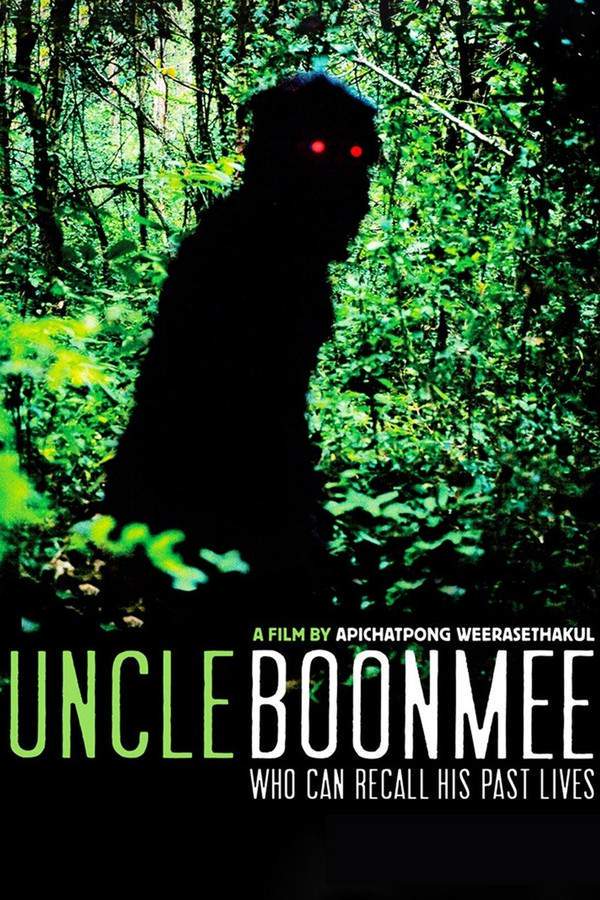
Uncle Boonmee Who Can Recall His Past Lives (2011) movie poster

Plot Summary

Uncle Boonmee Who Can Recall His Past Lives (2011) Plot Summary Explained

Release, runtime and language
2011 · 114 min · Thai
JustWatch #24,532 6
Directed by
Apichatpong Weerasethakul

As Uncle Boonmee’s life draws to a close, he is visited by the spirits of his deceased wife and his son, who disappeared years earlier and now appears in a transformed state. Guided by a young woman and her daughter, the dying man journeys into a mystical jungle cave to confront the mysteries of his failing health and past lives. He is surrounded by a dreamlike landscape filled with beauty and unsettling revelations, ultimately seeking understanding and acceptance as he faces his final moments.

On this page (6)
  1. 1 Where to watch
  2. 2 What happens: full plot
  3. 3 Plot questions answered
  4. 4 Movie threads
  5. 5 Movies like Uncle Boonmee Who Can Recall His Past Lives
  6. 6 Every angle

Where to watch

Where to Watch Uncle Boonmee Who Can Recall His Past Lives (2011)

Where can you watch Uncle Boonmee Who Can Recall His Past Lives? Stream, rent or buy it in the US, including on Amazon Video, Apple TV Store and Fandango At Home: current JustWatch availability with up-to-date prices.

Streaming availability powered by JustWatch

Full plot summary · contains spoilers

What Happens in Uncle Boonmee Who Can Recall His Past Lives: Full Plot Summary

The whole story of Uncle Boonmee Who Can Recall His Past Lives (2011) explained, from the opening scene to the final frame: every key event, every twist and what it all adds up to. Read it as a quick recap before the sequel, to check a scene you missed, or to finally understand what really happened.

In a serene grassy landscape, a water buffalo manages to break free from its tether and wanders into the depths of a forest, where it catches the attention of a man wielding a sickle. Unbeknownst to them, a shadowy figure with red eyes observes from afar.

In a quaint farmhouse, Boonmee lives with his sister-in-law Jen and his nephew Tong. Boonmee is grappling with his declining health due to a failing kidney, receiving dialysis treatments from his Laotian assistant Jaai. One evening, during a family dinner, the spirit of Boonmee's late wife, Huay, unexpectedly appears. Having passed away over ten years ago, Huay reveals that she has sensed their prayers and is aware of Boonmee's deteriorating condition. Shortly after, a wild figure with hairy red eyes emerges, identifying himself as Boonmee's long-lost son, Boonsong. Boonsong, who had vanished some time after Huay’s death while pursuing his passion for photography, recounts his encounter with a supernatural being he refers to as a "Monkey Ghost." He shares that he engaged with this creature, a fusion that drastically altered his appearance, leading him to forget his prior life.

As the day unfolds on the farm with Jen, Boonmee reflects upon his affliction, attributing it to karma due to his past actions—specifically, the communists he killed during his military service and the insects he dispatched on the farm.

Meanwhile, a princess is being carried through the forest in a litter. Upon reaching a waterfall, she gazes into its waters, finding her reflection more radiant than her actual self. After a brief kiss from a servant, she claims he merely imagined it. In her solitude, she is enchanted by a catfish’s compliment and seeks to exchange her jewelry for the beauty of her reflection, leading to an intimate encounter.

In a tender moment, Boonmee is found lying next to Huay. He embraces her and inquires about reuniting with her after death. Huay explains that spirits are bound to individuals rather than locations. Later, Boonmee, Huay, Jen, and Tong explore the forest where they glimpse enigmatic figures darting through the trees. Intrigued, Huay guides them into a cave, where Boonmee shares a fragmented memory of being born there, although he can’t fully recall it. He dreams of a future world where authorities eliminate “past people” with light. A significant moment arises when Huay detaches Boonmee's dialysis tube, leading to his tragic passing by the next day.

After the somber funeral, Jen is seen sorting through gifts of baht with her friend Roong. Meanwhile, Tong, who has taken vows as a monk, arrives but struggles to find peace in the temple. After a quick change from his robes to casual attire, he and Jen prepare for a meal. In a surreal twist, Tong is startled to see himself alongside Jen and Roong relaxing on the bed, while they continue their mundane evening, caught between two spaces.
Last updated: November 16, 2024 at 18:09

Was this helpful?

Plot questions answered

Uncle Boonmee Who Can Recall His Past Lives Plot Explained: Your Questions Answered

The questions people ask most about Uncle Boonmee Who Can Recall His Past Lives (2011): what happens in the confusing scenes, why the characters do what they do, the twists, hidden details and what the ending means. Each answer contains spoilers.

Q1

Why does Boonmee think his kidney failure is caused by karma?

Boonmee attributes his failing kidneys to karma from his past actions. He specifically mentions two things: the communists he killed during his military service and the insects he has exterminated on his farm. This reflects the Buddhist belief that actions in past lives (or this life) have consequences that manifest in current suffering. His illness is presented as the accumulated weight of these actions finally catching up with him.

Foreshadowing: Earlier, Boonmee reflects on his past during the day, linking his war experiences and farm work to his declining health.

  • karma
  • kidney failure
  • illness
  • military service
  • insects
Q2

What happened to Boonsong after he disappeared?

Boonsong, Boonmee's son, disappeared years earlier after the death of his mother Huay. He was pursuing his passion for photography when he encountered a supernatural being called the 'Monkey Ghost.' This encounter led to a fusion that drastically transformed his appearance, becoming the wild, hairy figure with red eyes who returns to the farm. The transformation caused him to forget his previous life entirely.

Foreshadowing: The mysterious red-eyed figure observed from the forest early in the film before being revealed as Boonsong.

  • Boonsong
  • Monkey Ghost
  • transformation
  • disappeared
  • photography
Q3

Why does Huay disconnect Boonmee's dialysis tube?

Huay disconnects Boonmee's dialysis tube as an act of compassionate release. Having returned to guide Boonmee through his final journey, she chooses to end his suffering rather than let him continue enduring the painful dialysis treatments. This deliberate act accelerates his death, but it is portrayed as a loving gesture, a final mercy from his wife who has already moved into the spirit realm.

Foreshadowing: Earlier, Huay explains that spirits are bound to people rather than places, showing her continued connection to Boonmee.

  • Huay
  • dialysis
  • death
  • mercy
  • tube
Q4

What is the Monkey Ghost that transformed Boonsong?

The Monkey Ghost is a supernatural entity that Boonsong encountered while traveling through the jungle after his mother's death. The encounter resulted in a fusion between Boonsong and this creature, transforming him into a being that is part human, part monkey-like spirit. This transformation represents a form of rebirth or reincarnation, though corrupted, Boonsong loses his human memories and identity, becoming a creature that roams the forest with red eyes.

Foreshadowing: The opening scene shows a shadowy figure with red eyes watching the water buffalo, hinting at the supernatural world that will be revealed.

  • Monkey Ghost
  • transformation
  • supernatural
  • fusion
  • forest
Q5

Why does Huay say spirits are bound to people rather than places?

Huay explains that when she appears to Boonmee, it is not because she is tied to the farm or any particular location, but because she is spiritually bound to him. This reflects a Buddhist understanding of the afterlife, spirits are connected to individuals through karmic ties and relationships, not to geographical places. This is why she can appear to Boonmee even though she died over ten years ago and was never at the farmhouse during her lifetime.

  • spirits
  • afterlife
  • bound to people
  • Huay
  • Buddhist
Q6

What is the significance of the cave where Boonmee was born?

The cave holds deep symbolic significance as the place of Boonmee's birth, which he partially recalls during the forest exploration. When Huay guides the family into the cave, Boonmee experiences fragmented memories of being born there, creating a powerful cycle, he enters the cave at the end of his life at the same place his life began. The cave represents the boundary between life and death, the womb-like origin, and the space where past lives connect to the present.

Foreshadowing: This moment connects to Boonmee's later dream about 'past people' and his exploration of reincarnation.

  • cave
  • birth
  • memory
  • past lives
  • origin
Q7

What is the princess and catfish story about in the movie?

The princess vignette is a symbolic story within the film about vanity and transformation. A princess traveling through the forest becomes enchanted by her reflection in a waterfall, which appears more beautiful than she actually is. A catfish (appearing as a magical being) compliments her and offers to exchange her jewelry for the beauty of her reflection. This leads to an intimate encounter that seems to transform or enrich her. The vignette parallels Boonmee's own journey, seeking something beyond the physical world and encountering supernatural beings that challenge reality.

Foreshadowing: The vignette appears as a separate story thread, reflecting the film's theme of past lives and transformations.

  • princess
  • catfish
  • reflection
  • vanity
  • transformation
Q8

What is Boonmee's dream about authorities eliminating past people with light?

In the cave, Boonmee shares a fragmented dream about a future world where authorities hunt and eliminate 'past people' using light. This dream reflects his anxiety about his past actions, specifically the people he killed during the communist insurgency. The 'past people' may represent those who died with unresolved karma, or it could symbolize guilt manifesting as a dystopian vision. It underscores the film's exploration of how past actions and past lives continue to influence the present.

Foreshadowing: This dream connects to Boonmee's belief that his illness stems from karma related to his wartime actions.

  • dream
  • past people
  • light
  • authorities
  • karma
Q9

What happens in the surreal scene where Tong sees himself?

In the film's ambiguous ending, Tong, who has become a monk, returns to the farmhouse after the funeral. While changing out of his robes, he suddenly sees another version of himself lying on the bed with Jen and Roong, as if reality has split or blurred. This surreal moment suggests that Tong is caught between two worlds: the spiritual path he has chosen and his familial ties. It may indicate that he hasn't fully transitioned into either realm, or that the boundary between life and death remains permeable for the family.

Foreshadowing: This scene follows Boonmee's death and the family's continued connection to the spirit world throughout the film.

  • Tong
  • double
  • ending
  • surreal
  • monk
Q10

What are the figures with red eyes that appear throughout the film?

The figures with red eyes represent transformed beings or spirits in the film's supernatural world. The first shadowy figure with red eyes observed from afar is later revealed to be Boonsong after his Monkey Ghost transformation. These red-eyed beings appear to be those who have undergone supernatural changes, souls that have fused with other entities and now exist between the human and spirit realms. They serve as visual reminders of the film's theme of transformation and the permeable boundary between life and death.

Foreshadowing: The mysterious observer appears in the opening scene before Boonsong's reveal.

  • red eyes
  • spirits
  • Boonsong
  • transformation
  • forest
Q11

Why does the water buffalo break free at the beginning of the film?

The water buffalo breaking free and wandering into the forest serves as an early motif of escape and transition. The buffalo, a common rural animal representing working life, breaks from its tether, symbolizing Boonmee's own approaching departure from the physical world. The buffalo ventures into the same forest where supernatural events occur, where Boonsong now roams as a transformed being. This opening establishes the film's themes of breaking free from physical existence and entering a realm beyond ordinary reality.

Foreshadowing: The buffalo enters the forest where the red-eyed figure watches, connecting the domestic and supernatural worlds.

  • water buffalo
  • escape
  • forest
  • opening
  • symbol

Movie threads

More Movies Like Uncle Boonmee Who Can Recall His Past Lives, by Mood & Story

Curated lists built around what makes Uncle Boonmee Who Can Recall His Past Lives tick: the same mood, the same kind of story or the same emotional payoff. Each list explains why these movies belong together.

Movies like Uncle Boonmee Who Can Recall His Past Lives about mystical death journeys

Slow, atmospheric stories about accepting death through surreal and spiritual encounters. If you enjoyed the serene, contemplative vibe of Uncle Boonmee Who Can Recall His Past Lives, you'll find similar movies here. These films share a gentle, slow-burn approach to themes of death, spirituality, and past lives, using dreamlike atmospheres and symbolic narratives to explore profound acceptance.

  • dreamlike
  • contemplative
  • serene
  • mystical
  • atmospheric
  • reflective
  • Tone: melancholic, serene, reflective
  • Pacing: slow, deliberate, meditative
Why these movies?

The story pattern: Narratives in this thread typically follow characters facing their own death or processing profound loss. The journey is internal and philosophical, often punctuated by visits from spirits, visions, or symbolic events that help the protagonist reconcile with their past and peacefully approach the unknown.

Why they belong together: Movies are grouped here for their shared focus on a gentle, mystical, and reflective exploration of death. They prioritize mood, atmosphere, and philosophical inquiry over conventional plot, creating a similarly meditative and emotionally resonant viewing experience.

Complex symbolic narratives like in Uncle Boonmee Who Can Recall His Past Lives

Complex, non-linear films where memory and reality blend into poetic visions. Fans of the complex, vignette-style storytelling in Uncle Boonmee Who Can Recall His Past Lives will appreciate these movies. They share a non-linear, symbolic approach to narrative, weaving together dreams, memories, and spiritual encounters to explore deep themes in an atmospheric and unsettling way.

  • surreal
  • symbolic
  • atmospheric
  • contemplative
  • unsettling
  • complex
  • Tone: ambiguous, mystical, unsettling
  • Pacing: slow, variable, contemplative
Why these movies?

The story pattern: The narrative pattern is less a linear arc and more a tapestry of events, visions, and memories. These stories might include seemingly disconnected vignettes that thematically reflect the protagonist's inner journey, requiring the viewer to piece together a deeper, often ambiguous, meaning.

Why they belong together: These films are connected by their complex, non-linear structures and their use of surreal, symbolic imagery to delve into themes of memory, past lives, and spirituality. They create a unique, immersive experience that feels both intellectually stimulating and dreamily atmospheric.

If you liked this

Movies Like Uncle Boonmee Who Can Recall His Past Lives

Similar movies to Uncle Boonmee Who Can Recall His Past Lives: the same genre, themes or kind of story. Each one comes with its own plot summary, timeline and ending explained.

Browse all movie summaries

Every angle

Uncle Boonmee Who Can Recall His Past Lives (2011) Explained: Plot, Timeline & Characters

Everything about Uncle Boonmee Who Can Recall His Past Lives in one place: what happens in the plot summary, the timeline in chronological order, the characters and meaning and a spoiler-free summary. What's After the Movie adds the cast, box office and post-credit scenes.

Coming soon on iOS and Android

The Plot Explained Movie Summary App

Plot summaries, endings explained and timelines on your phone. Catch up on any movie in minutes, save your favorites and never miss a twist again.

Be the first to know when we launch. Your email stays private, always.

Learn more about the app