Plot Explained Spoilers guaranteed!
Plot Explained

Browse by genre

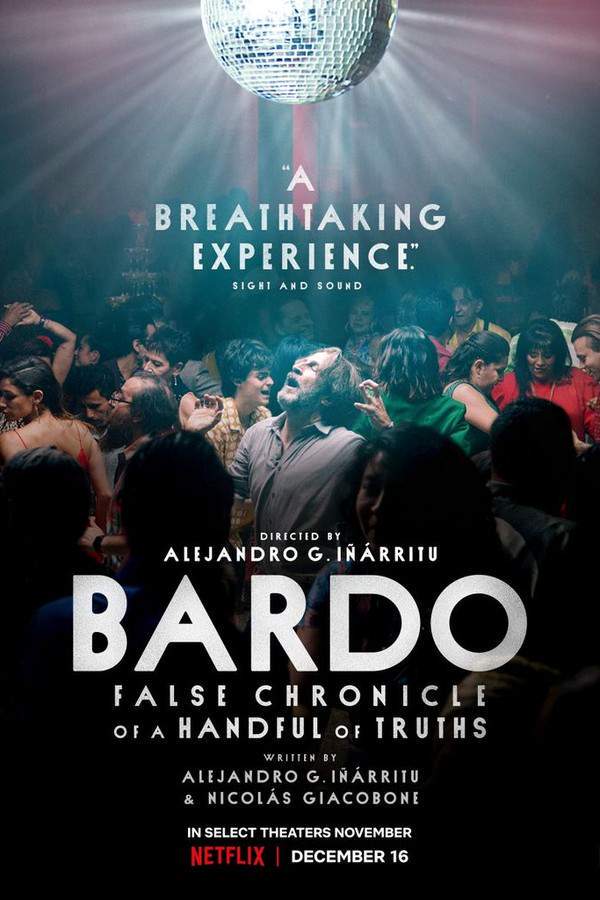
Bardo, False Chronicle of a Handful of Truths (2022) movie poster

Ending Explained

Bardo, False Chronicle of a Handful of Truths (2022) Ending Explained – Final Scene & Meaning

Release, runtime and language
2022 · 159 min · Spanish
Echo score 75
Loading streaming availability…
Directed by
Alejandro González Iñárritu
Starring
Daniel Giménez Cacho, Omar Leyva, Meteora Fontana, Edison Ruíz, Andrés Almeida, Armando Comonfort Santiago

Following a prestigious international award, renowned journalist Silverio returns to his native Mexico, triggering a profound personal upheaval. Alejandro G. Iñárritu’s visually striking film explores Silverio's journey as deeply buried memories and anxieties resurface, challenging his perception of reality. He grapples with existential questions about identity, success, and mortality, while navigating complex family relationships and reflecting on Mexico’s rich and sometimes turbulent history.

On this page (6)
  1. 1 Where to watch
  2. 2 What happens at the end
  3. 3 Final events in order
  4. 4 Ending questions answered
  5. 5 Movie threads
  6. 6 Every angle
Loading streaming availability…

Ending explained · contains spoilers

What Happens at the End of Bardo, False Chronicle of a Handful of Truths?

How Bardo, False Chronicle of a Handful of Truths (2022) ends, what the final scene means, which earlier moments set it up and how to read the ending if the film leaves it open. The full ending explained, with every spoiler.

Silverio Gama’s journey in "Bardo" is as much a personal voyage through memories, regrets, and identity as it is a reflection of Alejandro Inarritu’s own life. The film's final act suggests that Silverio’s story is ultimately a spiritual or existential one, with the scene in the desert symbolizing a liminal space between life and death. As Silverio’s family calls out to him, urging him to return, he stands at a crossroads where he can either move on or remain anchored by his unresolved internal conflicts. The recurring imagery of shadows growing smaller and then disappearing signifies his fading presence in the earthly realm, implying that Silverio may have passed away after suffering a stroke and slipping into a coma. The scenes depicting his reflections, conversations with his parents, and visions of Mexican history all seem to serve as a mental landscape representing his inner struggles—conflicts of belonging, pride, regret, and guilt.

The ambiguity of whether Silverio wakes up or not is central to understanding the film’s profound message. If viewed as a literal end, his disappearance in the desert could imply his death, having finally let go of the burdens that haunted him. On the other hand, if these visuals are seen as the culmination of his subconscious mind during his coma, it suggests that Silverio might wake up and survive, carrying the weight of his memories and internal battles. Either interpretation emphasizes the film’s exploration of mortality, memory, and the human condition. "Bardo" leaves its audience with a sense of melancholy and wonder, inviting viewers to ponder the intangible nature of identity and the afterlife, and the possibility that understanding oneself might be a lifelong, ongoing process. In its poetic, abstract style, the film ultimately suggests that the truths we seek are often elusive, hiding in the spaces between perception and reality.

Last updated: June 25, 2025 at 08:59

Was this helpful?

The last 4 events

How Bardo, False Chronicle of a Handful of Truths Ends: The Final Events in Order

The last events of Bardo, False Chronicle of a Handful of Truths (2022) in chronological order, the run-up to the ending explained above. The complete timeline has all 15 events, scene by scene.

Open the full timeline
  1. Purchase of Axolotls

    In a moment of impulsivity, Silverio decides to buy axolotls as a surprise for his family. This act serves as a coping mechanism, reflecting both the joy and sorrow intertwined in his family life.

  2. Silverio's Stroke

    While riding the L.A. Metro, Silverio suffers a sudden and violent stroke, leaving him unattended for hours. This critical event marks a turning point in his journey, leading him into a coma where he processes his memories.

    Where
    L.A. Metro
  3. Camila Accepts the Award

    As Silverio lies in a hospital bed, his daughter Camila steps up to accept the journalism award on his behalf. Surrounded by family and friends sharing stories, this moment emphasizes the legacy of Silverio's work and its impact on those he loves.

    Where
    Hospital
  4. Final Reflection in the Mind

    In the depths of his mind, Silverio encounters his deceased relatives while he ignores the living. The film concludes with an enigmatic vision of him soaring through the desert, leaving viewers to ponder the interplay between life, death, and personal reconciliation.

Ending questions answered

Bardo, False Chronicle of a Handful of Truths Ending: Your Questions Answered

The questions people ask most about the ending of Bardo, False Chronicle of a Handful of Truths (2022): what the final scene means, how the twist works, what happens to each character and how to read the ending. Each answer contains spoilers.

Q1

Does Silverio die at the end of Bardo?

The ending remains intentionally ambiguous. Silverio suffers a stroke and slips into a coma, and the desert scene represents a liminal space between life and death. He may have died, his physical body fading as the shadows shrink and disappear, or he may wake up from the coma. The film does not resolve this definitively, leaving both interpretations open.

  • silverio death ending
  • bardo ending explained
  • does silverio live or die
Q2

What does the desert scene represent in Bardo's ending?

The desert serves as a liminal space, a threshold between life and death where Silverio confronts his deepest fears, regrets, and memories. It symbolizes the bardo state from Tibetan Buddhism, representing the transitional realm between death and rebirth. His family's voices calling him back ground this surreal space in the physical world.

  • desert symbolism
  • bardo meaning
  • liminal space ending
Q3

What do the disappearing shadows mean in Bardo?

The recurring imagery of shadows growing smaller and then vanishing represents Silverio's fading presence in the earthly realm. As he approaches either death or a spiritual transition, this visual motif signifies his weakening connection to the physical world and his potential departure from it.

Foreshadowing: Earlier scenes establish shadows as representations of Silverio's earthly tether.

  • shadows symbolism
  • death imagery
  • mexican cinema imagery
Q4

Why is Bardo's ending deliberately ambiguous?

The ambiguity reinforces the film's core themes, identity, mortality, and the permeable boundaries between reality and perception. By refusing to confirm whether Silverio lives or dies, Iñárritu suggests that understanding oneself is an ongoing, elusive process. The uncertainty mirrors the nature of memory and consciousness themselves.

  • ambiguous ending
  • intentional ambiguity
  • inarritu ending meaning
Q5

What is the message or theme of Bardo's ending?

The ending explores mortality, memory, and the human condition. It suggests that self-understanding is a lifelong, ongoing process rather than a definitive achievement. Whether Silverio dies or wakes, the film implies he must ultimately let go of the burdens, guilt, regret, and loss, that haunted him to find any form of peace.

  • bardo theme
  • mortality ending
  • identity film meaning
Q6

Does Silverio wake up from his coma in Bardo?

The film does not provide a clear answer. If the desert and visions represent his subconscious during coma, he could wake up and survive. If the visuals depict his spiritual departure, he dies after finally releasing his internal conflicts. Both readings are supported by the imagery.

  • coma scene
  • silverio coma
  • waking up ending
Q7

What happens to Silverio's family in the ending?

Silverio's family appears in the desert, calling out to him and urging him to return. Their voices represent his connection to the living world and serve as the pullback toward life. Whether he chooses to answer them determines his fate, highlighting the tension between his unresolved past and the possibility of moving forward.

  • silverio family
  • family calling ending
  • return to life
Q8

Why does Silverio see his dead parents at the end?

His deceased parents appear as part of his inner mental landscape during the coma or near-death experience. These visions represent his confronting unresolved familial conflicts, feelings of belonging, pride, regret, and guilt, that have defined his lifelong struggle with identity and displacement.

  • dead parents
  • parent vision
  • family guilt ending
Q9

What does 'bardo' mean in the context of this film's ending?

Bardo refers to the Tibetan Buddhist concept of an intermediate state between death and rebirth, a transitional realm where the soul exists between two lives. The film uses this concept metaphorically to describe Silverio's existential crisis, representing his liminal space between life and death, reality and memory.

  • bardo meaning
  • tibetan buddhism
  • bardo concept film
Q10

What does Bardo say about identity and mortality?

The film suggests identity is fluid, constructed from memories, regrets, and relationships rather than fixed. Mortality is presented not as an ending but as a threshold, the ultimate unknown. Understanding oneself is portrayed as a lifelong, elusive process that continues even at the moment of death.

  • identity theme
  • mortality film
  • life death meaning

Movie threads

More Movies Like Bardo, False Chronicle of a Handful of Truths, by Mood & Story

Curated lists built around what makes Bardo, False Chronicle of a Handful of Truths tick: the same mood, the same kind of story or the same emotional payoff. Each list explains why these movies belong together.

Surreal introspective movies like Bardo, False Chronicle of a Handful of Truths

Films where dream logic blurs the line between memory, reality, and identity. If you enjoyed the dreamlike exploration of memory in Bardo, False Chronicle of a Handful of Truths, you'll find similar films here. These movies use surrealism and non-linear narratives to delve into identity, reality, and the past, perfect for viewers who like complex, metaphorical storytelling.

  • surreal
  • dreamlike
  • introspective
  • melancholic
  • metaphorical
  • psychological
  • Tone: melancholic, surreal, introspective
  • Pacing: slow, contemplative
Why these movies?

The story pattern: Stories in this thread often unfold as a series of interconnected vignettes, dreams, and flashbacks rather than a conventional plot. The protagonist's journey is internal, navigating a labyrinth of personal history, trauma, and existential questions, where the external world is filtered through a subjective and often unreliable perspective.

Why they belong together: Movies are grouped here for their shared approach to narrative, prioritizing psychological depth and metaphorical imagery over traditional storytelling. They create a consistent mood of melancholic introspection through slow pacing, complex structures, and a focus on the permeability of reality.

Emotionally heavy existential dramas like Bardo, False Chronicle of a Handful of Truths

Stories of profound personal loss that trigger deep questions about life's meaning. For viewers seeking movies like Bardo, False Chronicle of a Handful of Truths that delve into heavy themes of grief and existential crisis. These films feature characters confronting mortality and identity, often with an ambiguous or bittersweet resolution, matching the intense emotional weight of Bardo.

  • agonizing
  • somber
  • grief-stricken
  • existential
  • heavy
  • introspective
  • Tone: melancholic, somber, agonizing
  • Pacing: slow, deliberate
Why these movies?

The story pattern: The narrative pattern follows a character, often successful or accomplished, whose life is upended by a traumatic event—such as the loss of a child—forcing them to re-evaluate everything they know. The conflict is primarily internal, as they wrestle with guilt, regret, and the fragility of their own identity against a backdrop of personal and sometimes historical pain.

Why they belong together: These films are united by their exploration of the heaviest human emotions and philosophical questions. They share a slow, deliberate pacing that allows the emotional weight to settle, a melancholic or bleak tone, and a focus on the interior life of a character in crisis.

Every angle

Bardo, False Chronicle of a Handful of Truths (2022) Explained: Plot, Ending, Timeline & Characters

Everything about Bardo, False Chronicle of a Handful of Truths in one place: what happens in the plot summary, the timeline in chronological order, the characters and meaning, the ending explained and a spoiler-free summary. What's After the Movie adds the cast, box office and post-credit scenes.

Coming soon on iOS and Android

The Plot Explained Movie Summary App

Plot summaries, endings explained and timelines on your phone. Catch up on any movie in minutes, save your favorites and never miss a twist again.

Be the first to know when we launch. Your email stays private, always.

Learn more about the app