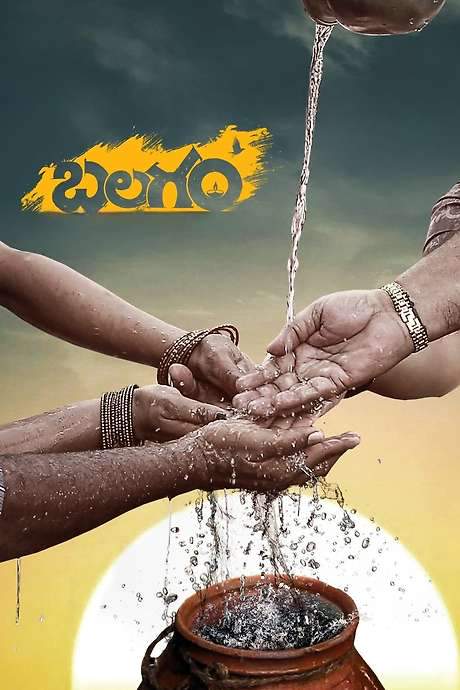
The sudden death of the lively and meddling village patriarch Komurayya throws his grandson Saayilu’s engagement and the entire family into turmoil. As preparations for the wedding are disrupted, long-buried secrets and existing tensions within the family are exposed, creating significant social upheaval in the small village and forcing everyone to confront difficult truths.
Warning: spoilers below!
Haven’t seen Balagam yet? This summary contains major spoilers. Bookmark the page, watch the movie, and come back for the full breakdown. If you're ready, scroll on and relive the story!
Read the complete plot breakdown of Balagam (2023), including all key story events, major twists, and the ending explained in detail. Discover what really happened—and what it all means.
Gajula [Komurayya], a typical elderly inhabitant of a Telangana village, sustains an apparently peaceful life with his elder son [Ailayya], his daughter-in-law, and their young son [Sayilu]. The tale follows a family bound by tradition, pride, and a web of obligations that strain every relationship in the small rural world they inhabit.
Unbeknownst to his hot-tempered father, [Sayilu] owes a massive sum of money to a cruel moneylender, and he tries to reassure everyone that he will repay the loan once he receives dowry from his fiancée’s family. This precarious arrangement shadows the household, coloring moments of joy with the fear of ruin and forcing choices that test loyalties. The tension around the impending marriage intensifies as the debt gnaws at Sayilu’s conscience and his family’s stability.
Komurayya’s untimely death leads to a cascade of consequences: Sayilu’s forthcoming marriage is postponed, and Lakshmi, his estranged daughter, returns to the village with the weight of a long-standing rift in her wake. Lakshmi’s husband, [Narayana], and [Ailayya] have not seen eye to eye for two decades, a feud that complicates every attempt at reconciliation. Narayana, a wealthy industrialist, soon reveals a hard-edged pragmatism in his plans, and his hunger for wealth drives him to pursue the hand of his heiress, [Sandhya], in a bid to consolidate power and fortune. Sayilu, meanwhile, sees an opportunity to secure Sandhya through his own courtship, a move that is repeatedly rebuffed as the family’s memories of old grievances resurface.
On the third day after Komurayya’s cremation, a village ritual comes to the forefront: a feast is offered to Komurayya’s soul, and a crow is expected to consume the meal as a sign of the departed’s satisfaction. When the crow does not devour, Narayana publicly humiliates [Ailayya] for failing to appease the restless spirit, and he departs from the village with Lakshmi and Sandhya, leaving Sayilu feeling cornered and disappointed by the turn of events. In the background, [Narsi], the tailor who had once mocked Komurayya’s fate, begins to bear the weight of guilt the moment he learns of the old man’s death, and feverish unease sweeps through him as well as through two other villagers indirectly touched by the tragedy.
In a bid to restore balance, Sayilu and his friend stage a public confrontation designed to cast the blame for the village’s malaise on the unsettled soul itself. The village Sarpanch summons Komurayya’s family to a Panchayat and sets a stark deadline: please Komurayya’s soul by the eleventh day, or bear responsibility and face banishment. As Lakshmi’s family returns and Sandhya’s presence looms large, there is a fragile sense that reconciliation might still be possible, especially as [Ailayya] reflects on his true feelings for Lakshmi and Komurayya’s sister recounts a childhood memory that softens hard hearts.
Komurayya’s brother steps forward to offer a candid truth: Komurayya had shown a leaning toward Sayilu and Sandhya’s marriage, and his blessing might calm the restless spirit if Narayana agrees, prompting Ailayya to reconsider his own conduct and seek reconciliation. Meanwhile, Mogilayya and his wife [Sujata] contemplate selling a plot of land to the wife’s brother, a move seen as fraught with ill omens for the family. Ailayya, who hopes to erect a gravestone for Komurayya in a place he loved, worries about the land’s fate, while the family’s quarrel over this mortal relic underscores their stubbornness and the fragility of their ties.
That night, Sayilu’s sorrow turns to a quiet, earnest mourning for the man his grandfather might have wished him to be. The mournful songs of village singers rise to honor Komurayya and to call for unity among the kin in anticipation of the eleventh day. Their voices carry a powerful message about forgiveness, accountability, and the need to come together as a family.
As the community listens, a collective breakthrough occurs: the extended family experiences an emotional awakening, acknowledging their past misdeeds, apologizing, and embracing one another with tearful reconciliations. Sayilu unveils a family portrait taken before Ailayya and Narayana’s estrangement, a symbol of the ties they once shared and now yearn to rebuild. When the crow finally accepts the feast, the final image is clear—the soul of Komurayya has found its longing for reunion, and the family’s long division gives way to a renewed sense of belonging, tempered by humility and mutual care.
Last Updated: October 09, 2025 at 14:16
Discover curated groups of movies connected by mood, themes, and story style. Browse collections built around emotion, atmosphere, and narrative focus to easily find films that match what you feel like watching right now.
A family death exposes buried tensions and disrupts tradition in a close-knit community.Discover movies like Balagam that delve into the heart of village life, where family tensions and long-buried truths come to light. If you enjoyed the blend of heartfelt drama, traditional rituals, and the upheaval caused by a patriarch's death, these films offer similar explorations of complex family dynamics in a rural setting.
The narrative typically begins with a catalyst, often a death or a ceremony, that shatters the fragile peace of a family and their community. As secrets are exposed, long-standing feuds and personal grievances come to the forefront, forcing characters to navigate a web of social obligations, tradition, and emotional baggage on their path to a resolution.
These films are grouped by their focus on the intersection of family conflict and community life. They share a steady, reflective pace, a bittersweet emotional core that moves from tension to hope, and a deep investment in how cultural settings shape personal dramas and reconciliation.
A loss forces a dysfunctional family to face their past and find a path to healing.Explore movies like Balagam that focus on a family's emotional journey through grief and toward reconciliation. If you enjoyed the heartfelt portrayal of a family mending their wounds after a loss, these films offer similar cathartic stories of healing, forgiveness, and bittersweet resolution.
These narratives follow a clear emotional arc: a sudden loss destabilizes a family, exposing old wounds and conflicts. The middle act is driven by the difficult and often tense process of airing grievances and confronting the past. The conclusion provides a cathartic release, where characters achieve a hard-won understanding and emotional closure, leading to a happy or hopeful ending.
This thread connects movies that share a specific emotional trajectory: starting with sadness and conflict, moving through a medium-intensity exploration of dysfunction, and ending on a note of hope and healing. They balance the weight of grief with the uplift of reconciliation, creating a consistently bittersweet and reflective tone.
Don't stop at just watching — explore Balagam in full detail. From the complete plot summary and scene-by-scene timeline to character breakdowns, thematic analysis, and a deep dive into the ending — every page helps you truly understand what Balagam is all about. Plus, discover what's next after the movie.
Track the full timeline of Balagam with every major event arranged chronologically. Perfect for decoding non-linear storytelling, flashbacks, or parallel narratives with a clear scene-by-scene breakdown.
Discover the characters, locations, and core themes that shape Balagam. Get insights into symbolic elements, setting significance, and deeper narrative meaning — ideal for thematic analysis and movie breakdowns.
Get a quick, spoiler-free overview of Balagam that covers the main plot points and key details without revealing any major twists or spoilers. Perfect for those who want to know what to expect before diving in.
Visit What's After the Movie to explore more about Balagam: box office results, cast and crew info, production details, post-credit scenes, and external links — all in one place for movie fans and researchers.
Discover movies like Balagam that share similar genres, themes, and storytelling elements. Whether you’re drawn to the atmosphere, character arcs, or plot structure, these curated recommendations will help you explore more films you’ll love.
Balagam (2023) Scene-by-Scene Movie Timeline
Balagam (2023) Movie Characters, Themes & Settings
Balagam (2023) Spoiler-Free Summary & Key Flow
Movies Like Balagam – Similar Titles You’ll Enjoy
Balu Mahi (2017) Plot Summary & Ending Explained
Thangamagan (2015) Story Summary & Characters
Gamak Ghar (2019) Full Summary & Key Details
Kalisundam Raa (2000) Detailed Story Recap
Bala (2002) Story Summary & Characters
Kalyanaraman (2002) Complete Plot Breakdown
Vasanthamalika (2002) Movie Recap & Themes
Bommarillu (2006) Complete Plot Breakdown
Malayogam (1990) Spoiler-Packed Plot Recap
T. P. Balagopalan M.A. (1986) Movie Recap & Themes
Malabar Wedding (2008) Full Movie Breakdown
Samajavaragamana (2023) Movie Recap & Themes
Balika Badhu (1976) Movie Recap & Themes
Vatsalyam (1993) Full Summary & Key Details
Kamaladalam (1992) Complete Plot Breakdown