Plot Explained Spoilers guaranteed!
Plot Explained

Browse by genre

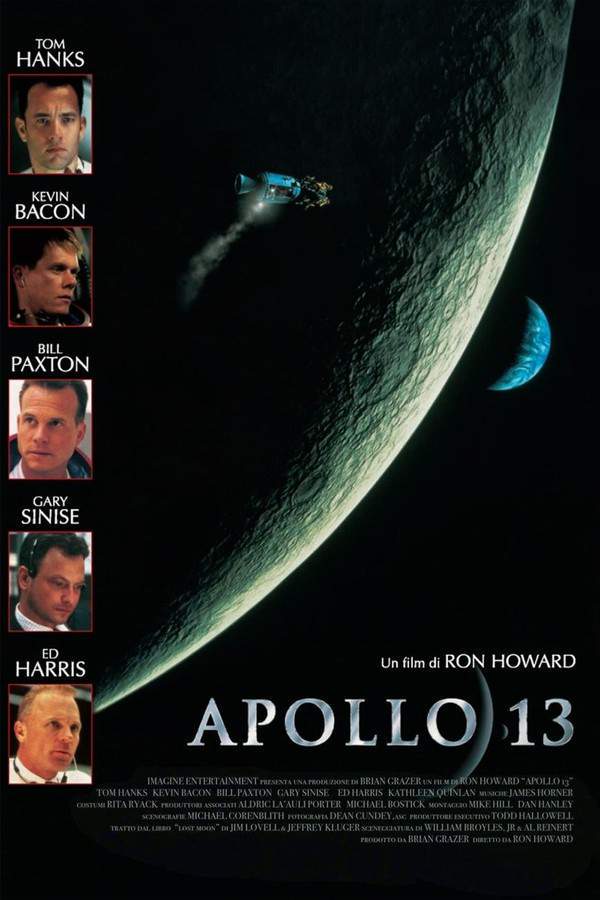
Apollo 13 (1995) movie poster

Plot Summary

Apollo 13 (1995) Plot Summary Explained

Release, runtime and language
1995 · 140 min · English
JustWatch #523 26
Directed by
Ron Howard
Starring
Tom Hanks, Ed Harris, Bill Paxton, Kevin Bacon, Gary Sinise

During the Apollo 13 mission, an oxygen tank explodes, crippling the spacecraft and leaving astronauts Jim Lovell, Jack Swigert, and Fred Haise struggling to survive 205,000 miles from Earth. With limited resources and facing extreme conditions, the crew and the dedicated team at Mission Control must work together, using their skills and ingenuity, in a tense and heart-stopping race against time to bring them home safely.

On this page (7)
  1. 1 Where to watch
  2. 2 What happens: full plot
  3. 3 Plot questions answered
  4. 4 The book behind the movie
  5. 5 Movie threads
  6. 6 Movies like Apollo 13
  7. 7 Every angle

Where to watch

Where to Watch Apollo 13 (1995)

Where can you watch Apollo 13? Stream, rent or buy it in the US, including on fuboTV, MGM Plus and Philo: current JustWatch availability with up-to-date prices.

Streaming availability powered by JustWatch

Full plot summary · contains spoilers

What Happens in Apollo 13: Full Plot Summary

The whole story of Apollo 13 (1995) explained, from the opening scene to the final frame: every key event, every twist and what it all adds up to. Read it as a quick recap before the sequel, to check a scene you missed, or to finally understand what really happened.

On July 20, 1969, the historic Apollo 11 mission reaches its pinnacle as Neil Armstrong takes his momentous steps on the Moon. In the lead-up to this extraordinary achievement, astronaut Jim Lovell (Tom Hanks) hosts a celebratory gathering at his home to commemorate the lunar landing. Among his colleagues are the quick-witted astronaut Jack Swigert (Kevin Bacon), as well as Ken Mattingly (Gary Sinise) and Fred Haise (Bill Paxton), both slated to join Lovell on the Apollo 14 mission. However, the space program faces budget cuts as pride swells following the United States' victory over the Soviets in the space race.

Amidst these preparations, the astronauts' plans are disrupted when Alan Shepard falls ill with an ear infection, forcing them to advance their mission to Apollo 13 just six months earlier than anticipated. During pre-launch training, Lovell, Haise, and Mattingly engage with the simulator for docking exercises. An unexpected test from the technicians leaves Mattingly momentarily disoriented, yet he manages to navigate the challenges adeptly.

Lovell's wife, Marilyn, grows uneasy about the fateful number 13, but Jim dismisses her concerns, focusing on fulfilling his lifelong dream of walking on the moon. A mere two days before launch, Lovell learns from Deke Slayton that they must withdraw Mattingly due to his exposure to Charlie Duke, who contracted measles. Faced with a tough decision, Lovell opts to continue the mission with Swigert instead.

As launch day arrives on April 11, a palpable tension hangs over the crew, particularly Swigert as he nervously prepares to board the Command Module, Odyssey. At Mission Control, the seasoned Gene Kranz (Ed Harris) dons his traditional white vest, overseeing the thorough pre-flight checks. The Apollo 13 mission takes off promptly, and cheers erupt from the crowd.

However, mid-flight tragedy strikes. As Swigert conducts a routine task of stirring the oxygen tanks, a catastrophic explosion occurs, throwing the Apollo 13 crew into chaos. Lovell's immediate response becomes iconic: > "Houston, we have a problem." With dangerously low oxygen levels and several systems in failure, the crew's situation deteriorates rapidly.

In Mission Control, Kranz and his team are faced with the daunting reality of rescuing the crew with limited resources and time. The decision is made to power the Lunar Module while combating rising CO2 levels. As the situation intensifies, the astronauts grapple with their reality, enduring heated exchanges yet banding together for survival.

Simultaneously, Mattingly races against time back at Mission Control to devise a plan for powering the Command Module with minimal energy. Ingenious solutions emerge, pushing the team to the limit of human ingenuity.

Despite insurmountable odds, the Apollo 13 crew successfully jettisons the damaged Service Module and re-establishes contact with Earth, collectively contemplating their precarious fate. Just before re-entry, Lovell delivers a somber yet dignified farewell to his crew: "Gentlemen, it's been a privilege flying with you."

As the Command Module enters Earth’s atmosphere, tension peaks until they behold the parachutes deploying successfully. Cheers erupt within Mission Control as Lovell jubilantly re-establishes communication, declaring, > "Hello, Houston? This is Odyssey. It's good to see you again."

In the aftermath of their safe recovery, Lovell, Haise, and Swigert celebrate their survival, while Kranz triumphantly acknowledges the team's hard-fought efforts. In the following months, investigations reveal the tragic flaw that led to the near-catastrophic mission: a minor defect in the oxygen tank that had existed for years. Through the adversity of Apollo 13, humanity's resilience and the pioneering spirit of exploration shine brighter than ever.
Last updated: November 08, 2024 at 00:32

Was this helpful?

Plot questions answered

Apollo 13 Plot Explained: Your Questions Answered

The questions people ask most about Apollo 13 (1995): what happens in the confusing scenes, why the characters do what they do, the twists, hidden details and what the ending means. Each answer contains spoilers.

Q1

Why was Ken Mattingly removed from the Apollo 13 mission?

Ken Mattingly was removed from the mission two days before launch because he had been exposed to Charlie Duke, who contracted measles. NASA doctors determined that Mattingly might develop the illness during the flight, so he was replaced by Jack Swigert. This was a difficult decision since Mattingly had trained extensively for the mission.

Foreshadowing: Earlier in the film, Mattingly performs well in simulator training, making his sudden removal more impactful.

  • ken mattingly
  • measles
  • jack swigert
  • crew replacement
  • apollo 13 crew
Q2

What caused the oxygen tank explosion on Apollo 13?

The explosion was caused by a minor defect in the oxygen tank that had existed for years. During the mission, as Jack Swigert performed a routine stir of the oxygen tanks, the damaged tank catastrophically exploded, crippling the spacecraft and creating a life-threatening situation for the crew.

Foreshadowing: The film establishes routine procedures aboard the spacecraft, making the sudden explosion more shocking.

  • oxygen tank
  • explosion
  • cause
  • swigert
  • service module damage
Q3

How did the Lunar Module save the Apollo 13 crew?

The Lunar Module Aquarius served as a lifeboat after the explosion. With the Command Module's life support systems damaged, the crew powered up the Lunar Module, which had its own oxygen and power supplies. This bought them enough time to survive the journey home while Mission Control worked on solutions to conserve resources and safely re-enter Earth's atmosphere.

Foreshadowing: The film shows the crew training with the Lunar Module, establishing its importance before the crisis.

  • lunar module
  • aquarius
  • lifeboat
  • survival
  • life support
Q4

What was the CO2 problem aboard Apollo 13?

After the explosion, carbon dioxide levels rose dangerously in the spacecraft because the damaged filtering systems couldn't handle the buildup. The crew faced potential carbon dioxide poisoning. Mission Control had to improvise a solution using spare parts and plastic bags to create a makeshift air filter, the famous 'mailbox' hack, that allowed the CO2 levels to stabilize.

Foreshadowing: Early scenes establish the technical complexity of life support systems aboard the spacecraft.

  • carbon dioxide
  • co2
  • mailbox hack
  • air filter
  • mission control solution
Q5

Why did Jim Lovell decide to continue the Apollo 13 mission after Mattingly was removed?

Jim Lovell chose to proceed with the mission despite losing Mattingly because the Apollo 13 launch had already been moved up six months due to Alan Shepard's illness. With significant resources invested and the mission timeline critical, Lovell decided to trust Swigert, who had trained as a backup crew member, and continue with the launch as scheduled.

Foreshadowing: The film shows Lovell's determination to walk on the Moon, which drives his decision to push forward.

  • jim lovell
  • decision
  • mission launch
  • swigert
  • leadership
Q6

How did Mission Control solve the power consumption problem on Apollo 13?

Mission Control devised a plan to minimize the Command Module's power usage during re-entry. Ken Mattingly, who had been removed from the crew, worked intensely at Mission Control to calculate exactly how much power was needed. The team developed procedures to keep critical systems running while conserving energy, ensuring the spacecraft would have enough power for the critical re-entry phase.

Foreshadowing: Mattingly's earlier simulator expertise and his removal from the mission set up his crucial role in the rescue.

  • mission control
  • power consumption
  • ken mattingly
  • re-entry
  • calculations
Q7

What happened when the Apollo 13 crew jettisoned the Service Module?

The crew successfully jettisoned the damaged Service Module, which had been exposing the Command Module to the vacuum of space. When they jettisoned it, they got their first look at the extent of the damage, the entire side of the module was torn away. This was a critical moment because they needed to ensure the Command Module's heat shield was still intact for re-entry.

Foreshadowing: The buildup to this moment shows growing tension as the crew prepares for this irreversible step.

  • service module
  • jettison
  • damage
  • heat shield
  • re-entry preparation
Q8

Why was the number 13 significant to Jim Lovell's wife?

Jim Lovell's wife Marilyn expressed concern about the mission being called Apollo 13, fearing the number 13 would bring bad luck. Jim dismissed her superstitious fears, focusing instead on his lifelong dream of walking on the Moon. The dramatic events that followed the mission's name became intertwined with this earlier concern about the unlucky number.

Foreshadowing: Marilyn's warning about 13 appears early in the film, creating dramatic irony as events unfold.

  • marilyn lovell
  • number 13
  • superstition
  • bad luck
  • lunar landing dream
Q9

How did the Apollo 13 crew conserve water during the crisis?

The crew faced a severe water shortage after the explosion because the damaged fuel cells could no longer produce water as a byproduct. They had to drastically reduce their water intake, surviving on minimal hydration for days. This deprivation contributed to their physical hardship during the return journey.

Foreshadowing: The film establishes water as a precious resource that the spacecraft normally produces automatically.

  • water shortage
  • hydration
  • survival
  • fuel cells
  • resource management
Q10

What did Jim Lovell mean by 'Gentlemen, it's been a privilege flying with you'?

Before re-entering Earth's atmosphere, Jim Lovell delivered this poignant farewell to his crew as they prepared to separate the Command Module from the Lunar Module. The statement acknowledged the gravity of their situation and the strong bond formed during the life-or-death crisis. It was a dignified, emotional moment that reflected their successful partnership in surviving the disaster.

Foreshadowing: Earlier heated exchanges between the crew establish the tension that makes this reconciliation meaningful.

  • jim lovell
  • farewell quote
  • crew bond
  • re-entry
  • emotional moment
Q11

Why does Gene Kranz wear a white vest in Mission Control?

Gene Kranz wears a traditional white vest as a personal superstition and symbol of leadership during critical missions. The vest represents his confidence and serves as a visual marker of his authority in Mission Control. He puts on the vest before important launches and crisis moments, treating it as a talisman for mission success.

Foreshadowing: Kranz's vest is introduced during the pre-launch sequence, establishing its significance before the crisis.

  • gene kranz
  • white vest
  • mission control
  • leadership
  • tradition
Q12

Why was Apollo 13 originally supposed to land on the Moon?

Apollo 13 was intended to be the third Moon landing mission, targeting the Fra Mauro highlands region of the Moon. Jim Lovell was supposed to become the next astronaut to walk on the Moon, fulfilling his lifelong dream. The mission was moved up six months when Alan Shepard became ill, pushing Lovell's chance at a Moon walk further into the future.

Foreshadowing: Lovell's dream of walking on the Moon is established early, making the mission's abrupt change frustrating.

  • fra mauro
  • moon landing target
  • jim lovell dream
  • apollo mission
  • lunar surface

Movie threads

More Movies Like Apollo 13, by Mood & Story

Curated lists built around what makes Apollo 13 tick: the same mood, the same kind of story or the same emotional payoff. Each list explains why these movies belong together.

Movies with triumphant crisis management like Apollo 13

Stories where brilliant minds unite to solve a life-or-death problem. If you enjoyed the intense, real-life problem-solving of Apollo 13, you'll love these movies. This collection features stories where teams use their intellect and determination to overcome seemingly impossible challenges, resulting in a hopeful and cathartic viewing experience.

  • tense
  • urgent
  • nerve-wracking
  • hopeful
  • cathartic
  • triumphant
  • Tone: tense, urgent, hopeful
  • Pacing: variable, building to relentless
Why these movies?

The story pattern: Narratives in this thread typically begin with a sudden, catastrophic failure that establishes immediate, high-stakes danger. The core of the story is a procedural journey, following a team of experts as they methodically work through a series of escalating problems, often under a tight deadline, building tension until a final, triumphant resolution.

Why they belong together: These movies are grouped by their shared focus on logical, step-by-step problem-solving as the primary driver of the plot. They create a specific kind of tension that is intellectual and urgent, rooted in the collective effort to avert disaster, which makes the eventual success feel enormously satisfying.

Movies about isolated team survival like Apollo 13

Stories of groups trapped in a deadly environment, fighting to stay alive. Looking for more movies with the claustrophobic tension of Apollo 13? This list features films where a small team is trapped in a perilous, isolated environment, battling against the elements and technical failures in a gripping race for survival that tests their teamwork and resolve.

  • claustrophobic
  • tense
  • anxious
  • urgent
  • survival
  • nerve-wracking
  • Tone: tense, claustrophobic, anxious
  • Pacing: steady, with intense surges
Why these movies?

The story pattern: The narrative pattern involves a team becoming stranded in an inherently dangerous locale. The confined setting becomes a character in itself, amplifying tension and conflict. The plot revolves around managing dwindling resources, overcoming technical failures, and maintaining morale, all while facing the constant, oppressive threat of the environment.

Why they belong together: This thread unites movies through their shared setting-driven tension. The experience is defined by a feeling of confinement and vulnerability, where the characters' survival hinges on their ability to master or endure a hostile world. The focus is on collective endurance rather than individual heroics.

If you liked this

Movies Like Apollo 13

Similar movies to Apollo 13: the same genre, themes or kind of story. Each one comes with its own plot summary, timeline and ending explained.

Browse all movie summaries

Every angle

Apollo 13 (1995) Explained: Plot, Timeline & Characters

Everything about Apollo 13 in one place: what happens in the plot summary, the timeline in chronological order, the characters and meaning and a spoiler-free summary. What's After the Movie adds the cast, box office and post-credit scenes.

Coming soon on iOS and Android

The Plot Explained Movie Summary App

Plot summaries, endings explained and timelines on your phone. Catch up on any movie in minutes, save your favorites and never miss a twist again.

Be the first to know when we launch. Your email stays private, always.

Learn more about the app