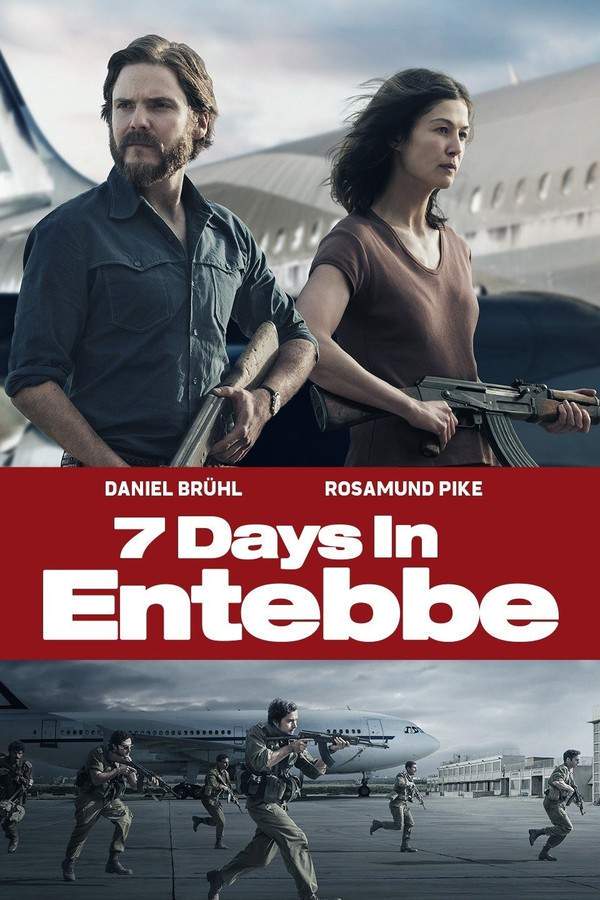
On June 27, 1976, four terrorists belonging to a splinter group of the Popular Front for the Liberation of Palestine boarded and hijacked an Air France Airbus A300 in Athens, Greece. With the permission of Idi Amin the hijackers divert the airliner and its hostages to Entebbe Airport in Uganda. Once there, they identify Israeli passengers and release the non-Jewish travelers, while presenting a set of demands, including the release of 40 Palestinian militants held in Israel, in exchange for the hostages’ freedom.
The Israeli government responds with resolve. Led by Prime Minister Yitzhak Rabin, the cabinet refuses to bow to the terrorists’ terms and authorizes a covert military operation, code-named Operation Thunderbolt. The plan unfolds with extraordinary orchestration: a two-pronged raid mounted from thousands of miles away, spanning a journey that would push into enemy territory on the Jewish Sabbath. In the background, the planners weigh risk after risk, balancing the urgent need to rescue lives with the peril of a surprise showdown in a hostile, deeply fortified airport.
As negotiations continue, the Israeli forces prepare two Lockheed C-130 Hercules transports, carefully staged to avoid detection. The aircraft must reach Entebbe under the cover of darkness, refueling first in Kenya before they touch down. The mission is commanded by Brigadier General Dan Shomron, a seasoned officer who has to synchronize precision with the chaos of a live, high-stakes operation. The men who will execute the raid move with a calm urgency, understanding that every decision could determine life or death for their fellow citizens.
The breach team, led by a brave, disciplined commander—Yonatan 'Yonni' Netanyahu—faces a countdown that has no room for error. Netanyahu, the brother of a future Israeli leader, carries the weight of a mission that could change the course of history. The team negotiates a tense landscape, leveraging a clever ruse: a black Mercedes limousine is brought aboard to mimic the appearance of President Amin’s official car, a deception that helps crack the airport’s defenses and buy crucial moments of surprise.
When the gate finally opens to the commandos, the raid achieves near-total surprise. A fierce firefight erupts, and the attackers contend with a sizeable Ugandan military presence. In the ensuing combat, seven terrorists and 45 Ugandan soldiers are killed. The hostages are rounded up and loaded onto the idling C-130s, as the operation moves toward its next phase: a calculated, audacious stand against any potential retaliation.
The mission does not end with a clean helicopter-to-home rescue. A second objective remains: to prevent any Egyptian- or Ugandan-backed response by crippling Uganda’s air capability. The surviving forces stay behind briefly to destroy Ugandan Air Force MiG-17 and MiG-21 fighters, a move aimed at thwarting retaliation and ensuring a safer return flight for the rescuers and rescued alike. In the end, with 102 hostages aboard the aircraft, the operation proceeds to Nairobi and Sharm el-Sheikh before the entire team makes its way back to Israel, having fulfilled their mission with remarkable restraint and calculated audacity.
In the quiet aftermath, the story remains one of meticulous planning, courage under pressure, and the heavy toll of warfare carried out far from home. The events at Entebbe Airport are remembered as a defining moment in rescue missions, a blend of strategic intelligence, daring execution, and the shared resolve of a nation to protect its citizens even in the most daunting circumstances.