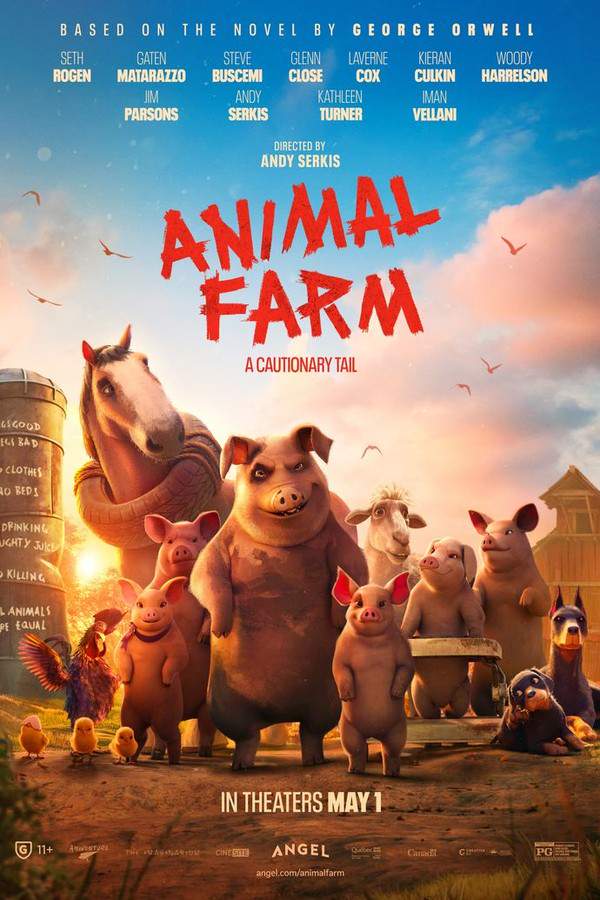
Manor Farm is repossessed after Farmer Jones falls behind on his mortgage, and the bank plans to sell the property to Pilkington Industries. The ruthless Frieda Pilkington, Glenn Close, aims to slaughter the livestock, turning what begins as rumors of a vacation into a grim reality for the animals. A sow named Snowball, Laverne Cox, quickly sees through the deception and rallies the animals to stand up against their human oppressors. Their defiant stand becomes a full-blown rebellion, and they drive out the human owners, renaming the farm “Animal Farm.”
With Snowball at the helm, the animals institute an autonomous government and draft a code of laws intended to keep them from slipping into the very habits they despise in humans. The new order is hopeful at first, a promise of equality and stewardship that reflects their best intentions. The farm becomes a living experiment in self-rule, where the animals learn to manage chores, trade, and decision-making in a collective effort to protect their own interests.
Yet internal tensions begin to surface as power shifts. Napoleon, Seth Rogen, emerges as a rival to Snowball’s vision. He objects to Snowball’s plan to build a watermill, arguing that it distracts the group from practical needs. Napoleon works to sway the others, portraying Snowball as a hindrance to freedom, and gradually pushes Snowball out of a leadership role. The bank’s demand for a $1,000 monthly loan payment adds pressure, testing the farm’s ability to sustain itself without human support. The animals improvise by running a market, using the revenue to shop at Pilkington’s mall, a move that complicates their ideals and foreshadows the creeping influence of outside interests.
Pilkington’s aid and the pigs’ manipulation blur the lines between ally and adversary. The pig faction, led by Napoleon and aided by his flunkey Squealer, Kieran Culkin, begins distorting the rules of their own revolution to grant favors to the pigs and even some humans. They rewrite memories and retell history to justify their growing privilege, convincing many animals that their origins were misremembered and that the new system is about mutual benefit rather than betrayal.
Time wears on, and life on Animal Farm grows harsher for most of the animals while Napoleon and the pigs enjoy a more comfortable, even luxurious, lifestyle. The once-idealistic dream darkens as the leadership becomes increasingly indistinguishable from the humans they overthrew. Snowball’s former protégé, Lucky, Gaten Matarazzo, begins to question the regime, especially as Puff leaves the farm under bleak conditions. Lucky’s doubts deepen when Napoleon hints at selling off non-pig residents, an idea that sickens many of the loyal animals.
The spark of rebellion is rekindled when the donkey Benjamin’s weathered wisdom inspires a plan to confront Napoleon during a public address to Pilkington’s company. A catastrophic dam break threatens the entire farm, flooding the fields and trapping the animals on a water tower. In the ensuing confrontation, Napoleon is confronted by Lucky, and the struggle ends with Napoleon drowning as he is overwhelmed by the flood’s force and the collapsing tower. With the tyrant gone, the animals look toward the stars, uncertain yet momentarily hopeful about whatever future might lie ahead for Animal Farm.
Benjamin, the elderly donkey who has long observed the rise and fall of revolutions, remains a quiet witness to the changes around him, offering quiet commentary as the animals navigate a world that is less ideal than they once imagined. Kathleen Turner lends Benjamin a patient, enduring presence that underscores the toll of leadership and memory on a community trying to survive.
In the end, the exhale of relief is tempered by the losses suffered, and the survivors—led by a mix of fear, resilience, and stubborn hope—look up to the night sky and wonder what comes next for a place that has tried so hard to be free, yet has learned that freedom is a continuous work in progress. Inside Animal Farm, the story remains a quiet meditation on power, loyalty, and the delicate balance between equality and control.