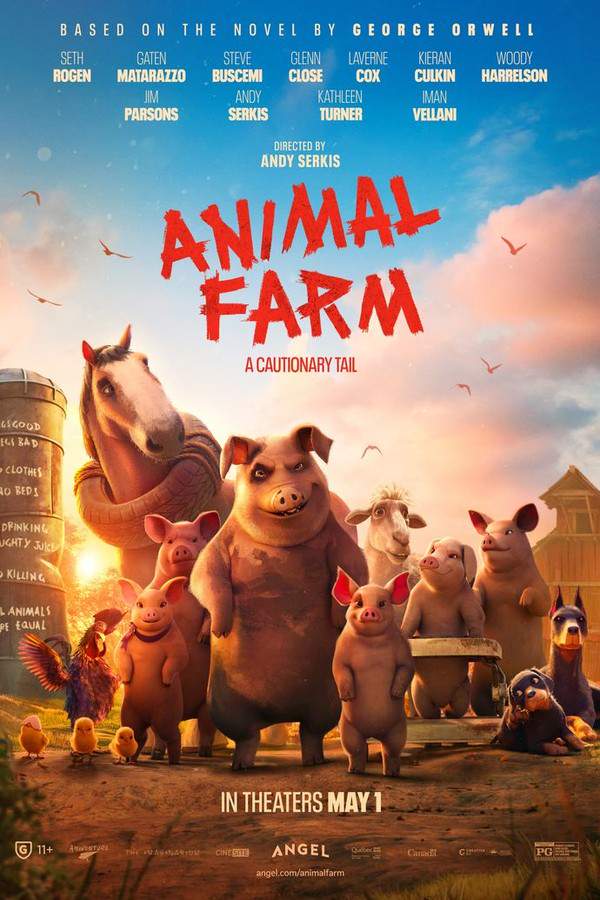
Farmer Jones, Andy Serkis, loses Manor Farm after failing to keep up with mortgage payments, and the bank repossesses the property. The farm is set to be sold to Pilkington Industries, led by ruthless billionaire Frieda Pilkington, Glenn Close, who intends to slaughter the livestock. While the animals initially believe they are being taken on vacation to a "laughterhouse," a sow named Snowball, Laverne Cox, realizes their true fate and decides that the animals should rebel against the humans. The animals drive out their human owners and rename the place Animal Farm. Under Snowball's watch, they establish an autonomous government with a code of laws designed to prevent them from becoming like humans, a moment that marks a hopeful, collective attempt to define their own destiny.
As the animals struggle to learn how to run the farm on their own, Boxer, Woody Harrelson, and Carl, Jim Parsons, among others, contribute muscle and voice to the early experiment, while the crafty Squealer is always nearby to interpret and adjust the message for the group. Napoleon, Seth Rogen, objects to Snowball's plan to build a watermill and begins convincing the other animals that Snowball is hindering their freedom. The disagreement grows into a power struggle, and Napoleon uses pressure and persuasion to push Snowball out, seizing control of Animal Farm for himself.
The farm soon faces a new pressure from the human world in the shape of a loan demand: the bank requires the farm to pay $1,000 per month, an obligation the animals doubt they can meet. Yet they find a way to raise the funds by operating a market; the profits enable them to purchase goods at Pilkington's mall, blurring the line between self-sufficiency and complicity with the humans they overthrew. Pilkington, still intent on owning the farm, begins to ally with Napoleon and the pigs, providing them with material favors that deepen the pigs' power and privilege. With the help of his lackey Squealer, Kieran Culkin, Napoleon begins to bend the rules of Animal Farm to suit the pigs’ interests, convincing many of the animals that their memory of the original principles was flawed or exaggerated.
Life on Animal Farm grows progressively harsher for most of the animals, even as the pigs enjoy a more comfortable, human-like lifestyle. Snowball’s former protegé Lucky, Gaten Matarazzo, begins to question the regime as conditions deteriorate, while Puff leaves the farm under pressure, a concession that further shakes the animals’ faith in the leadership. Lucky’s skepticism is reinforced by the elderly donkey Benjamin, Kathleen Turner, who quietly urges resistance and reminds the others that memory and truth may still matter.
A plan to ridicule Napoleon during a visit by Pilkington's company becomes a spark for renewed dissent. However, a catastrophic dam breaks, flooding the farm and forcing everyone to confront the fragility of their new order. Lucky and the other rebels find themselves on a water tower as the flood rages, and Napoleon confronts Lucky in a confrontation that ends with Napoleon drowning when trapped on the tower. The loss of Napoleon leaves the animals facing an uncertain future, but the survivors—led by Lucky and the steadfast Benjamin—look up toward the sky and toward each other with a cautious sense of hope, wondering what kind of life might still be possible after the fall of the regime they once believed would set them free.