




Plot Explained Spoilers guaranteed!
Plot Explained

Browse by genre

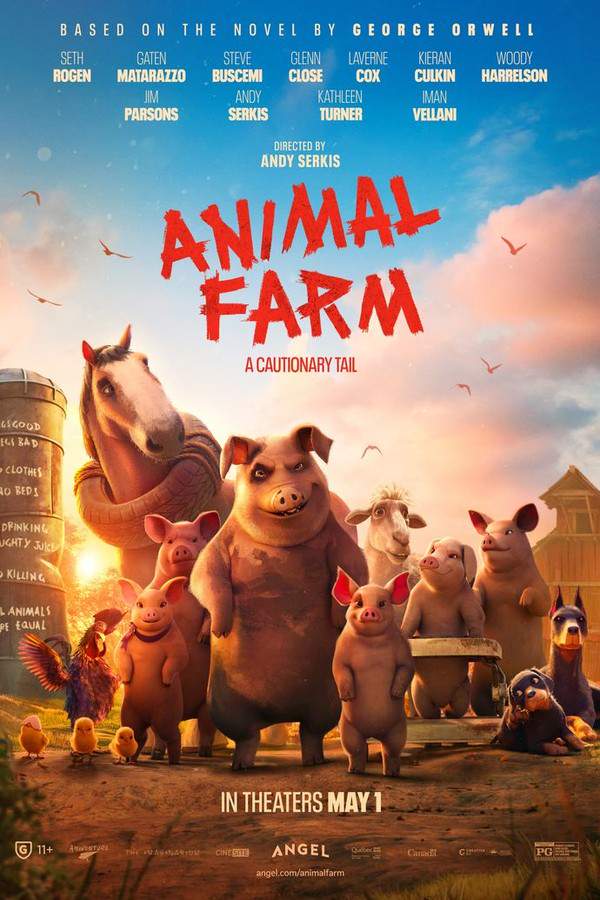
Animal Farm (2026) movie poster

Characters & Themes

Animal Farm (2026) Characters, Setting & Themes Explained

Release, runtime and language
2026 · 1 h 36 m · English
Echo score 6
JustWatch #5,192 19
Starring
Andy Serkis, Woody Harrelson, Steve Buscemi, Glenn Close, Seth Rogen, Laverne Cox
Budget
$35M

Directed by Andy Serkis and voiced by Seth Rogen, Gaten Matarazzo, Glenn Close and Woody Harrelson, this film is a satirical allegory of revolution and power. It follows a hopeful movement for equality that is progressively usurped as the pigs seize control, rewrite history, silence dissent and turn the farm into a brutal dictatorship, echoing Orwell’s warning about the perils of communism.

On this page (8)
  1. 1 Where to watch
  2. 2 Characters explained (9)
  3. 3 Where & when it takes place
  4. 4 Themes & meaning (4)
  5. 5 Character & meaning questions
  6. 6 The book behind the movie
  7. 7 Movie threads
  8. 8 Every angle

Where to watch

Where to Watch Animal Farm (2026)

Where can you watch Animal Farm? Stream, rent or buy it in the US, including on Angel Studios, Amazon Video and Apple TV Store: current JustWatch availability with up-to-date prices.

Streaming availability powered by JustWatch

9 main characters · contains spoilers

Animal Farm Characters Explained: Who Is Who

The main characters of Animal Farm (2026), heroes and villains: what drives them, how they change over the course of the story and what each of them reveals about the film's bigger ideas.

  • Mr. Jones (Andy Serkis)

    The neglectful farmer who loses control of Manor Farm when the bank repossesses the estate. His inability to keep the farm financially viable sets the stage for the animals' revolt. He represents the fragile exit point of the old social order. His fall also signals the volatility of property under financial pressure.

    • 🏠 Farm owner
    • 💳 Debt
    • ⚖️ Power
  • Snowball (Laverne Cox)

    A bold sow who leads the initial rebellion and crafts a vision of a self-governed farm. He advocates ambitious projects like a watermill and a more equal law code. Snowball's ideals clash with Napoleon's fallback to manipulation, ultimately forcing him into exile. He embodies idealism and principled leadership.

    • 🐷 Pig
    • 🧭 Leadership
    • 🗣️ Oratory
  • Napoleon (Seth Rogen)

    A power-hungry pig who seizes control of Animal Farm by sidelining Snowball and consolidating authority. He uses manipulation and propaganda to maintain dominance while preserving his own luxury. Napoleon's governance warps the original laws, ensuring pigs and their human allies prosper. He personifies the slide from revolutionary idealism to tyrannical rule.

    • 🐷 Pig
    • 🧠 Manipulation
    • 🏛️ Authority
  • Lucky (Gaten Matarazzo)

    An elderly donkey and Snowball's protégé who grows skeptical of the regime. He is pulled into the struggle when Napoleon targets non-pig animals for removal. Lucky's doubts fuel a late rebellion attempt, showing the cost of oppression on ordinary farm residents. He becomes a symbol of disillusioned hope.

    • 🐴 Donkey
    • 🌟 Idealism
    • 🧭 Doubt
  • Benjamin (Kathleen Turner)

    The old donkey known for his wisdom and skepticism. He quietly guides the younger animals with a wary eye on the escalating power games. Benjamin's cynical outlook adds a stabilizing moral commentary to the unrest. He helps push Lucky toward questioning Napoleon's regime.

    • 🐴 Donkey
    • 🧠 Skepticism
    • 🕯️ Wisdom
  • Freida Pilkington (Glenn Close)

    A ruthless business figure allied with Napoleon who buys into the farm's future for profit. She aligns with the pigs, providing goods and support that blur the lines between human and animal governance. Her company represents external corporate pressure facilitating tyranny. Her presence underscores the trap of commodified power.

    • 👩‍💼 Human
    • 🏢 Wealth
    • 🤝 Alliance
  • Puff (Iman Vellani)

    A pig who becomes disillusioned with the living conditions on the farm. Puff's departure from the regime reveals the growing discontent among the animal residents. The character's arc helps illustrate how internal dissent arises within the ruling class. Puff's presence marks the shifting loyalties among farm animals.

    • 🐷 Pig
    • 🌬️ Discontent
    • 🧭 Change
  • Squealer (Kieran Culkin)

    The persuasive pig who twists facts to justify Napoleon's decisions. He reshapes the farm's history and present circumstances to keep the others obedient. Squealer's propaganda cements the leader's control and masks the corruption behind a veneer of unity. His role demonstrates the power of rhetoric in tyranny.

    • 🐷 Pig
    • 🗣️ Propaganda
    • 🧠 Persuasion
  • Carl, Sheep (Jim Parsons)

    One of the non-pig animals who contributes to the crowd dynamics. Carl and his fellow sheep embody the collective voice of the farm's ordinary residents. Their presence illustrates how the majority can be swayed or subdued by those in power. Carl stands as a representative of rural workers caught in the political machinery.

    • 🐑 Sheep
    • 🧠 Conformity
    • 🗳️ Compliance

Last updated: May 19, 2026 at 05:52

Was this helpful?

Setting

Where and When Does Animal Farm Take Place?

The setting of Animal Farm (2026): the year and time period, the places and locations, and how they shape the characters, the mood and the tension of the story.

Time period

Location

Manor Farm, Animal Farm

Manor Farm is a rural estate whose mortgage troubles lead to its repossession and sale. After the animals seize control, the farm is renamed Animal Farm as a symbolic shift from human ownership to animal governance. The location serves as a testing ground for a self-governed community while external corporate buyers and bankers loom as continuous threats. The setting underscores how ideals can be corrupted when power is concentrated.

  • 🏡 Farm
  • 💳 Debt
  • ⚖️ Power

Last updated: May 19, 2026 at 05:52

Was this helpful?

4 major themes

Animal Farm Meaning: Themes & Message Explained

What is Animal Farm (2026) really about? The emotional, social and philosophical themes the film keeps returning to, its symbolism and the message beneath the surface.

  • Power

    Napoleon's rise to leadership shows how quickly authority can corrupt a movement meant to be egalitarian. The pigs privilege themselves while enforcing rules that keep others subservient. The legal code is gradually rewritten to justify this new hierarchy. The farm's governance mirrors a tyranny that disguises itself as equality.

  • Rebellion

    A spontaneous uprising begins when Snowball advocates a different path for their future, including plans like the watermill. The animals overthrow the human owners and establish Animal Farm, hoping for lasting autonomy. Internal cracks soon appear as expedient leadership fractures the original ideal. The rebellion's energy ultimately faces the weight of real-world challenges.

  • Propaganda

    Squealer becomes the mouthpiece that reshapes truth to justify the pigs' growing privileges. The animals' memories and perceptions are manipulated, blurring the line between memory and myth. Rhetoric and selective information maintain Napoleon's grip on power. The manipulation reveals how language can shield domination.

  • Equality

    The initial code of laws promises equality for all animals, but the rules are bent to reward the pigs and their human allies. The society's promise of fair treatment devolves into a new hierarchy that mirrors human oppression. The dream of a truly equal farm fades as privileges, luxury, and control concentrate at the top. The outcome questions whether any system can sustain real equality.

Last updated: May 19, 2026 at 05:52

Was this helpful?

Character & theme questions

Animal Farm Characters & Meaning: Your Questions Answered

The questions people ask about Animal Farm (2026): who the characters really are, their relationships, what the symbols mean, where it takes place and what the movie is really about. Each answer contains spoilers.

Q1

Where is Animal Farm set?

The story takes place on Manor Farm, a rural estate that becomes Animal Farm after the animals overthrow their human owner. The farm represents a microcosm of society, where external corporate buyers and bankers continuously threaten the animals' self-governed community.

  • manor farm
  • setting
  • rural farm
  • location
Q2

What was Manor Farm before the animals took over?

Manor Farm was a struggling rural estate owned by Mr. Jones, a neglectful farmer who could not keep the farm financially viable. The bank repossessed the property due to mortgage troubles, setting the stage for the animals' revolt.

  • manor farm
  • mr jones
  • repossession
  • bank
Q3

What are the main themes in Animal Farm?

The movie explores several interconnected themes: power and its corruption, the betrayal of rebellion, the manipulation of truth through propaganda, and the broken promise of equality. These themes work together to illustrate how revolutionary ideals can be corrupted into tyranny.

  • themes
  • power
  • rebellion
  • propaganda
  • equality
Q4

How does Animal Farm explore the theme of power?

The film shows how quickly authority can corrupt a movement meant to be egalitarian. Napoleon's rise demonstrates how power concentrates among few, while the pigs privilege themselves and rewrite laws to justify their dominance, mirroring how tyrants disguise oppression as equality.

  • power
  • napoleon
  • corruption
  • tyranny
  • leadership
Q5

What does Animal Farm say about rebellion?

The movie portrays rebellion as a hopeful beginning that faces inevitable corruption. The animals overthrow human owners with vision for autonomy, but internal fractures and expedient leadership undermine the original ideal, showing how revolutionary energy struggles against real-world challenges.

  • rebellion
  • revolution
  • uprising
  • snowball
  • idealism
Q6

How is propaganda depicted in Animal Farm?

Squealer serves as the propaganda minister who reshapes truth to justify the pigs' growing privileges. The film illustrates how language manipulates memories and perceptions, blurring the line between fact and myth to maintain Napoleon's grip on power.

  • propaganda
  • squealer
  • manipulation
  • language
  • control
Q7

Who is Napoleon in Animal Farm?

Napoleon is a power-hungry pig who seizes control of Animal Farm by sidelining Snowball and consolidating authority. He uses manipulation and propaganda to maintain dominance while preserving luxury for himself and fellow pigs, personifying the slide from revolutionary idealism to tyrannical rule.

  • napoleon
  • pig
  • leader
  • tyrant
  • power
Q8

Who is Snowball in Animal Farm?

Snowball is a bold sow who leads the initial rebellion and crafts a vision for a self-governed farm. He advocates ambitious projects like a watermill and a more equal law code, embodying idealism and principled leadership before being exiled by Napoleon.

  • snowball
  • sow
  • idealist
  • leader
  • exile
Q9

Who are the key characters in Animal Farm?

The main characters include Napoleon (the tyrannical leader), Snowball (the idealistic rival), Squealer (propaganda mouthpiece), Benjamin and Lucky (skeptical donkeys), Mr. Jones (the deposed farmer), and Freida Pilkington (corporate ally). Each represents different facets of the political allegory.

  • characters
  • cast
  • napoleon
  • snowball
  • squealer
  • benjamin
Q10

What does Animal Farm say about equality?

The film questions whether any system can sustain real equality. The initial promise of equal treatment devolves into a new hierarchy where privileges concentrate at the top, showing how the dream of a truly equal farm fades as pigs and their human allies prosper.

  • equality
  • hierarchy
  • justice
  • fairness
  • system
Q11

What time period is Animal Farm set in?

Animal Farm does not specify a concrete time period, functioning as a timeless allegory. The setting uses rural farmland elements that could fit various historical eras, allowing the story to remain relevant as a commentary on political corruption across different contexts.

  • time period
  • era
  • setting
  • timeless
Q12

What is the ending of Animal Farm about?

The ending is ambiguous, while the immediate dictator is removed, the animals' future remains uncertain. The film offers a sliver of hope without a clear resolution, creating a bittersweet tone that reflects the heavy themes of betrayal, oppression, and the difficulty of sustaining revolutionary ideals.

  • ending
  • conclusion
  • hope
  • ambiguity
  • resolution

Movie threads

More Movies Like Animal Farm, by Mood & Story

Curated lists built around what makes Animal Farm tick: the same mood, the same kind of story or the same emotional payoff. Each list explains why these movies belong together.

Dark Political Allegories Like Animal Farm

Stories that use metaphor to critique power structures and political systems. Explore movies like Animal Farm that use satirical allegory to critique power structures and political systems. If you enjoyed the dark political commentary of Animal Farm, you'll find similar thought-provoking stories here.

  • thought-provoking
  • satirical
  • oppressive
  • uneasy
  • rebellious
  • tragic
  • Tone: dark, satirical, grim
  • Pacing: steady, methodical
Why these movies?

The story pattern: These narratives typically follow a hopeful movement or revolution that becomes corrupted by power. They show a gradual descent into tyranny, often through the rewriting of history, silencing of dissent, and manipulation of the masses. The journey is usually tragic, ending on an ambiguous or bleak note that serves as a warning.

Why they belong together: Movies are grouped here for their shared use of allegory to deliver dark political commentary. They combine heavy thematic weight with a satirical, often grim tone, creating a cohesive experience of thoughtful unease about systems of power.

Movies About Failed Revolutions Like Animal Farm

Stories where idealistic uprisings gradually descend into new forms of oppression. Discover films similar to Animal Farm that explore hopeful revolutions turning tragic. If you were captivated by the story of idealism corrupted by power, you'll find more movies with this compelling narrative pattern.

  • hopeful
  • tragic
  • oppressive
  • rebellious
  • betrayal
  • dread
  • Tone: dark, tragic, hopeful beginnings
  • Pacing: steady, building dread
Why these movies?

The story pattern: These stories follow a clear arc: starting with righteous anger and hope for change, then showing the gradual corruption of the revolution's ideals as new leaders seize power. The pacing is steady, building dread as conditions worsen and dissent is silenced. The ending typically offers no clear victory, leaving questions about whether cycles of oppression can ever be broken.

Why they belong together: These films share the specific narrative pattern of a revolution that becomes corrupted from within. They create a cohesive experience through their steady pacing, building sense of dread, heavy emotional weight, and ambiguous endings that challenge simplistic notions of good versus evil.

Every angle

Animal Farm (2026) Explained: Plot, Timeline & Characters

Everything about Animal Farm in one place: what happens in the plot summary, the timeline in chronological order, the characters and meaning and a spoiler-free summary. What's After the Movie adds the cast, box office and post-credit scenes.

Coming soon on iOS and Android

The Plot Explained Movie Summary App

Plot summaries, endings explained and timelines on your phone. Catch up on any movie in minutes, save your favorites and never miss a twist again.

Be the first to know when we launch. Your email stays private, always.

Learn more about the app