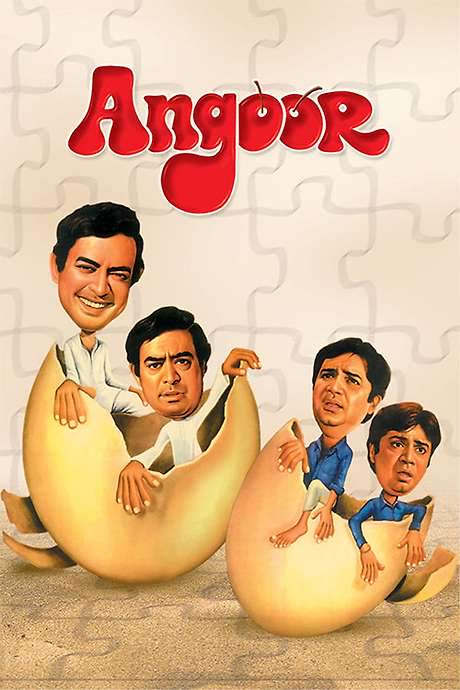
Year: 1982
Runtime: 136 mins
Language: Hindi
Director: Gulzar
Two sets of identical twins are separated after an accident in childhood. Years later their paths cross in the same city, sparking a cascade of mistaken identities, absurd situations and comedic misunderstandings. The story adapts Shakespeare’s The Comedy of Errors for a modern Indian setting.
Warning: spoilers below!
Haven’t seen Angoor yet? This summary contains major spoilers. Bookmark the page, watch the movie, and come back for the full breakdown. If you're ready, scroll on and relive the story!
Trace every key event in Angoor (1982) with our detailed, chronological timeline. Perfect for unpacking nonlinear stories, spotting hidden connections, and understanding how each scene builds toward the film’s climax. Whether you're revisiting or decoding for the first time, this timeline gives you the full picture.
Last updated: February 18, 2026 at 23:45
Find frequently asked questions about the Angoor (1982) timeline, including chronological order, nonlinear jumps, cause-and-effect links, and scene sequence clarifications. This timeline FAQ helps explain when key events happen, how moments connect, and why the story unfolds in that specific order.
Raj Tilak believed that identical twins should share the same name, which reflects his unusual sense of symmetry and sets up the central premise of the film. This unusual naming choice creates the foundation for all the identity confusion that follows when the two pairs of twins are separated and later reunite.
The father's belief about twin naming foreshadows how identity will blur throughout the story.
An unfortunate accident divided the family, leaving each parent with one child from each twin pair. This means Raj Tilak and his wife ended up with one Ashok and one Bahadur each, while the adopted twins were split between the two households. The separation seeds the confusion that occurs years later when all four men end up in the same city.
This early separation creates two households that mirror each other, setting up the farcical reunification.
The second Ashok is a detective-fiction aficionado who arrives in the city years after the original family was separated. His resemblance to the first Ashok is so strong that it deepens the existing confusion about who belongs to which family. His爱好 of reading detective novels adds another layer to the identity confusion theme.
His arrival marks the turning point where the separate lives of the twins begin to collide.
The second Bahadur is a bhang-loving character who arrives shortly after the second Ashok. His addition creates parallel confusion with his counterpart, as both Bahadurs have different personalities and habits. His volatile nature intensifies the existing tensions in the household and adds to the comedic chaos.
His arrival compounds the existing confusion and multiplies the misunderstandings.
The families rely on personality differences, habits, and quirks to distinguish between the lookalikes. The detective-novel loving Ashok behaves differently from the original Ashok, while the bhang-loving Bahadur contrasts with the more conventional Bahadur. However, these distinctions are not always reliable, leading to the cascade of mistaken identities that drive the comedy.
The personality differences become both the means of identification and the source of confusion.
These three professionals become entangled in the chaos because they interact with the twins in their daily work. The Jeweller encounters them during transactions, the Taxi Driver transports them, and the Inspector must sort out the mistaken identities when reports are filed. Their inability to tell the twins apart highlights how widespread the confusion has become throughout the city.
The involvement of outsiders like the Inspector suggests the chaos has spread beyond the family.
Yes, Angoor directly adapts Shakespeare's The Comedy of Errors for a modern Indian setting. The core premise of two sets of identical twins separated at birth and later reuniting in the same city, causing mistaken identities and comedic chaos, mirrors Shakespeare's classic comedy exactly.
The entire farcical structure follows Shakespeare's template of escalating misunderstandings.
The arrival of the second Ashok and second Bahadur in the same city where the first twins already live triggers the cascade. Once both lookalikes are present in the same location, anyone who interacts with them can easily mistake one for the other, leading to a chain reaction of misunderstandings involving family members, the jeweler, taxi driver, and police.
The mere presence of both sets of twins in one city makes confusion inevitable.
There are two Ashoks and two Bahadurs total. Originally, Raj Tilak had twin sons both named Ashok, and he also adopted twin sons both named Bahadur. After the accident split the family, each parent ended up with one Ashok and one Bahadur. When all four grow up and end up in the same city, the two original twins and the two adopted twins create the confusing scenario.
The four characters all sharing names sets up the numerical confusion that defines the plot.
The film resolves the confusion through the eventual recognition of each character's true identity and family placement. The cumulative chaos becomes overwhelming, but ultimately the families sort out who is who and reconcile. The resolution is happy, reuniting the family and restoring order despite the absurd complexity of the situation.
The Inspector's involvement hints at an authority figure who will help resolve the confusion.
Discover curated groups of movies connected by mood, themes, and story style. Browse collections built around emotion, atmosphere, and narrative focus to easily find films that match what you feel like watching right now.
Stories where cases of mistaken identity spiral into hilarious chaos and confusion.If you enjoyed the cascade of confusion in Angoor, you'll love these other movies built on mistaken identity. This list features hilarious films where characters' lives are turned upside down by cases of mistaken identity, leading to fast-paced farcical situations and comedic misunderstandings.
The narrative pattern centers on a single mistaken identity that rapidly multiplies into a web of confusion. Characters find themselves in increasingly absurd situations they cannot control, creating a structured chaos where every attempt to clarify things only deepens the misunderstanding. The journey is one of escalating comedy, resolved neatly when the true identities are finally revealed.
These films are grouped together because they share a core reliance on mistaken identity as the primary engine of comedy. They feature fast pacing, light emotional weight, and a focus on situational humor derived from characters' bewilderment, creating a consistently playful and amusing viewing experience.
Fast-paced, lighthearted stories where misunderstandings create wholesome, amusing chaos.Fans of Angoor's playful and innocent humor will enjoy these movies. This collection features lighthearted comedies with fast pacing and absurd situations, where a series of misunderstandings leads to delightful chaos without any heavy emotional stakes, perfect for a cheerful viewing experience.
The narrative follows a structure of escalating, interconnected errors. Seemingly minor mix-ups or coincidences compound upon each other, creating a complex but ultimately harmless web of confusion. The journey is characterized by a rapid series of amusing events that test the characters' patience but are resolved in a satisfying, happy conclusion that restores order.
These movies are grouped by their shared commitment to light, innocent comedy. They prioritize fast-paced, situational humor over deep character drama, maintaining a cheerful tone and ensuring the viewer is consistently entertained by the absurdity of the characters' predicaments.
Don't stop at just watching - explore Angoor in full detail. From the complete plot summary and scene-by-scene timeline to character breakdowns, thematic analysis, and a deep dive into the ending - every page helps you truly understand what Angoor is all about. Plus, discover what's next after the movie.
Read a complete plot summary of Angoor, including all key story points, character arcs, and turning points. This in-depth recap is ideal for understanding the narrative structure or reviewing what happened in the movie.
Discover the characters, locations, and core themes that shape Angoor. Get insights into symbolic elements, setting significance, and deeper narrative meaning - ideal for thematic analysis and movie breakdowns.
Discover movies like Angoor that share similar genres, themes, and storytelling elements. Whether you’re drawn to the atmosphere, character arcs, or plot structure, these curated recommendations will help you explore more films you’ll love.
Angoor (1982) Plot Summary & Movie Recap
Angoor (1982) Scene-by-Scene Movie Timeline
Angoor (1982) Spoiler-Free Summary & Key Flow
Movies Like Angoor – Similar Titles You’ll Enjoy
Kangaroo (2007) Complete Plot Breakdown
Hungama (2003) Full Movie Breakdown
Taxi No. 9211 (2006) Full Movie Breakdown
Anwar (2007) Spoiler-Packed Plot Recap
Otso Otso Pamela-mela Wan (2004) Spoiler-Packed Plot Recap
Godfather (1991) Full Summary & Key Details
The Angrez (2006) Full Summary & Key Details
Bhrantibilas (1963) Complete Plot Breakdown
Aankhen (1993) Movie Recap & Themes
Loafer (1996) Ending Explained & Film Insights
Angaar (1992) Story Summary & Characters
Andaz Apna Apna (1994) Plot Summary & Ending Explained
Aflatoon (1997) Detailed Story Recap
Aagey Se Right (2009) Full Summary & Key Details
Amigos (2023) Detailed Story Recap