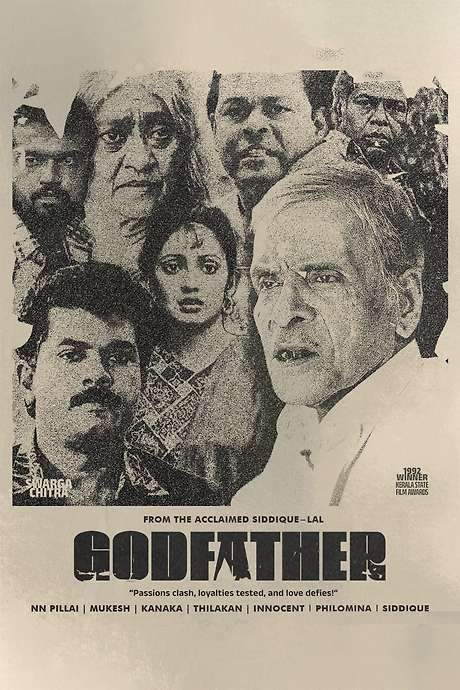
Anjooran and his four sons—Balaraman, Swaminathan, Premachandran, and Ramabhadran—stand at the center of a long and bitter feud with the Anappara family. The roots of this enmity go back to a brutal episode in the past: the men of Anappara abducted Balaraman's fiancée and forced her to marry Achamma’s eldest son. In the chaos that followed, Anjooran’s wife was killed, and he spent time in jail after avenging her by murdering Achamma’s husband. The consequences of this chain of violence left him with a deep-seated mistrust of women and a rule that their entry into his home is forbidden.
The drama widens with Malu, the granddaughter of Achamma, becoming a focal point in the family’s struggle. At law college, Mayin Kutty and Ramabhadran devise schemes to humiliate Malu, who is in line to marry Shyam Prasad, a young state minister. Yet Achamma’s political influence throws a wrench into that engagement when she learns of Malu’s interest in Ramabhadran and uses it to threaten political consequences. The plan to keep Malu apart intensifies when Mayin Kutty suggests that Ramabhadran should pretend to be in love with Malu to sow further discord within the Anappara camp. As the tension grows, Malu’s feelings begin to shift from a calculated move to something genuine.
Meanwhile, Swaminathan—a figure living a double life as Ramanathan—appears to complicate matters further. He has a wife, Kochammini, and two children, and he promises to help unite the two families. This declaration adds another layer of secrecy and urgency to the loyalties at play, as Ramabhadran contends with the truth Swaminathan has kept hidden and the role it might play in Malu’s future.
Trouble comes to a head when Anjooran learns of Ramabhadran’s secret love for Malu and discovers Swaminathan’s deceit. The revelations drive both Ramabhadran and Swaminathan to be ostracised from the family, leaving Malu and her grandmother Achamma to navigate a divided house. In Anappara, Achamma’s plans to secure Malu’s marriage—this time to the son of the family’s advocate—move forward, while signals about the house’s unity are carefully manipulated to sway opinion. Achamma herself does not yet realize that Veerabhadran—Veerabhadran, the youngest son—feels compassion for the lovers and has secretly shared this sympathy with Ramabhadran.
The turning point arrives when Ramabhadran, emboldened by Veerabhadran’s hidden support, makes a bold move: he sneaks into the marriage hall with the intention of preventing Malu’s alliance with a political counting of bets, rather than to marry her. His intrusion forces Achamma to confront the reality of her scheming, and she curses Anjooran for not being vigilant enough to protect her plans. In a moment of candor, Ramabhadran reveals that his intent was never to marry Malu but to foil Achamma’s scheme and safeguard his father’s honor. The act of truth and defiance shifts the mood of the room, and Anjooran, moved by the sincerity of the lovers, finally grants permission for the wedding to take place. He also welcomes Swaminathan and their families back into the fold, signaling a renewed possibility for harmony in the house and a tentative re-entry of women into the home after a long taboo.
What unfolds is a story of old wounds being reopened and new loyalties formed, tempered by acts of sacrifice and moments of reconciliation. It portrays how love, when tested by political pressure, family honor, and past traumas, can still find a way to heal a fractured household. The narrative threads—jealousy, deception, forgiveness, and the ultimate assertion of family unity—combine to offer a textured portrayal of tradition colliding with changing social norms, all framed within the weight of a centuries-old feud that finally yields to a hopeful, if fragile, sense of togetherness.



















-hbTR_oK2SWsInw.jpg)