Plot Explained Spoilers guaranteed!
Plot Explained

Browse by genre

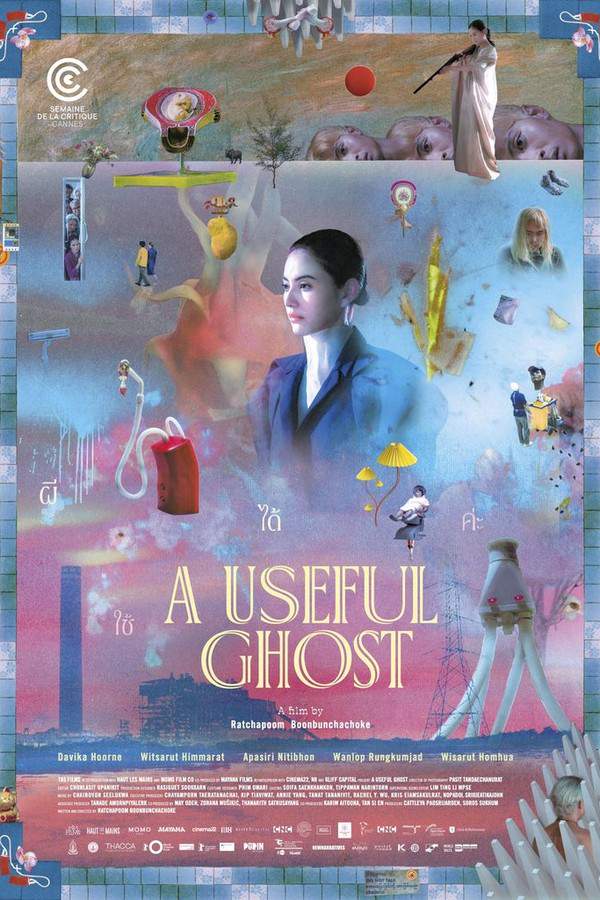
A Useful Ghost (2025) movie poster

Plot Summary

A Useful Ghost (2025) Plot Summary Explained

Release, runtime and language
2025 · 130 mins · Thai
Echo score 87
Loading streaming availability…
Directed by
Ratchapoom Boonbunchachoke
Starring
Chatchawat Sanveang, Teepisit Mahaneeranon, Wanlop Rungkumjad, Davika Hoorne, Sarut Komalittipong, Apasiri Nitibhon

March mourns his wife Nat, who died from dust pollution. Her spirit returns, inhabiting a vacuum cleaner. When a ghost appears after a worker’s death forces the factory to shut, March’s family rejects the human‑ghost bond. To prove their love, Nat offers to cleanse the plant, but to become a useful ghost she must first rid it of the useless ones.

On this page (5)
  1. 1 Where to watch
  2. 2 What happens: full plot
  3. 3 Plot questions answered
  4. 4 Movie threads
  5. 5 Every angle
Loading streaming availability…

Full plot summary · contains spoilers

What Happens in A Useful Ghost: Full Plot Summary

The whole story of A Useful Ghost (2025) explained, from the opening scene to the final frame: every key event, every twist and what it all adds up to. Read it as a quick recap before the sequel, to check a scene you missed, or to finally understand what really happened.

In a city clawing its way back to modern life through sweeping renewal projects, a self-described "academic ladyboy" brings home a new vacuum cleaner to tidy his small apartment. At night the device coughs so loudly that the air seems to tremble, and by morning it has somehow expelled the very dust it had just collected. He calls for a repairman, Krong, Wanlop Rungkumjad, who arrives almost instantly and explains that the vacuum is physically fine but haunted by a ghost—one of several spirits tied to the factory that produced the device. The repairman’s tale pulls the man deeper into a world where memories and machines intertwine, and he invites Krong to tell the story of the haunted factory, inviting a stranger into his own haunted life.

Suman, the heir to her late husband’s electronics factory, is haunted by Tok, a resentful spirit who died on the job from congenital heart disease. Tok blames the factory for his death and frequently interrupts work by possessing machinery, his presence anchored in the world only because someone who remembers his life remains. Tok’s ghost flouts hygiene rules, pushing Suman to the brink and contributing to the factory’s decline as she loses her license and the business shuts down.

Meanwhile, March—the younger of Suman’s two sons—mourns Nat and their unborn child, both claimed by a respiratory illness. While investigating Tok’s haunting, March glimpses Nat’s spirit in an inventory warehouse and follows her. Nat possesses a vacuum and seduces March, a revelation that unsettles his family and religious authorities and lands him in hospital. Nat, still bound to the vacuum, travels to the hospital to visit March, and their reunion rekindles a fragile hope. Nat envisions a future they might share, even contemplating using Nat’s frozen eggs to start a family again, a plan that would bind the past to a possible future.

Nat’s presence—and her growing bond with March—draws in Dr. Paul, the Prime Minister [Gandhi Wasuvitchayagit], who intervenes as Nat’s story collides with politics and power. Dr. Paul works to shield Nat and March, pressing for a more ethical handling of her condition and the vacuum’s haunting. Yet conservative in-laws push back, and Buddhist monks attempt to exorcise Nat; Suman, however, confronts them with a stark choice between science, religion, and the ghosts that haunt their lives. Dr. Paul argues for a more nuanced approach, and with his help the charges against Nat are dropped as he repairs the appliance and reframes her role as a “good ghost” who can still influence the world for the better.

As the factory is reopened under the banner of progress, Nat undertakes a radical project: she uses her ability to enter dreams to learn which memories sustain Tok’s haunting in the workers. In this dreamscape, Tok visits the dreams of Pin, a worker, and Suman confronts Pin with an ultimatum: undergo electroshock therapy to forget Tok or lose his job. Tok weaponizes the situation by possessing a refrigerator, creating a dangerous clash that Nat must stop in order to protect Suman and the factory’s fragile revival. Through her intervention, Nat becomes more visible to others, and her status as a benevolent ghost grows.

Dr. Paul eventually orchestrates a more controversial arrangement, inviting Nat and March to his home to celebrate their efforts—an apparent moment of triumph that spirals into a scene with political ghosts from history. These spirits—haunting figures connected to violence in power—press Nat to use her eggs and help them “cleanse” the past. Nat resists, but the promise of clearing bureaucratic obstacles leads her to consent.

The plan succeeds in purging many of the politically inconvenient ghosts, but it strains Nat and March’s relationship. March fears that Nat has changed too much, to the point where she might forget who she used to be. He clings to the past and pursues a study of political violence to keep the memory of the ghosts alive. When Nat becomes pregnant, a difficult betrayal follows: Nat agrees to cooperate with Dr. Paul to secure the future she desires, even as March watches his world crumble around him.

A violent turn comes when a coughing fit at a critical moment topples a bust of Nat, injuring March and leaving him in the hospital with the fear that Nat’s bond to him may vanish forever. Nat begins to fade, and a heavy sense of loss settles over the hospital, leaving Suman alone with the baby she did not expect to raise.

Amid these twin stories—the Ladyboy’s life and Krong’s restless ghost—Krong’s tale takes on new dimension. He reveals that he was murdered by feet encased in concrete and thrown into a lake, his physical existence tethered to the memories of his daughter, which Nat’s therapy has been eroding. The Ladyboy begins to see that Krong is more than a repairman; he is a ghost whose presence lingers in the vacuum that still sits in their shared life. They make love again, and the Ladyboy vows to remember Krong even as the ghost begins to fade.

In a bold, desperate act, the Ladyboy dives into the lake to retrieve the concrete block containing Krong’s feet and hands it to Dr. Paul. Reconstituted by this act, Krong and a chorus of vengeful spirits surge into Dr. Paul’s home, enacting a final reckoning that leaves him, his family, and his associates dead in the wake of their haunting.

This story-within-a-story unfolds through a tapestry of memory, loss, and the uneasy alliance between the living and the dead. It is a meditation on how progress can be a double-edged blade—how a city’s renewal can restore some lives while unearthing others, how love can endure even as it shifts shape, and how the line between healer and exploiter, guardian and aggressor, can blur when ghosts choose to intervene in the world of the living.

Last updated: December 04, 2025 at 15:32

Was this helpful?

Plot questions answered

A Useful Ghost Plot Explained: Your Questions Answered

The questions people ask most about A Useful Ghost (2025): what happens in the confusing scenes, why the characters do what they do, the twists, hidden details and what the ending means. Each answer contains spoilers.

Q1

Why does Nat's spirit inhabit a vacuum cleaner?

Nat died from dust pollution, a respiratory illness caused by the factory's hazardous environment. When her spirit returns, she is drawn to the vacuum cleaner because it represents the very thing that killed her, dust. The vacuum becomes her vessel, allowing her to remain connected to the living world while also symbolizing her unfinished business with the factory that caused her death.

Foreshadowing: The vacuum coughs loudly and expels the dust it collected, hinting at Nat's presence tied to the polluted air that killed her.

  • Nat's ghost
  • vacuum cleaner
  • dust pollution
  • cause of death
  • spirit possession
Q2

How does Nat become visible to others as a ghost?

Initially, only March can see Nat because their emotional bond transcends death. As she performs helpful acts, cleaning dust, intervening during Tok's possession of the refrigerator, and later mass-exorcising political ghosts, Nat accumulates positive energy that makes her increasingly visible. By the factory confrontation, she appears in human form to everyone, transforming from a feared specter into a recognized benevolent spirit.

Foreshadowing: Nat cleans dust from Dr. Paul's eyes in the hospital, an act of kindness that begins to make her more tangible to others.

  • ghost visibility
  • spiritual manifestation
  • Nat's powers
  • ghost mechanics
Q3

What does Nat mean by becoming a "useful ghost"?

Nat initially returns as a haunting presence tied to her grief and March's memory. To prove her worth to Suman and the family, and to avoid being exorcised, she commits to helping the factory by eliminating Tok and other useless, vengeful ghosts. This "useful ghost" status represents her transformation from a burden into a beneficial force, though this goal ultimately leads her to compromise her values through the mass exorcism.

Foreshadowing: Suman challenges Nat to prove her love by cleansing the factory of harmful spirits rather than simply haunting it.

  • useful ghost
  • Nat's redemption
  • proving love
  • factory cleansing
  • Tok's haunting
Q4

Why does Suman have March undergo electroshock therapy?

Suman, under pressure from conservative family members and religious authorities, views Nat's presence as dangerous and shameful. She believes that if March forgets Nat, the ghost will lose her anchor to the living world and finally depart. The electroshock therapy is designed to damage March's memory, severing his bond with Nat so she will fade away, effectively using medical violence to perform what the failed exorcism could not.

Foreshadowing: After the failed exorcism attempt, Suman grows desperate to remove Nat from March's life by any means necessary.

  • electroshock therapy
  • Suman
  • memory erasure
  • March
  • forced forgetting
  • family rejection
Q5

What is Dr. Paul's dream harvesting operation at the factory?

Dr. Paul, actually the Prime Minister, reopens the factory as a cover to drug employees and harvest their dreams. Using electroshock equipment repurposed as dream-intervention tools, he sends Nat into workers' dreams to identify which memories sustain Tok's haunting. His true goal is political, to identify and erase memories of past political violence by mass-exorcising inconvenient ghosts who bear witness to historical atrocities.

Foreshadowing: Dr. Paul invites Nat and March to celebrate, then ambushes them with ghosts from political violence, revealing his willingness to exploit supernatural powers for political gain.

  • Dr. Paul
  • Prime Minister
  • dream harvesting
  • political conspiracy
  • factory
  • electroshock
  • mass exorcism
Q6

Why does Nat agree to help with the mass exorcism despite her initial refusal?

Nat initially refuses Dr. Paul's unethical plan to use her abilities to erase politically inconvenient ghosts. However, she ultimately consents because Dr. Paul promises to clear bureaucratic obstacles preventing her and March from using her frozen eggs to start a family. This desperate desire for a future with March leads her to compromise her principles, illustrating how personal longing can be exploited by those in power.

Foreshadowing: Nat and March discussed using her frozen eggs to restart their family while in the hospital, establishing her deep desire for this outcome.

  • Nat's betrayal
  • mass exorcism
  • frozen eggs
  • Dr. Paul's deal
  • political ghosts
  • ethical compromise
Q7

What happens to March at the end of the movie?

During Nat's childbirth, a violent coughing fit dislodges a bust of Nat, which falls and strikes March. He is left in the hospital, and the narrative implies he either dies or loses all memory of Nat entirely. The final scenes show Suman alone with a baby she did not expect to raise, while Nat fades away. March's fate represents the ultimate cost of the political conspiracy, he becomes another victim erased by those in power.

Foreshadowing: March's earlier electroshock therapy already threatened his memory, and the bust falling mirrors the violence of forced forgetting.

  • March's death
  • March's memory loss
  • hospital
  • ending
  • Nat fades
  • baby
Q8

Why does Krong's daughter remembering him matter for his existence?

Ghosts in this universe remain anchored to the living world through memory. Someone must actively remember them for their spirit to persist. Krong's daughter is the only person who remembers him, which is why he lingers. Nat's dream therapy nearly erases those memories, threatening to make Krong fade away entirely, which is why the Ladyboy's promise to remember him becomes crucial to his survival.

Foreshadowing: Krong explains that he was murdered and his feet encased in concrete, with his existence sustained only by his daughter's fading memories.

  • Krong
  • daughter
  • memory
  • ghost anchor
  • fading ghost
  • murder
Q9

What is the significance of Krong's feet encased in concrete and the lake?

Krong was murdered by having his feet and hands encased in concrete and being thrown into a lake, a method designed to ensure he would never rise or be found. The concrete binds his physical remains, and the lake represents both his place of death and the depths of forgotten violence. The Ladyboy diving into the lake to retrieve the concrete block is an act of love and memory, reconstituting Krong so he can finally seek revenge against those who killed him.

Foreshadowing: The Ladyboy notices Krong's strange attachment to water and his incomplete physical description early in their encounters.

  • Krong's murder
  • concrete feet
  • lake
  • revenge
  • retrieval
  • Ladyboy
Q10

How do the political ghosts connect to Nat and March's story?

The political ghosts represent suppressed historical violence, victims of state oppression whose memories have been systematically erased. Dr. Paul seeks to eliminate them because they threaten his political legacy. By forcing Nat to mass-exorcise these ghosts, he uses personal tragedy (Nat's desire for a child) to commit collective erasure. This connects to the film's themes of memory versus forgetting, as both March and Nat become victims of similar political violence against personal memory.

Foreshadowing: Dr. Paul orchestrates the dream harvesting specifically to target ghosts connected to political violence, revealing his willingness to manipulate supernatural forces for power.

  • political ghosts
  • historical violence
  • memory erasure
  • Dr. Paul
  • state oppression
  • mass exorcism
Q11

Why does the Ladyboy dive into the lake to retrieve Krong's concrete feet?

The Ladyboy's dive represents an act of unconditional love and commitment to memory. By retrieving Krong's concrete-encased feet, the Ladyboy physically reconstitutes Krong, allowing his spirit to become whole again. This act enables Krong to lead the final ghostly assault against Dr. Paul. It also symbolizes the film's theme that memory must be actively preserved, even at great personal cost, to keep the dead alive.

Foreshadowing: After learning Krong is a ghost and fading away, the Ladyboy declares they will remember him, setting up the sacrifice of the dive.

  • Ladyboy
  • Krong
  • lake dive
  • concrete feet
  • reconstitution
  • final revenge
  • memory love
Q12

How do ghosts remain anchored to the living world in this movie?

Ghosts in "A Useful Ghost" require living people to remember them in order to persist in the world. This is why Tok remains at the factory, someone still remembers his life and death. When that memory fades through electroshock therapy or Nat's interventions, ghosts begin to fade. This mechanic creates the central tension: the living hold power over the dead through memory, and those in power can weaponize forgetting to eliminate inconvenient truths.

Foreshadowing: Tok's ghost remains anchored because someone who remembers his life still exists, and his haunting intensifies as his memory fades.

  • ghost mechanics
  • memory anchor
  • fading ghosts
  • Tok
  • remembering the dead
  • forgetting

Movie threads

More Movies Like A Useful Ghost, by Mood & Story

Curated lists built around what makes A Useful Ghost tick: the same mood, the same kind of story or the same emotional payoff. Each list explains why these movies belong together.

Macabre domestic fantasy movies like A Useful Ghost

Stories where the supernatural intrudes on domestic life with morbid humor and heart. Find movies similar to A Useful Ghost, where supernatural events disrupt home life with a blend of dark comedy and tragedy. If you liked the unique premise of a ghost in a vacuum cleaner, you'll enjoy these other stories of melancholic fantasy and morbid humor centered on family and domestic spaces.

  • macabre humor
  • tragic romance
  • ghostly
  • melancholy
  • domestic surreal
  • anxious
  • Tone: dark, melancholic, satirical
  • Pacing: steady, character-focused
Why these movies?

The story pattern: Narratives in this thread typically begin with a disruption of the ordinary by the supernatural, using this intrusion to explore deep-seated emotional issues like grief, memory, or family bonds. The stories often progress by balancing the absurdity of the situation with the genuine pathos of the characters' struggles, leading to endings that are bittersweet or bleak, having used the fantastic to illuminate harsh realities.

Why they belong together: These films are grouped together because they share a unique tonal blend of the whimsical and the mournful, set against a domestic backdrop. They use supernatural conceits not for epic adventure but for intimate, character-driven drama infused with a distinctively macabre sense of humor, creating a cohesive vibe of tragicomic fantasy.

Bleak political satire movies with a supernatural edge like A Useful Ghost

Where personal hauntings become metaphors for systemic oppression and control. Discover films like A Useful Ghost that combine ghostly elements with sharp political commentary. These similar movies use supernatural love stories or hauntings to explore themes of state violence, memory erasure, and resistance, perfect for viewers who enjoyed the film's satirical critique and anxious atmosphere.

  • political dread
  • satirical edge
  • anxious
  • tragic
  • psychological control
  • fatalistic
  • Tone: dark, satirical, tense
  • Pacing: steady, dread-building
Why these movies?

The story pattern: The narrative pattern involves a personal supernatural story—a haunting, a curse, a unique ability—that becomes inextricably linked to a broader political struggle. The protagonist's intimate conflict mirrors or directly challenges a corrupt system, leading to a collision where personal sacrifice is often demanded for a larger, albeit grim, cause. The structure is frequently complex, juxtaposing the personal and the political.

Why they belong together: These movies are united by their fusion of the fantastical and the politically resonant. They share a dark tone, a steady pacing that builds dread, and a complex narrative structure that explores how systemic violence impacts individual lives, often using satirical edge to highlight absurdities and ethical compromises within power structures.

Every angle

A Useful Ghost (2025) Explained: Plot, Timeline & Characters

Everything about A Useful Ghost in one place: what happens in the plot summary, the timeline in chronological order, the characters and meaning and a spoiler-free summary. What's After the Movie adds the cast, box office and post-credit scenes.

Coming soon on iOS and Android

The Plot Explained Movie Summary App

Plot summaries, endings explained and timelines on your phone. Catch up on any movie in minutes, save your favorites and never miss a twist again.

Be the first to know when we launch. Your email stays private, always.

Learn more about the app