








Plot Explained Spoilers guaranteed!
Plot Explained

Browse by genre

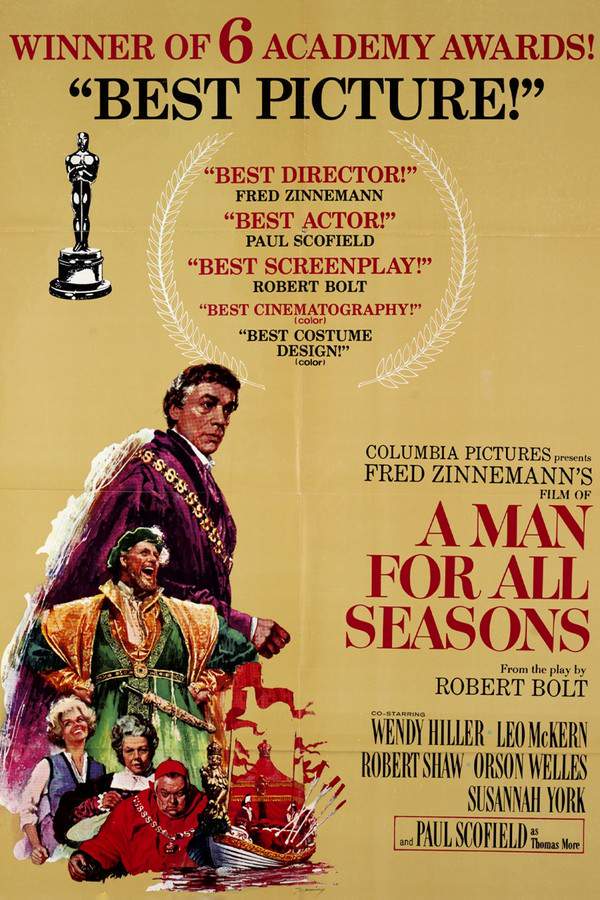
A Man for All Seasons (1966) movie poster

Timeline

A Man for All Seasons (1966) Timeline Explained – Every Event in Order

Release, runtime and language
1966 · 120 min · English
Directed by
Fred Zinnemann
Starring
Orson Welles, Colin Blakely, John Hurt, Leo McKern, Paul Scofield, Wendy Hiller

During the reign of King Henry VIII, the steadfast Sir Thomas More finds himself at odds with the ambitious monarch who seeks to annul his marriage. More's deep religious convictions lead him to defy the King's demands, triggering a tense conflict that challenges the foundations of the royal court. Faced with immense pressure to compromise his beliefs, More must choose between personal safety and his unwavering principles, ultimately risking everything for his conscience.

On this page (6)
  1. 1 Where to watch
  2. 2 Events in order (15)
  3. 3 Timeline questions answered
  4. 4 Movie threads
  5. 5 Movies like A Man for All Seasons
  6. 6 Every angle

Where to watch

Where to Watch A Man for All Seasons (1966)

Where can you watch A Man for All Seasons? Stream, rent or buy it in the US, including on YouTube Free, Amazon Video and Apple TV Store: current JustWatch availability with up-to-date prices.

Streaming availability powered by JustWatch

15 events in order · contains spoilers

A Man for All Seasons Timeline: Events in Chronological Order

Every key event of A Man for All Seasons (1966) in order, scene by scene, with when and where it takes place. Use it to untangle flashbacks, time jumps and parallel storylines, to refresh your memory before the sequel or to find the exact scene you are thinking of.

  1. Wolsey Summons More

    Cardinal Wolsey summons Sir Thomas More to his grand palace at Hampton Court, seeking his support in securing a divorce from the Pope for King Henry. Wolsey feels frustrated as More stands as the sole voice of dissent in the Privy Council, insisting that the Pope will never grant the annulment.

    Where
    Hampton Court
  2. More Refuses to Back Wolsey

    During their meeting, Wolsey is taken aback by More's firm refusal to endorse his plan to exert pressure for a divorce. More emphasizes that all legal and religious avenues have been exhausted, indicating there is no basis for the Pope to approve such a request.

    Where
    Hampton Court
  3. Encounter with Richard Rich

    On his way home, More takes a ferry along the River Thames and encounters Richard Rich, an ambitious young man from his past. Rich expresses a desire for a court position, but More warns him about the rampant corruption at Court and advises him to pursue teaching instead.

    Where
    River Thames
  4. More's Dilemma with Meg and Roper

    Upon returning home, More finds his daughter Meg with William Roper, a young Lutheran seeking her hand. More, holding strong to his Catholic beliefs, refuses, stating that until Roper abandons his heretical views, he will not allow the marriage.

    Where
    More's estate
  5. Wolsey's Downfall

    Following his failure to procure a divorce from the Pope, Wolsey is stripped of his power and banished from Court, which leads to his demise. In contrast, King Henry promotes More to the position of Lord Chancellor of England.

    Where
    Court
  6. The King's Visit

    King Henry visits More unexpectedly at his home, arriving on a barge to discuss the divorce. More firmly upholds his beliefs even as Henry veers between threats and promises, resulting in a fierce argument that ends with the King storming off in anger.

    Where
    More's estate
  7. Richard Rich and Thomas Cromwell

    At the riverbank, Rich meets Thomas Cromwell who hints at having information that could ruin More's reputation. Rich, eager for a position at Court, aligns himself with Cromwell, setting the stage for future betrayals.

    Where
    Riverbank
  8. Roper's Revelation

    Roper confronts More, declaring his belief that the King is 'the Devil's minister' for opposing the Catholic Church. More, fearing for Roper's safety, advises caution amidst Rich's continued attempts to gain favor with More.

    Where
    More's estate
  9. More's Resignation

    In a display of quiet defiance, More resigns as Chancellor rather than submit to the King's new demands. He recognizes that discretion has become more crucial than open discourse given the King's declarations of supremacy over the Church.

    Where
    More's estate
  10. The Oath of Supremacy

    More learns of a newly circulated oath regarding King Henry's marriage to Anne Boleyn. Although he initially considers taking it, he ultimately refuses, understanding it contradicts his beliefs about the Pope's role.

    Where
    More's estate
  11. Imprisonment in the Tower

    Following his refusal to take the oath, More is imprisoned in the Tower of London. Despite facing threats and coercion from Cromwell, he steadfastly upholds his principles, enduring harsh conditions for his beliefs.

    Where
    Tower of London
  12. Trial for Treason

    More's trial commences, during which he remains silent, refusing to compromise his principles. Ultimately, he is convicted based solely on the perjured testimony of Richard Rich, who then receives a promotion in reward for his betrayal.

    Where
    Courtroom
  13. More's Final Stand

    Facing imminent execution, More boldly denounces the King's overreach, invoking the sanctity of the Papacy and Church immunity from state interference. His courtroom speech stirs chaos among spectators, revealing the tension of the moment.

    Where
    Courtroom
  14. Aftermath of More's Death

    After More's execution, a narrator reflects on the fates of the main characters. More's head is displayed as a warning but is later retrieved by his daughter Margaret, while Cromwell faces execution himself within five years.

    Where
    Traitor's Gate
  15. Rich's Rise to Power

    Despite the turmoil following More's execution, Richard Rich ascends to power, eventually becoming Chancellor of England. He lives on unscathed while other key figures face dire consequences for their roles in the King's court.

Last updated: November 04, 2024 at 00:45

Was this helpful?

Timeline questions answered

A Man for All Seasons Timeline Explained: Your Questions Answered

When does it happen, and why in that order? The questions people ask about the chronology of A Man for All Seasons (1966): time jumps, flashbacks, cause and effect between scenes and the correct order of events, each answered with spoilers.

Q1

Why does Thomas More refuse to support King Henry's divorce?

Thomas More refuses because he believes the Pope has no authority to grant an annulment. All legal and religious avenues have been exhausted, and More sees no valid basis for the Pope to approve such a request. His deep Catholic convictions prevent him from endorsing any plan to pressure the Pope into granting a divorce, even when faced with the King's direct demands and the threat of royal displeasure.

Foreshadowing: Earlier in the Privy Council, More stands alone as the sole voice of dissent against Wolsey's plan to pressure the Pope.

  • thomas more
  • king henry
  • divorce
  • pope
  • annulment
  • catholic
Q2

Why does Thomas More resign as Lord Chancellor?

More resigns after King Henry declares himself Supreme Head of the Church in England, forcing Parliament and bishops to abandon their allegiance to the Pope. Recognizing that open resistance would be futile and dangerous, More steps down as Lord Chancellor, choosing discretion over direct confrontation while still refusing to submit to the new religious order.

Foreshadowing: After the King's visit to his home, where More maintains his position despite threats and offers of favor, the conflict escalates toward this resignation.

  • thomas more
  • lord chancellor
  • resignation
  • king henry
  • supreme head
  • church england
Q3

What is the Oath of Supremacy and why does More refuse it?

The Oath of Supremacy was an oath acknowledging King Henry as the supreme head of the Church in England, required for the King's marriage to Anne Boleyn. More initially considers taking it conditionally if it aligns with his conscience, but he realizes the oath means accepting that the King, not the Pope, holds supreme authority over the Church, which directly contradicts his core religious beliefs. He cannot swear to something that denies papal authority.

Foreshadowing: When More learns of the oath from his daughter Meg, his initial contemplation shows he desperately wants to find a way to comply, but his understanding of its implications leads to refusal.

  • oath of supremacy
  • anne boleyn
  • king henry
  • pope
  • thomas more
  • refusal
Q4

Why does Richard Rich testify against Thomas More?

Richard Rich betrays More primarily out of ambition for a position at Court. When More repeatedly denies him a court position and warns him against corruption, Rich becomes resentful. Thomas Cromwell exploits this by suggesting Rich could provide information that would damage More's reputation in exchange for advancement. Rich testifies falsely at More's trial, claiming More made incriminating statements about the oath, perjured testimony that convict him of treason.

Foreshadowing: Earlier at the riverbank, Cromwell hints to Rich that he might have information useful for bringing down More, planting the seed of betrayal.

  • richard rich
  • thomas more
  • betrayal
  • perjury
  • testimony
  • cromwell
  • court position
Q5

Why does Thomas More stay silent during his trial?

More remains silent throughout most of his trial because he believes he has legal rights under English law that should protect him from being forced to incriminate himself. His silence is also a form of principled resistance, refusing to engage with what he sees as an unjust process. He only speaks when convicted, then boldly denounces the King's overreach, invoking biblical authority and the Magna Carta.

Foreshadowing: Earlier, when interrogated by Cromwell at Hampton Court, More cites his rights under English law and refuses to respond, establishing his legal strategy.

  • thomas more
  • trial
  • silence
  • treason
  • english law
  • rights
Q6

Why is Thomas More executed for treason?

More is executed for treason based solely on the perjured testimony of Richard Rich, who claims More made incriminating statements about the Oath of Supremacy. No other evidence exists. The King and Cromwell use Rich's false testimony to condemn a man who has been a loyal servant but refuses to compromise his religious principles. More's execution demonstrates the King's willingness to eliminate those who defy his authority over the Church.

Foreshadowing: Rich's earlier alignment with Cromwell and his repeated attempts to get information on More foreshadow his role as the key witness against him.

  • thomas more
  • execution
  • treason
  • richard rich
  • perjury
  • king henry
Q7

What happens to Thomas More's head after his execution?

After execution, More's head is displayed on Traitor's Gate for a month as a warning to others. His daughter Margaret (Meg) eventually retrieves it and keeps it until her death. This detail emphasizes the personal tragedy beneath the political conflict, the King's victory is hollow, while More's family preserves his memory and legacy.

  • more's head
  • traitor's gate
  • margaret
  • daughter
  • display
  • burial
Q8

How does Thomas Cromwell manipulate Richard Rich into betraying More?

Cromwell approaches Rich at the riverbank and slyly suggests that Rich might have information useful for tarnishing More's reputation. Knowing Rich's ambition for a Court position, Cromwell implies that providing such information could earn him favor. Rich, desperate for advancement after More repeatedly denies him employment, takes the bait and aligns himself with Cromwell, eventually providing the false testimony needed to convict More.

Foreshadowing: This riverbank meeting directly leads to Rich's later accusations against More at trial.

  • thomas cromwell
  • richard rich
  • manipulation
  • betrayal
  • corruption
  • court
Q9

Why does King Henry VIII want a divorce so badly?

King Henry wants a divorce (annulment) from Catherine of Aragon because she has not provided him with a male heir, and he desperately needs one to secure the Tudor succession. Additionally, he has fallen in love with Anne Boleyn, who refuses to become his mistress. When the Pope refuses to grant the annulment due to Catherine being his deceased brother's widow, Henry breaks with Rome entirely and creates the Church of England.

  • king henry
  • divorce
  • catherine of aragon
  • anne boleyn
  • male heir
  • pope
Q10

Why does Cardinal Wolsey fail and what happens to him?

Wolsey fails because he cannot convince the Pope to grant King Henry an annulment from Catherine of Aragon. Despite his attempts to exert pressure on the Vatican, the Pope refuses, there is no valid religious basis for the divorce. Stripped of his power and banished from Court for this failure, Wolsey dies in disgrace. His downfall clears the way for More's rise as Lord Chancellor, and ultimately demonstrates the dangerous consequences of failing to serve the King's ambitions.

Foreshadowing: Wolsey's dismissal sets the stage for More's appointment and the subsequent conflict.

  • cardinal wolsey
  • failure
  • annulment
  • pope
  • banishment
  • death
Q11

What role does conscience play in Thomas More's decisions?

More's conscience is the driving force behind all his key decisions. He believes that even the King is subject to a higher moral law, divine law as interpreted by the Catholic Church and the Pope. He cannot simply say what the King wants because doing so would violate his deeply held beliefs. His famous 'conscience' argument is that every person must answer to a higher authority, and he would rather die than compromise what he believes is right, even when silence would save his life.

  • conscience
  • moral law
  • divine law
  • thomas more
  • principles
  • belief
Q12

What happens to Thomas Cromwell after More's execution?

Thomas Cromwell, who orchestrates More's downfall and becomes Lord Chancellor, himself faces execution for high treason within five years of More's death. His rise and fall demonstrate the brutal nature of Henry's court, those who serve the King's ruthless purposes are themselves vulnerable when they fall out of favor. Cromwell's fate serves as ironic justice for his role in More's martyrdom.

  • thomas cromwell
  • execution
  • treason
  • lord chancellor
  • downfall

Movie threads

More Movies Like A Man for All Seasons, by Mood & Story

Curated lists built around what makes A Man for All Seasons tick: the same mood, the same kind of story or the same emotional payoff. Each list explains why these movies belong together.

Movies about conscience versus power like A Man for All Seasons

Stories of individuals whose unwavering integrity brings them into direct conflict with authority. If you admired the moral fortitude in A Man for All Seasons, explore these movies like it. This collection features similar historical dramas and intense character studies where individuals risk everything for their principles against corrupt systems and political pressure.

  • moral conflict
  • tense
  • defiant
  • tragic
  • stoic
  • oppressive
  • Tone: tense, bleak, defiant
  • Pacing: steady, deliberate
Why these movies?

The story pattern: The narrative pattern follows a person of conviction who is pressured by a corrupt or authoritarian system to betray their beliefs. The conflict escalates through dialogue and psychological tension rather than action, often culminating in a tragic outcome that highlights the cost of integrity.

Why they belong together: These films are grouped by their shared focus on a singular, high-stakes moral dilemma. They create a tense, oppressive atmosphere and feature a stoic protagonist whose journey is a testament to the power and pain of living by one's conscience.

Claustrophobic political dramas with tense dialogue like A Man for All Seasons

Tense stories where dialogue and manipulation create a suffocating atmosphere of intrigue. For viewers who appreciated the tense dialogue and political pressure in A Man for All Seasons, this section lists similar movies. Discover other claustrophobic dramas about betrayal and integrity within powerful, restrictive systems like royal courts and legal trials.

  • tense
  • oppressive
  • political intrigue
  • betrayal
  • psychological
  • claustrophobic
  • Tone: tense, oppressive, somber
  • Pacing: steady, slow burn
Why these movies?

The story pattern: These narratives unfold in restricted settings where escape is impossible. The plot is driven by verbal sparring, legal maneuvering, and shifting allegiances, methodically tightening the vise around a protagonist. The journey is less about physical action and more about the psychological erosion and moral fortitude under immense systemic pressure.

Why they belong together: They are united by a specific atmospheric quality: a sense of being trapped in a gilded cage. The similarity comes from the oppressive mood, the steady pacing that builds unease, and the central conflict of an individual being crushed by the machinations of an institution.

If you liked this

Movies Like A Man for All Seasons

Similar movies to A Man for All Seasons: the same genre, themes or kind of story. Each one comes with its own plot summary, timeline and ending explained.

Browse all movie summaries

Every angle

A Man for All Seasons (1966) Explained: Plot, Timeline & Characters

Everything about A Man for All Seasons in one place: what happens in the plot summary, the timeline in chronological order, the characters and meaning and a spoiler-free summary. What's After the Movie adds the cast, box office and post-credit scenes.

Coming soon on iOS and Android

The Plot Explained Movie Summary App

Plot summaries, endings explained and timelines on your phone. Catch up on any movie in minutes, save your favorites and never miss a twist again.

Be the first to know when we launch. Your email stays private, always.

Learn more about the app