Plot Explained Spoilers guaranteed!
Plot Explained

Browse by genre

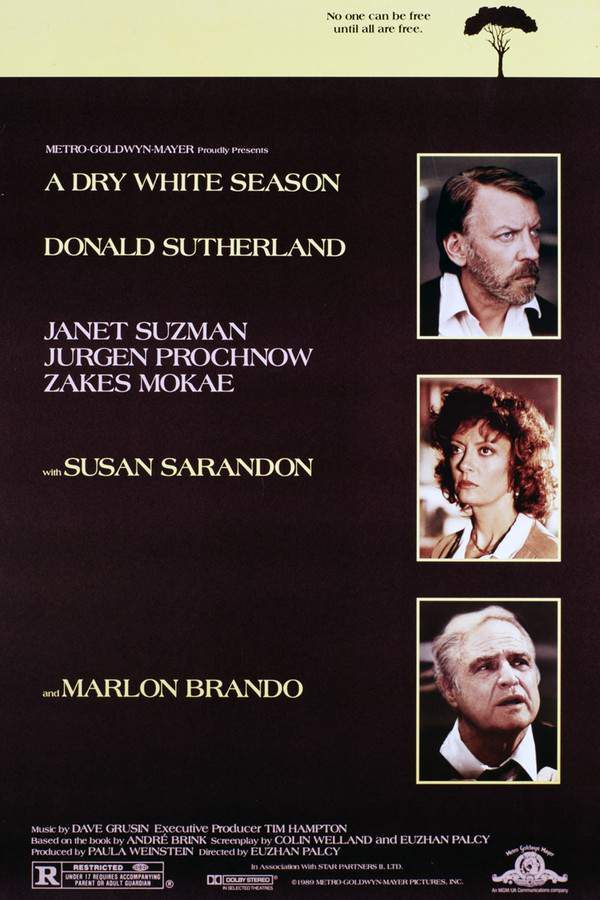
A Dry White Season (1989) movie poster

Plot Summary

A Dry White Season (1989) Plot Summary Explained

Release, runtime and language
1989 · 97 min · English
Loading streaming availability…
Directed by
Euzhan Palcy
Starring
Donald Sutherland, Janet Suzman, Zakes Mokae

During apartheid in South Africa, a teacher named Ben du Toit is deeply affected by the death of a young boy. Driven to seek justice, he teams up with a lawyer to confront the oppressive regime and expose corruption. This journey of activism forces du Toit to examine his own values and beliefs, leading to a profound personal transformation and challenging his closest relationships.

On this page (6)
  1. 1 Where to watch
  2. 2 What happens: full plot
  3. 3 Plot questions answered
  4. 4 Movie threads
  5. 5 Movies like A Dry White Season
  6. 6 Every angle
Loading streaming availability…

Full plot summary · contains spoilers

What Happens in A Dry White Season: Full Plot Summary

The whole story of A Dry White Season (1989) explained, from the opening scene to the final frame: every key event, every twist and what it all adds up to. Read it as a quick recap before the sequel, to check a scene you missed, or to finally understand what really happened.

In 1976, amid the tumult of apartheid in South Africa, Ben Du Toit (Donald Sutherland), a school teacher at a whites-only institution, finds himself entangled in a harrowing incident. The son of his gardener, Gordon Ngubene (portrayed by Winston Ntshona), faces brutal police violence while participating in a peaceful protest advocating for improved educational rights for black South Africans. When Gordon seeks Ben's assistance, he is met with hesitation; Ben places his trust in the authorities. Tragically, this decision backfires, leading to Gordon's arrest and subsequent torture at the hands of Captain Stolz (Jürgen Prochnow).

Despite the protests of his wife, Susan (Janet Suzman), and their daughter, Suzette (Susannah Harker), Ben is compelled to investigate the mystery surrounding his gardener's disappearance. His quest reveals the chilling reality of Gordon and his son's murders, a discovery that ignites Ben's resolve to take action. With Ian McKenzie (Marlon Brando) as his attorney, he attempts to bring the injustices to light in court, only to face defeat. Undeterred, Ben forms alliances with members of the black community, including his driver Stanley Makhaya (Zakes Mokae), in a grassroots effort to inspire social change.

As tensions rise, the police become aware of Ben's actions, leading to the detention of several key individuals involved in their campaign. To support a civil suit, Ben gathers affidavits and discreetly stores them in his home. He confides in his son about his plans, and the two siblings become privy to the location of the hidden evidence. However, their efforts are thwarted when the police conduct a search, resulting in a dangerous explosion triggered by a betrayal from Suzette.

Amidst escalating violence, Emily, Gordon's wife, is tragically killed after she resists eviction from her home, leading to the disintegration of Ben's family as Susan and Suzette leave him. In a desperate attempt to protect the incriminating documents, Ben meets his daughter at a restaurant, where he hands her what she believes to be the crucial papers, only for him to secretly substitute them with a book on art.

In a heart-wrenching climax, Ben's fight for justice costs him dearly. He ultimately meets a grim fate at the hands of Captain Stolz, who is later avenged by Stanley's desperate act of violence. The story highlights the extreme struggles against systemic oppression, the sacrifice for truth, and the devastating personal toll such battles can extract.

Last updated: November 15, 2024 at 20:43

Was this helpful?

Plot questions answered

A Dry White Season Plot Explained: Your Questions Answered

The questions people ask most about A Dry White Season (1989): what happens in the confusing scenes, why the characters do what they do, the twists, hidden details and what the ending means. Each answer contains spoilers.

Q1

Why did Ben hesitate to help Gordon when he approached him for assistance?

Ben hesitated because he mistakenly trusted the authorities to handle the situation fairly. As a white South African living in privilege, he believed the system would rectify the injustice. This hesitation proved catastrophic, Gordon was arrested and subsequently tortured by Captain Stolz, and both Gordon and his son were later murdered. Ben's initial passivity represents the complicity of white South Africans during apartheid.

Foreshadowing: Early scenes show Ben living comfortably in his whites-only neighborhood, detached from the struggles of the black community around him.

  • ben du toit
  • gordon ngubene
  • hesitation
  • police arrest
  • apartheid
Q2

What motivated Ben to investigate Gordon's disappearance despite the risks?

Ben was compelled by guilt after his initial hesitation led to Gordon's arrest, combined with his wife Susan's protests and the growing evidence of the brutal truth. Once he discovered that both Gordon and his son had been murdered, this revelation ignited a moral awakening that drove him to seek justice, despite knowing the danger it would bring to his family.

Foreshadowing: Susan explicitly warns Ben that getting involved will put their family in danger, foreshadowing the tragic consequences to come.

  • ben du toit
  • investigation
  • gordon ngubene
  • murder
  • guilt
Q3

Why did Ben and Ian McKenzie lose their court case against the apartheid regime?

Ben and Ian McKenzie faced defeat because the South African legal system at the time was fundamentally complicit in upholding apartheid. Despite presenting evidence of the murders and torture, the court ruled against them, demonstrating how the judiciary was not an impartial body but part of the oppressive systemic structure. This loss convinced Ben that legal avenues alone could not bring justice.

Foreshadowing: The timeline establishes early on that the courtroom battle would be an uphill struggle against systemic racism.

  • ian mckenzie
  • court case
  • apartheid
  • legal defeat
  • justice
Q4

What were the affidavits Ben collected and why were they critical to his cause?

The affidavits were sworn statements from black South Africans documenting the injustices they suffered under apartheid, including arbitrary arrests, torture, and murder. Ben gathered these documents to support a civil suit against the regime. They represented concrete evidence of state-sponsored violence and were crucial because they could potentially expose the systematic brutality to the international community and implicate the authorities.

Foreshadowing: The timeline notes Ben gathering evidence as a pivotal moment that increased his personal risk significantly.

  • affidavits
  • evidence
  • civil suit
  • documents
  • resistance
Q5

Why did Suzette betray her father by revealing the location of the hidden documents?

Suzette betrayed her father because she was coerced by the police or feared for her own safety and that of her family. The timeline indicates her betrayal led to a police search that triggered a dangerous explosion. Her betrayal represents the terrible toll apartheid took on family relationships, forcing children into impossible positions against their own parents. The pressure and intimidation from state security forces proved overwhelming for her.

Foreshadowing: Earlier tension shows Susan and Suzette struggling to cope with the threats and dangers that have invaded their previously comfortable lives.

  • suzette
  • betrayal
  • police search
  • explosion
  • family
Q6

What happened when Ben met Suzette at the restaurant and gave her the documents?

At the restaurant, Ben handed Suzette what appeared to be the crucial affidavits, but secretly substituted them with a book on art. This clever deception was Ben's attempt to protect the documents while ensuring his daughter would not be caught carrying incriminating evidence. He likely suspected the police might intercept her, so he preserved the real affidavits while giving Suzette plausible deniability.

Foreshadowing: This scene demonstrates Ben's growing cunning and desperation as his resistance work becomes increasingly dangerous.

  • restaurant
  • documents
  • art book
  • deception
  • ben suzette
Q7

Why did Ben's wife Susan and daughter Suzette leave him?

Susan and Suzette left Ben because the constant threats, police surveillance, and dangerous presence in their home became unbearable. The escalating violence and fear for their lives, combined with the explosive betrayal and the subsequent dangers, proved too much for them to endure. Their departure represents the personal collateral damage of resistance work and how activism against oppression often comes at the cost of familial bonds.

Foreshadowing: The timeline explicitly notes the family fraying as tension escalates, culminating in their departure.

  • susan
  • suzette
  • family
  • leave
  • apartheid
Q8

Why did Stanley Makhaya kill Captain Stolz after Ben's death?

Stanley killed Captain Stolz as an act of vengeance for Ben's murder and as a response to the broader violence inflicted by the apartheid regime. Stolz had tortured and murdered Gordon and his son, and then killed Ben when he sought justice. Stanley's revenge symbolizes the desperation and fury of the oppressed community, demonstrating that the struggle against systemic oppression sometimes erupted into violent retaliation when all other avenues were closed.

Foreshadowing: Throughout the film, Stanley forms a close bond with Ben through their shared resistance work, making Ben's death a personal loss that drives Stanley to desperate action.

  • stanley makhaya
  • captain stolz
  • revenge
  • murder
  • justice
Q9

What is the significance of Ben's death in the story?

Ben's death at the hands of Captain Stolz represents the ultimate price paid by those who dare to challenge oppressive systems. His murder highlights the brutal reality that speaking truth to power in apartheid South Africa was often fatal. However, his sacrifice also demonstrates the transformation of a privileged white South African who ultimately chose moral courage over comfortable complicity, leaving a legacy that inspired others like Stanley to continue fighting.

Foreshadowing: The film consistently escalates the dangers Ben faces, building toward this fatal confrontation as an inevitable consequence of his activism.

  • ben du toit
  • death
  • captain stolz
  • sacrifice
  • oppression
Q10

Why was Emily's death a turning point in the story?

Emily's murder, killed by police after resisting eviction from her home, served as a catalyst that deepened Ben's commitment to the resistance. Her death represented the relentless brutality of the apartheid regime against even the most vulnerable members of the black community. Witnessing yet another senseless killing, this time of Gordon's widow, further convinced Ben that the system could not be reformed and that incremental change was impossible.

Foreshadowing: Emily's death follows the pattern of escalating violence that intensifies throughout the narrative.

  • emily
  • eviction
  • murder
  • police
  • turning point
Q11

What does Ben's journey from teacher to activist represent thematically?

Ben's transformation represents the awakening of white South Africans to the moral imperative of confronting systemic injustice. His journey from a comfortable, somewhat oblivious teacher to a man willing to risk everything for justice mirrors the broader historical reckoning that would eventually end apartheid. The film suggests that meaningful change required white citizens to move beyond passive acceptance of the status quo and actively resist the oppressive systems around them.

Foreshadowing: The opening scenes establish Ben's comfortable life and privilege, setting up his eventual transformation.

  • transformation
  • activism
  • awakening
  • values
  • white south african
Q12

What does the film's bleak ending suggest about the fight against apartheid?

The ending suggests that the fight against systemic oppression required immense sacrifice, often without immediate results. Ben is murdered and the system remains largely unchallenged, yet his actions inspired others like Stanley to continue the struggle. The film conveys that resistance, even when it appears to fail, plants seeds for future change. Stolz's death at Stanley's hands shows that the oppressed would not accept injustice passively, even if formal legal avenues were closed.

Foreshadowing: The entire narrative builds toward this confrontation, showing how each death and sacrifice compounds the urgency of resistance.

  • ending
  • apartheid
  • sacrifice
  • resistance
  • system

Movie threads

More Movies Like A Dry White Season, by Mood & Story

Curated lists built around what makes A Dry White Season tick: the same mood, the same kind of story or the same emotional payoff. Each list explains why these movies belong together.

Political Awakening Dramas like A Dry White Season

Ordinary individuals risk everything to expose systemic injustice and corruption. If you were moved by the powerful journey in A Dry White Season, explore more movies like it. This collection features similar stories of ordinary people who, after a moral shock, risk everything to challenge brutal regimes and fight for justice, often with tragic consequences.

  • urgent
  • somber
  • determined
  • harrowing
  • grim
  • anxious
  • Tone: dark, somber, urgent
  • Pacing: steady, methodical
Why these movies?

The story pattern: The narrative follows a linear but impactful path: an initial, often personal, tragedy shatters a character's insulated worldview. This sparks a slow-burn investigation or legal battle that reveals the depth of systemic corruption. The protagonist's resolve hardens as they face escalating threats, leading to a climax that underscores the immense sacrifice required for defiance.

Why they belong together: These movies are grouped by their shared focus on a singular, transformative character arc from complacency to activism. They share a dark, grim tone, a steady pacing that builds urgency, and a heavy emotional weight derived from confronting state-sanctioned violence and moral compromise.

Harrowing Social Thrillers with the vibe of A Dry White Season

Tense, politically-charged dramas where the search for truth leads to ruin. For viewers seeking the grim, tense atmosphere of A Dry White Season, this list features similar harrowing thrillers. These movies combine a steady, suspenseful plot with heavy themes of corruption and violence, delivering a powerful and emotionally taxing viewing experience.

  • tense
  • harrowing
  • grim
  • oppressive
  • anxious
  • somber
  • Tone: dark, tense, bleak
  • Pacing: steady build, suspenseful
Why these movies?

The story pattern: Stories in this thread typically unfold as a procedural investigation into a crime or cover-up that exposes a wide-reaching corrupt system. The plot builds tension steadily, with each discovery increasing the protagonist's peril. The conflict is less about physical action and more about the psychological and moral strain of confronting an unbeatable foe, often culminating in a bleak resolution that highlights the cost of resistance.

Why they belong together: These films are united by their specific mix of a thriller's narrative drive with the sobering gravity of a drama. They share a high intensity, a dark and oppressive mood, a steady pacing that methodically increases dread, and a bleak ending feel that leaves a lasting impact.

If you liked this

Movies Like A Dry White Season

Similar movies to A Dry White Season: the same genre, themes or kind of story. Each one comes with its own plot summary, timeline and ending explained.

Browse all movie summaries

Every angle

A Dry White Season (1989) Explained: Plot, Timeline & Characters

Everything about A Dry White Season in one place: what happens in the plot summary, the timeline in chronological order, the characters and meaning and a spoiler-free summary. What's After the Movie adds the cast, box office and post-credit scenes.

Coming soon on iOS and Android

The Plot Explained Movie Summary App

Plot summaries, endings explained and timelines on your phone. Catch up on any movie in minutes, save your favorites and never miss a twist again.

Be the first to know when we launch. Your email stays private, always.

Learn more about the app