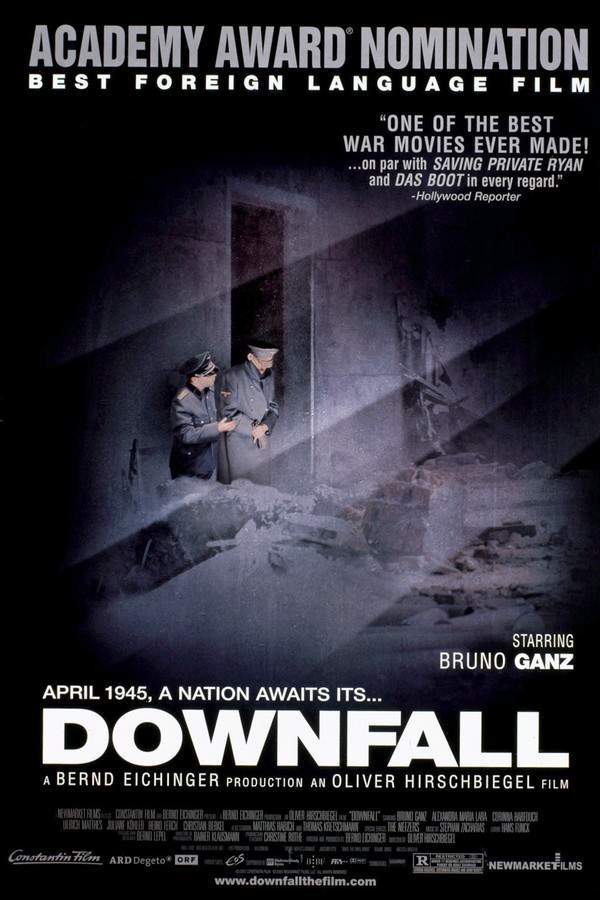
In November 1942, Adolf Hitler interviews a group of young women for the position of personal secretary and ultimately selects Traudl Junge, Alexandra Maria Lara. The film then pivots from the early accession of a trusted aide to the grim, final days of a crumbling regime, tracing the echoing fear, the tangled loyalties, and the rigid routines that persist even as the war closes in on Berlin.
By 20 April 1945, Hitler’s birthday, the city is pounded by the Red Army as artillery shells streak through the sky, signaling the start of the Battle of Berlin. Inside the bunker, the power dynamics tighten: Reichsführer-SS Heinrich Himmler, unable to persuade Hitler to flee, slips away to secretly negotiate with the Allies. His counterpart, SS-Gruppenführer Hermann Fegelein, who is Eva Braun’s brother-in-law, also fails to move the dictator from the capital. In a parallel bid to safeguard civilians, SS doctor Ernst-Günther Schenck remains behind, stubbornly staying to tend to the people despite the collapsing situation. The tension inside the bunker sharpens as a father, whose son Peter Kranz fights on the front, pleads for desertion, but Peter’s resolve only hardens in the face of wartime indoctrination.
In a telling meeting inside the Führerbunker, Hitler forbids any retreat by the overwhelmed 9th Army and orders counter-attacks by units under Obergruppenführer Felix Steiner and Lieutenant General Walther Wenck’s 12th Army. The dictator himself steps outside the confines of the bunker to recognize a young tank destroyer, Peter, praising him as braver than his generals. The conversation then shifts to the arming of the nation’s dwindling resources; Hitler debates Albert Speer about a scorched-earth policy. Speer argues against destroying the country’s infrastructure, yet Hitler insists the German people have earned their fate and deserve death. Meanwhile, Eva Braun hosts a party in the Reich Chancellery, a scene interrupted by shelling, and she remains firm in her decision not to flee Berlin with Fegelein.
As the pressure mounts, General Weidling learns that a death sentence awaits him for allegedly relocating his command post, prompting him to present himself in the Führerbunker to clear his name. Hitler is visibly moved by Weidling’s sense of duty and promotes him to commander of Berlin’s defense. When Hitler discovers that Steiner’s weakened forces did not mount the anticipated counter-attack, a rare public rage erupts; he denounces his generals in a blistering tirade and, for the first time, acknowledges that the war is lost. He declares his intent to commit suicide rather than surrender or abandon Berlin.
Within the political maelstrom, Goebbels pleads for fewer inexperienced soldiers to be thrown into combat, but the propaganda minister dismisses the notion, asserting that the German people, having proven weaker than their enemies, deserve their fate. A tense communication arrives from Reichsmarschall Hermann Göring, who asks for a leadership role in Hitler’s stead; Hitler responds by ordering Göring’s arrest for treason. Speer returns to the bunker for a final visit and admits that he defied the scorched-earth order. Overcome by a sense of betrayal, Hitler dismisses Speer, choosing not to punish him but to sever ties.
News reaches the Führerbunker that Himmler has engaged in secret negotiations with the Allies, and Hitler orders the execution of Fegelein when the desertion plans become clear. The SS physician Grawitz refuses to leave Berlin and, fearing an Allied reprisal, takes his own life along with his family with hand grenades. Hitler learns of Fegelein’s attempted desertion and authorizes his execution despite Eva’s pleas.
As the city’s plight worsens, Hitler pinpoints a glimmer of hope in Wenck’s 12th Army, even as he knows the odds are slipping away. He dictates his last will and testament to Traudl Junge before a formal marriage to Eva Braun in the early hours of the morning. The moment is shadowed by the realization that the city cannot be saved, and Hitler tests poison on his dog Blondi as a grim prelude to what follows. After farewell exchanges with his inner circle and a resolute refusal to escape, he and Eva commit suicide, their bodies subsequently cremated in the Chancellery garden.
In the aftermath, General Hans Krebs fails to negotiate a ceasefire with Red Army Colonel General Vasily Chuikov, who remains steadfast on unconditional surrender. Magda Goebbels, wife of Goebbels, poisons their six children with cyanide, sealing a grim family tragedy. Krebs and Wilhelm Burgdorf take their own lives as the bunker braces for a surrender. Peter Kranz, the only surviving member of his unit, learns that his parents were executed, while the Goebbels family also perishes. The remaining occupants of the bunker attempt to break out, but only Traudl Junge and Peter manage to escape together. Walther Hewel, a diplomat aligned with the regime, commits suicide despite pleas from Schenk to live.
The film closes with documentary footage featuring an elderly Traudl Junge confessing that youthful ignorance should not have justified involvement in the Nazi regime. The final images linger on the cost of loyalty, the consequences of blind obedience, and the quiet, human toll of a history that, even in its darkest hour, demanded a reckoning.