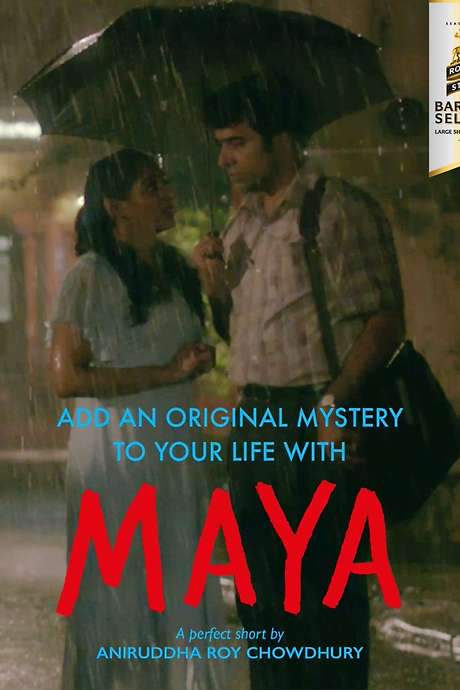
Ashok, played by Abir Chatterjee, is a screenwriter who has just steered a critically acclaimed short film named Anba into the world with quiet confidence. Now he dreams of a feature-length project, but a stubborn lack of a solid script gnaws at him, threatening to turn his ambitions into a stalled dream. The spark that finally flickers to life comes not from a plot outline, but from a moment of intimate honesty: he spots his wife Maya in a tender, loving light, and this glimpse of domestic warmth plants the seed for a potential love story that could anchor his next work.
What follows is a journey through a maze of imagined possibilities, each one more ambitious than the last. Ashok envisions a college-set love story where the two leads are far from ordinary. Maya becomes a bold, almost mythic presence—a boxer-like heroine with strength and will—and Ashok casts himself as a sensitive, emotionally fragile student in her orbit. The imagined drama widens into a social-activist arc in which Maya fights for justice while Ashok, distracted by his own insecurities, struggles to keep pace with her intensity. The narrative expands and mutates as Ashok tests different tones and turns of fate, chasing a compelling hook that could translate into box-office appeal while staying true to a sense of truth about love and loss.
Yet the creative process takes another turn as Ashok reshapes his characters to fit a different stage. He reimagines the female lead as coming from a wealthy, strict family that adheres to routines and expectations, insisting that everything be done on time, leaving little room for experimentation in the kitchen of life. The male lead becomes an insomniac, aware of his own restlessness and limited by it. One night, the couple is locked inside the kitchen, and the emotional rawness of their confinement brings them to share every feeling they’ve kept at bay. But exhaustion and pressure take a heavy toll—the man suffers a cardiac arrest and dies, and the myth of insomnia’s cure as eternal sleep begins to tease the edges of his mind. In this moment, an inner voice debates the shape of the story with Ashok: while the inner voice hints at tragedy, Ashok challenges the notion with a counterpoint, asking, “this isn’t what real life is, what has ever ended well?”
This inner dialogue threads through the film as Ashok confronts the gaze of reality versus the lure of art. He looks back at the poster for Anba, a reminder of how life’s messy truth can be packaged for the screen. Critics hailed Anba as the “commercial-fantasy movie of the year,” a label that both acknowledges its broad appeal and invites scrutiny about how realism and spectacle coexist in cinema. The inner voice defends the film’s realism, arguing that there is something honest and resonant in telling life as it truly unfolds, even when the world around it is entertaining and enlarged.
With these tensions in mind, Ashok pivots again, drawn toward a different vein of storytelling. He longs to write about a real-life struggle—a writer alone against the odds, someone who has no one to lean on, a character whose loneliness mirrors his own. The solitude becomes a catalyst, and he conjures an imaginary wife as a source of inspiration—an invented partner who could accompany every new tale he tries to tell. This imaginative device works as a creative muse, infusing his pages with life and momentum. The process feels liberating, and gradually he channels his energy into a fresh screenplay that centers on a woman named Maya, weaving together the personal and the fictional in a way that feels both intimate and expansive.
In the end, the film leaves Ashok on the cusp of a renewed artistic path. The journey from a riven attempt at a “commercial” love story to a contemplative, almost meta-textual exploration of how stories are built culminates in a project that seems both deeply personal and universally relatable. The imaginary wife who sparked his imagination morphs into a guiding force behind a new script, and the name Maya becomes more than a character in a script—it becomes a symbol of aspiration, heartbreak, resilience, and the endless search for meaning in both life and art.