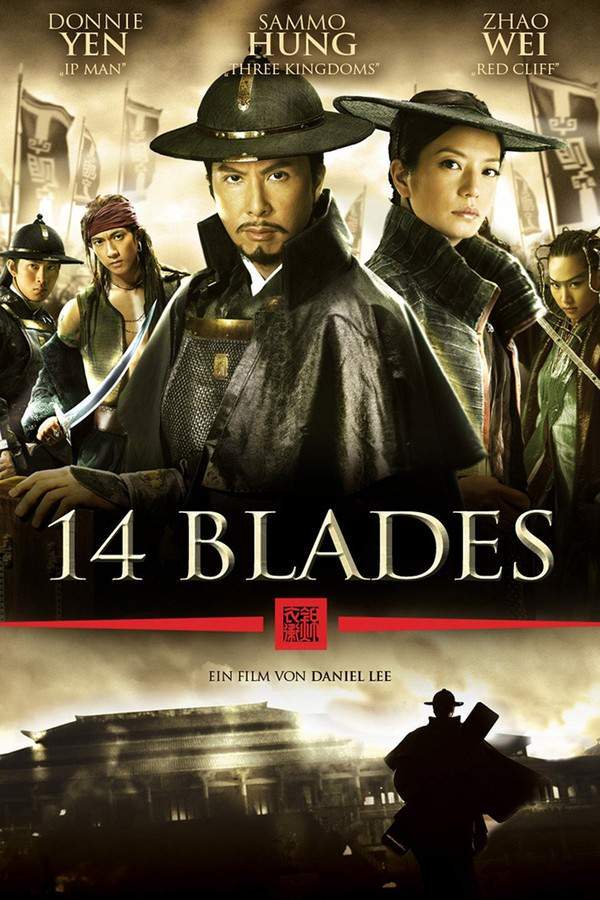
In ancient China, Qinglong, a highly trained warrior, discovers a dangerous conspiracy within the Imperial Court. After being betrayed by those he trusted, he finds himself hunted and must use his skills to confront corrupt officials and powerful enemies. His mission is to rescue the Emperor and restore justice to the land, facing perilous challenges and uncovering a deadly legacy of stealth and strength along the way.
Find where to stream, rent, or buy 14 Blades (2014) in the US with current JustWatch availability, up-to-date pricing, and platform listings for subscription, rental, and digital purchase options.
Warning: spoilers below!
Haven’t seen 14 Blades yet? This summary contains major spoilers. Bookmark the page, watch the movie, and come back for the full breakdown. If you're ready, scroll on and relive the story!
Trace every key event in 14 Blades (2014) with our detailed, chronological timeline. Perfect for unpacking nonlinear stories, spotting hidden connections, and understanding how each scene builds toward the film’s climax. Whether you're revisiting or decoding for the first time, this timeline gives you the full picture.
Last updated: November 09, 2024 at 11:27
Find frequently asked questions about the 14 Blades (2014) timeline, including chronological order, nonlinear jumps, cause-and-effect links, and scene sequence clarifications. This timeline FAQ helps explain when key events happen, how moments connect, and why the story unfolds in that specific order.
Jia Jingzhong manipulated Qinglong by claiming the box contained evidence of councillor Zhao Shenyang's treason. In reality, the box held the Imperial Seal, which was essential for legitimizing Prince Qing's claim to the throne. This deception forced Qinglong into becoming an unwitting participant in the conspiracy to overthrow the emperor.
Earlier scenes establish Jia's position as a trusted eunuch close to the emperor, making his betrayal more impactful.
Xuanwu, Qinglong's brother-in-arms, allied himself with Jia Jingzhong and the conspirators. After Jia's downfall, Xuanwu killed him and aspired to serve under the ambitious Prince Qing instead. His betrayal was motivated by ambition and the promise of power within the new regime.
Qinglong needed safe passage out of the city to reach Yanmen Pass and gather intelligence on his enemies. When the owner refused to help further, Qinglong took his daughter Qiao Hua hostage to ensure his compliance with the journey. This desperate action reflected his worsening situation as a fugitive hunted by the jinyiwei.
The owner initially offered help after Qinglong's fee, showing his growing concern for safety.
The mechanical box is Qinglong's signature weapon, a specialized device containing 14 concealed blades designed for lethal combat. As a commanding officer of the jinyiwei, he used this deadly weapon in his perilous missions for the imperial government. The box represents his elite status and lethal skills within the secret police force.
Tuo-Tuo, Prince Qing's adoptive daughter, kidnapped Qiao Hua to use her as leverage in obtaining the Imperial Seal. With the seal, Prince Qing could legitimize his claim to power and complete the coup. This kidnapping created a tense standoff with Qinglong, who was caught between his duty and his growing connection to Qiao Hua.
Qinglong chose to relinquish the seal to Tuo-Tuo to secure Qiao Hua's release, showing his conflicted loyalties. However, he insisted on returning Qiao Hua to her fiancé before handing over the seal, demonstrating his sense of honor despite being a fugitive. This decision reflected his internal struggle between survival and moral principles.
Qinglong and Tuo-Tuo engaged in an intense battle at an abandoned temple, driven by their conflicting loyalties and personal desires. The confrontation was emotionally charged as both fighters were evenly matched. The duel tragically ended with both Qinglong and Tuo-Tuo dying, symbolizing the devastating cost of the political conflict.
Prince Qing's rebellion collapsed following the defeat at Yanmen Pass and the deaths of his key allies. With his coup doomed and no path to power remaining, Prince Qing chose to end his own life rather than face capture or execution. His suicide marked the final collapse of the conspiracy against the emperor.
After her father died and Qinglong was gone, Qiao Hua inherited the Justice Security Service. She later traveled through the desert holding a bell bracelet that Qinglong had gifted her, hoping to find reminders of him. The film ends with her sighting a figure on the horizon who resembles Qinglong, leaving her future uncertain but hopeful.
Xuanwu murdered Jia Jingzhong after the latter's conspiracy began to unravel. With Jia no longer useful to his ambitions, Xuanwu eliminated him to seize power and position himself as a key supporter of Prince Qing. This act demonstrated the ruthless nature of the conspirators who would betray even their own allies for greater influence.
The Heaven's Eagles Gang, led by the Judge of the Desert, formed a temporary alliance with Qinglong for mutual benefit. Both parties were enemies of the corrupt court, making cooperation strategically advantageous. The gang joined Qinglong's raid on Yanmen Pass, where their combined forces achieved victory, though Xuanwu still managed to escape with the Imperial Seal.
The late Ming dynasty was plagued by rampant corruption that crippled the government, exacerbated by an incompetent emperor who failed to govern effectively. This weakness created a power vacuum that allowed factions like the jinyiwei and ambitious officials like Jia Jingzhong to manipulate court affairs. The corruption ultimately enabled Prince Qing's failed rebellion.
Qinglong discovered that the conspirators planned to sell three provinces to fund Prince Qing's rebellion and claim to the throne. This betrayal of imperial territory revealed the extent of the corruption within the court and motivated Qinglong to stop them. The sale would have enabled the rebels to finance their military campaign against the emperor.
The mutual destruction of Qinglong and Tuo-Tuo resulted from their irreconcilable positions in the conflict. Qinglong served the emperor while Tuo-Tuo supported her adoptive father Prince Qing's coup. Their emotional but deadly duel reflected the tragedy of individuals trapped by larger political forces. Neither would yield, leading to their simultaneous deaths in the abandoned temple.
The bell bracelet was a personal gift from Qinglong to Qiao Hua, symbolizing their connection despite their tumultuous circumstances. Qiao Hua kept the bracelet throughout her journey, using it as a tangible reminder of Qinglong. The bracelet represents hope, memory, and the lingering emotional bond that persists even after his death.
Discover curated groups of movies connected by mood, themes, and story style. Browse collections built around emotion, atmosphere, and narrative focus to easily find films that match what you feel like watching right now.
A highly skilled operative is betrayed and must clear their name against impossible odds.Find more movies like 14 Blades where a skilled agent is betrayed and becomes a fugitive. These action-packed thrillers feature political conspiracies, intense martial arts or combat, and a hero's quest for redemption against powerful enemies.
The narrative follows a highly competent protagonist whose unwavering loyalty is repaid with betrayal, turning them from hunter to hunted. The plot is a fast-paced race against time as they evade their former allies, uncover a deeper conspiracy, and are forced to make new, uneasy alliances. The story often culminates in a bittersweet victory where justice is served, but not without significant personal sacrifice.
Movies in this thread share a core narrative of institutional betrayal and a fugitive's struggle for vindication. They are united by a tense, gritty atmosphere, high-stakes action, and a protagonist grappling with a heavy emotional burden of lost trust and a duty that costs them everything.

Fast-paced action set in ancient courts, filled with political intrigue and deadly machinations.If you liked the political intrigue and ancient China setting of 14 Blades, explore these similar historical action thrillers. Discover films featuring corrupt courts, secret organizations, and heroes fighting to restore order with intense, period-accurate combat.
Stories in this thread unfold within a powerful historical institution—often an imperial court or royal palace—where a conspiracy threatens the state's stability. A protagonist, sometimes an official agent and sometimes an outsider, uncovers the plot and must navigate a web of deceit, where friends can be enemies and truth is a dangerous commodity. The narrative is propelled by raids, chases, and confrontations, leading to a resolution that stabilizes the realm but often leaves emotional scars.
These movies are grouped by their shared setting of a corrupt historical power structure and a central political conspiracy. They deliver a specific vibe combining the visual richness of a period piece with the tense, fast-paced energy of a modern thriller, all grounded in brutal, realistic action.
Don't stop at just watching - explore 14 Blades in full detail. From the complete plot summary and scene-by-scene timeline to character breakdowns, thematic analysis, and a deep dive into the ending - every page helps you truly understand what 14 Blades is all about. Plus, discover what's next after the movie.
Read a complete plot summary of 14 Blades, including all key story points, character arcs, and turning points. This in-depth recap is ideal for understanding the narrative structure or reviewing what happened in the movie.
Discover the characters, locations, and core themes that shape 14 Blades. Get insights into symbolic elements, setting significance, and deeper narrative meaning - ideal for thematic analysis and movie breakdowns.