Plot Explained Spoilers guaranteed!
Plot Explained

Browse by genre

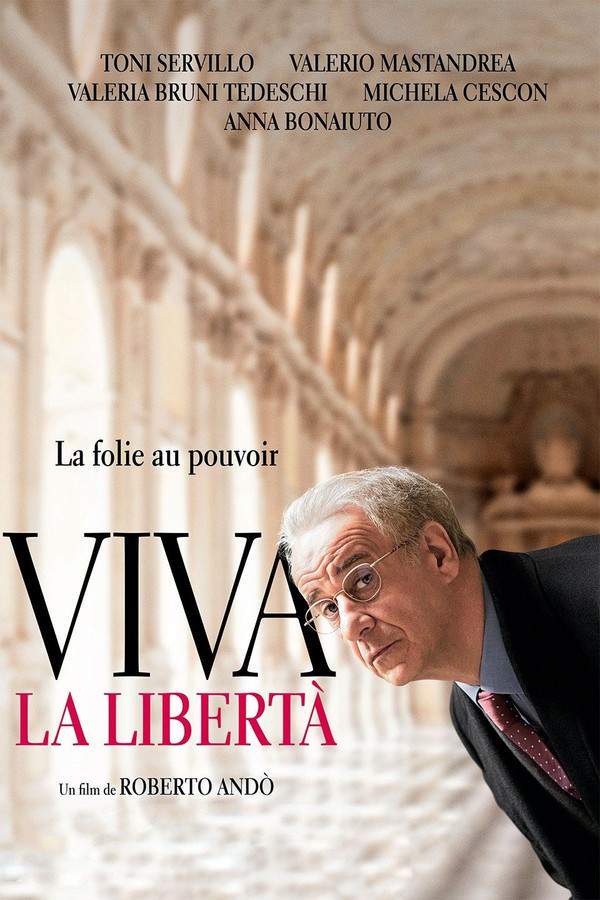
Viva la Libertà (2014) movie poster

Plot Summary

Viva la Libertà (2014) Plot Summary Explained

Release, runtime and language
2014 · 94 min · Italian
JustWatch #33,110
Directed by
Roberto Andò

With Italy's election nearing, the leader of a political party vanishes, throwing his organization into turmoil. To resolve the crisis, his loyal aide devises a risky scheme: replace him with his identical twin brother, a former philosopher recently released from a mental institution. Assuming the role of Enrico, the twin unexpectedly connects with the public, captivating audiences with speeches even more compelling than his brother's. However, the deception threatens to unravel as Giovanni’s actions gain unexpected momentum.

On this page (6)
  1. 1 Where to watch
  2. 2 What happens: full plot
  3. 3 Plot questions answered
  4. 4 Movie threads
  5. 5 Movies like Viva la Libertà
  6. 6 Every angle

Where to watch

Where to Watch Viva la Libertà (2014)

Where can you watch Viva la Libertà? Stream, rent or buy it in the US, including on OVID, Philo and Fawesome: current JustWatch availability with up-to-date prices.

Streaming availability powered by JustWatch

Full plot summary · contains spoilers

What Happens in Viva la Libertà: Full Plot Summary

The whole story of Viva la Libertà (2014) explained, from the opening scene to the final frame: every key event, every twist and what it all adds up to. Read it as a quick recap before the sequel, to check a scene you missed, or to finally understand what really happened.

In this compelling narrative about global politics, Toni Servillo delivers a stunning performance, showcasing his talent by stepping into two distinct roles. First, he captures the essence of Enrico Oliveri, a party leader who reflects the tragic failure of political ideals. Next, he transforms into Giovanni Ernani, Enrico’s unhinged twin brother who seizes control in the wake of Enrico's mysterious disappearance. Each portrayal is rich in complexity, highlighting Servillo's remarkable attention to detail.

As the nation prepares for a national election, Enrico finds himself plummeting in the polls, prompting both allies and opponents to anticipate his inevitable downfall. In an act of desperation, driven by an inability to confront his party's decline, he vanishes into the night. The party officials attempt to manage the crisis by obscuring Enrico's absence with clever maneuvers. Meanwhile, his loyal aide, Andrea Bottini, makes a fateful decision to locate Enrico's look-alike, his estranged twin brother, Giovanni, who has just been released from a psychiatric facility.

As Giovanni gradually immerses himself in Enrico's public life, he begins to mimic his brother’s mannerisms and behaviors with a remarkable yet subtly flawed mastery. Surprisingly, Giovanni's approach surpasses Enrico's political savvy; he possesses an uncanny ability to captivate crowds with bold and inspiring speeches that reflect an innovative spirit. The juxtaposition of Enrico's intellectual failures against Giovanni's audacious rise creates a narrative that questions the underlying motivations of modern political landscapes.

In a poignant exploration of identity and power, the film digs deep into the struggles faced by individuals caught between the public and private spheres. Enrico, the secretary of the main opposition party, grapples with nostalgic memories while battling bouts of depression exacerbated by unflattering opinion polls. Unbeknownst to his wife, Anna, and Bottini, Enrico takes off one night to reconnect with Danielle, a woman from his past who now leads a different life in Paris, married to the renowned Chinese director, Mung, and raising their twelve-year-old daughter, Hélène.

Back in Italy, Anna and Bottini scramble to rectify the unexpected predicament by enlisting Giovanni. Despite their physical similarities, the twins embody two radically different personas. Giovanni assumes Enrico's role, engaging in interviews, giving public speeches, and leading conferences with a revolutionary zeal that shocks opponents and inspires the electorate. He embodies a fresh, creative wave in politics, turning the tide in ways that leave critics and supporters alike in awe.

This mesmerizing tale unfolds as a mysterious duet, intertwining the public lives of two brothers with their personal emotions, both vying for the affection of the same woman. It becomes a strategic game of distance, where the stakes concern the nature of truth and deception within the realm of power. The film raises profound inquiries, inviting viewers to reflect on the driving forces shaping today’s political realities through a rich tapestry of human experiences and ideological divides, ultimately rendering it a provocative thriller that resonates in our contemporary world.
Last updated: May 12, 2025 at 07:04

Was this helpful?

Plot questions answered

Viva la Libertà Plot Explained: Your Questions Answered

The questions people ask most about Viva la Libertà (2014): what happens in the confusing scenes, why the characters do what they do, the twists, hidden details and what the ending means. Each answer contains spoilers.

Q1

Why does Enrico Oliveri disappear during the election?

Enrico vanishes because he is overwhelmed by his political decline and depression. With the national election approaching, he faces plummeting polls and the realization that his political career is ending. Unable to confront this failure, he escapes to Paris to reconnect with Danielle, leaving his party in crisis.

Foreshadowing: Earlier scenes establish Enrico's depressive state through his nostalgia and declining poll numbers, hinting at his inability to cope with failure.

  • enrico oliveri disappearance
  • politician depression
  • election decline
Q2

Why does Andrea Bottini decide to find Enrico's twin brother?

Bottini needs someone who looks exactly like Enrico to conceal his disappearance from the public and media. When Enrico vanishes unexpectedly, Bottini locates Giovanni Ernani, who was recently released from a psychiatric hospital. Despite knowing Giovanni's unstable history, Bottini believes his physical similarity can temporarily solve the crisis.

Foreshadowing: The party officials were already planning maneuvers to obscure Enrico's absence, making the twin substitution a logical escalation.

  • andrea bottini
  • giovanni ernani
  • political cover-up
  • twin substitution
Q3

How does Giovanni manage to impersonate Enrico in public?

Giovanni meticulously studies Enrico's mannerisms, speech patterns, and behavior, mimicking them with remarkable precision. Though his approach is subtly flawed, his physical similarity to Enrico allows him to pass in public settings. He adopts Enrico's role by conducting interviews, delivering speeches, and attending conferences, gradually immersing himself in his brother's political life.

Foreshadowing: The timeline notes that Giovanni begins to embrace Enrico's public persona, meticulously adopting his brother's mannerisms.

  • giovanni impersonation
  • twin deception
  • political mimicry
Q4

Why does Giovanni become more successful than Enrico at politics?

Giovanni possesses an innovative spirit and philosophical background that Enrico lacks. While Enrico represents intellectual failure and political idealism, Giovanni brings bold, inspiring speeches that reflect creative energy. His audacious approach and charisma captivate crowds in ways Enrico never could, quickly outshining his brother's previous political prowess.

Foreshadowing: Giovanni is described as having a sharp intellect and understanding of philosophy that can manipulate public opinion.

  • giovanni political success
  • inspiring speeches
  • charisma
  • political innovation
Q5

What triggers the unraveling of the twin deception?

As Giovanni continues to impersonate Enrico, the party eventually confronts the reality of Enrico's prolonged absence. The final act reveals the chaotic consequences when the truth threatens to surface. The stakes grow higher as the electorate responds to Giovanni's inspiring leadership, making the exposure increasingly dangerous for the party's credibility.

Foreshadowing: The constant threat of exposure creates tension throughout the narrative, with the scheme becoming harder to maintain as Giovanni gains momentum.

  • deception exposed
  • political scandal
  • truth revealed
  • identity crisis
Q6

Why does Enrico travel to Paris during the election?

Enrico travels to Paris to reconnect with Danielle, a woman from his past with whom he had a passionate affair twenty years earlier. This journey represents his search for solace and escape from the pressures of his failing political career. Danielle now lives in Paris, married to Chinese director Mung, raising their twelve-year-old daughter Hélène.

Foreshadowing: The story hints at Enrico's nostalgia and personal struggles that drive him to seek refuge in his past.

  • enrico paris
  • danielle
  • affair
  • escape from politics
Q7

How does Giovanni's philosophical background influence his political approach?

Giovanni's background as a philosopher gives him a different perspective on politics than Enrico. His sharp intellect and understanding of philosophical ideas allow him to craft speeches that resonate deeply with audiences. Rather than relying on traditional political tactics, he brings an innovative, intellectual approach that challenges conventional political discourse.

Foreshadowing: Giovanni is described as possessing a sharp intellect and understanding of philosophy that could manipulate public opinion.

  • giovanni philosopher
  • political philosophy
  • intellectual approach
Q8

Why does Giovanni captivate the public more than Enrico did?

Giovanni's charismatic oratory and fearless approach create a sense of hope among voters that Enrico could never inspire. His revolutionary spirit and bold vision contrast sharply with Enrico's melancholic, failing leadership. While Enrico represents political idealism that has collapsed, Giovanni brings fresh energy that resonates with an electorate seeking change.

Foreshadowing: Giovanni's ability to rally the masses with his eloquent speeches is established early in his impersonation.

  • giovanni charisma
  • public support
  • political hope
  • oratory skills
Q9

What are the consequences of the twin switch for the political party?

The party initially faces crisis when Enrico disappears, but Giovanni's unexpected success turns their fortunes around. His inspiring leadership wins over the electorate and shocks political opponents. However, the party must eventually confront the truth of Enrico's absence, leading to a dramatic reckoning that threatens their entire operation.

Foreshadowing: The stakes concern the nature of truth and deception within political power, with consequences looming over the party's future.

  • political party consequences
  • election outcome
  • party crisis
  • political deception
Q10

What causes Enrico Oliveri's depression?

Enrico's depression stems from his political decline and the realization that his career is ending. As the main opposition party leader facing an upcoming election, he experiences plummeting poll numbers and unflattering public perception. His struggle is compounded by his inability to reconcile his political ideals with the reality of his failing influence.

Foreshadowing: The summary establishes Enrico as a character who grapples with depressive episodes exacerbated by his political circumstances.

  • enrico depression
  • political failure
  • party decline
  • melancholia
Q11

Why does the film have an ambiguous ending?

The ending remains ambiguous because the film prioritizes exploring themes of truth, deception, and identity in politics over providing neat resolution. Both brothers' fates and the political outcome are left open, reflecting the film's view of political reality as complex and uncertain. The 'strategic game of distance' between the brothers and the woman they both love further complicates any definitive conclusion.

Foreshadowing: The narrative presents a 'mysterious duet' between the brothers, suggesting their connection remains unresolved.

  • ambiguous ending
  • film resolution
  • truth deception
  • identity politics

Movie threads

More Movies Like Viva la Libertà, by Mood & Story

Curated lists built around what makes Viva la Libertà tick: the same mood, the same kind of story or the same emotional payoff. Each list explains why these movies belong together.

Movies about political deceptions like Viva la Libertà

Stories where political figures hide behind fabricated personas under public pressure. If you liked the high-stakes twin swap and the tense political deception in Viva la Libertà, you'll find similar stories here. These movies explore themes of identity crisis, public vs. private life, and the fragile nature of power, often featuring unexpected substitutes who must perform a role.

  • tense
  • cerebral
  • unsettling
  • anxious
  • satirical
  • reflective
  • Tone: tense, cerebral, unsettling
  • Pacing: steady, deliberate
Why these movies?

The story pattern: Narratives in this thread typically follow a protagonist, often an unlikely substitute, who must assume a public role under immense pressure. The plot is driven by the escalating risk of the deception unraveling, forcing characters to navigate a web of lies while their true selves conflict with their public persona. The journey often leads to a questioning of identity, ideology, and the very nature of truth.

Why they belong together: These films are grouped together because they share a core premise of political or public deception centered on identity. They create a similar viewing experience of tense, cerebral unease, anchored by themes of duality and the performative nature of power, making them compelling for viewers interested in psychological political dramas.

Satirical political dramas like Viva la Libertà

Biting dramas that expose the absurdity and fragility of political systems. For viewers who enjoyed the satirical edge and thematic exploration of political failure in Viva la Libertà, this collection highlights similar movies. These films blend drama with sharp social commentary, often presenting a melancholic or unsettling look at the collapse of ideologies and the people caught in the middle.

  • satirical
  • melancholic
  • reflective
  • cerebral
  • unsettling
  • anxious
  • Tone: satirical, melancholic, reflective
  • Pacing: steady
Why these movies?

The story pattern: The narrative pattern involves a critical examination of an institution or belief system, typically through the lens of a character's personal crisis or a contained, high-pressure scenario. The plot unfolds to reveal the hypocrisies and inherent flaws of the system, leading to an ambiguous or bittersweet conclusion that questions whether any meaningful change is possible.

Why they belong together: These movies are united by their unique blend of dramatic tension and satirical wit aimed at critiquing societal structures. They share a specific mood mix of anxiety, melancholy, and intellectual reflection, appealing to viewers who appreciate stories that are both emotionally engaging and thought-provokingly critical.

If you liked this

Movies Like Viva la Libertà

Similar movies to Viva la Libertà: the same genre, themes or kind of story. Each one comes with its own plot summary, timeline and ending explained.

Browse all movie summaries

Every angle

Viva la Libertà (2014) Explained: Plot, Timeline & Characters

Everything about Viva la Libertà in one place: what happens in the plot summary, the timeline in chronological order, the characters and meaning and a spoiler-free summary. What's After the Movie adds the cast, box office and post-credit scenes.

Coming soon on iOS and Android

The Plot Explained Movie Summary App

Plot summaries, endings explained and timelines on your phone. Catch up on any movie in minutes, save your favorites and never miss a twist again.

Be the first to know when we launch. Your email stays private, always.

Learn more about the app