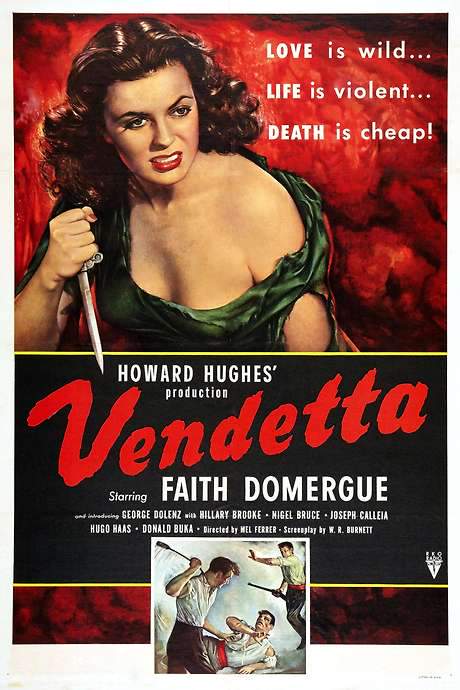
In 1825, the windswept village of Pietranera on Corsica—then under French rule—forms the uneasy backdrop for a story where kinship, passion, and the weight of tradition collide. Colomba della Rabia [Faith Domergue] is a fierce, uncompromising figure who longs for justice after the murder of her father, a vendetta that has long haunted her family. She believes the killers are the Barracini clan, a powerful faction whose grip on the island’s politics and law seems unshakable. Her brother, Orso Antonio della Rabia [George Dolenz], stands in stark contrast: a loyal lieutenant who embodies a calm, principled resolve. He is a man of peace who distrusts the Corsican custom of payback, preferring dialogue, restraint, and a chance for a different path—even as his sister pushes him toward a duty she sees as inevitable.
Orso’s heart is pulled in a new direction by Lydia Nevil [Hillary Brooke], an English aristocrat who has come to the island with her father, Colonel Sir Thomas Nevil [Nigel Bruce]. Lydia embodies refinement and a gentler, more measured approach to life, and she notices in Orso a rare blend of honor and humanity. Her presence complicates Colomba’s plan, since she represents the possibility of a life beyond blood feuds for Orso, one that Lydia fears will be shattered by a storm of revenge. The two women—Lydia’s measured, cosmopolitan sensibility and Colomba’s fiery, Corsican pride—become mirrors for Orso’s inner conflict: can a man truly choose mercy without betraying family loyalty or the memory of a father’s death?
To persuade Orso to honor his duty to the family, Colomba enlists help from an unlikely source: Padrino [Donald Buka], a hardened bandit who has operated on the edges of law for years, and his capable assistant Brando [Hugo Haas]. The trio forms a fragile alliance built on expedience and strategic cunning, with Padrino’s street-smarts and Brando’s sly resourcefulness rounding out Colomba’s unyielding resolve. The plan is twofold: reveal the Barracini guilt in a way that cannot be dismissed and maneuver Orso toward a duel that would, in Colomba’s view, restore the balance of honor. Yet the path is slippery, because what begins as a calculated test of loyalty very quickly strains the bonds between love, duty, and conscience.
As the story unfolds, Orso uncovers that the Barracini family were acquitted at trial not because they were innocent, but because the testimony against them was built on perjury. The stakes rise, and Orso makes a fateful decision: he accepts a duel with Vincente Barracini, seeking a decisive moment to right a broken system and to prove that courage can take the form of restraint as well as confrontation. Colomba’s reaction is a mix of vindication and horror—she sees the duel as a necessary catharsis, while Lydia fears the violence could undo everything she might have with Orso, including a potential betrothal that would bind him to a rowdy, vengeance-tainted horizon.
The appointed meeting place becomes a crucible. Colomba races to warn Orso of an ambush planned by the Barracini brothers, hoping to safeguard him from a trap that could spill more blood. In the tense confrontation that follows, tragedy strikes: Colomba is shot and dies in Orso’s arms, a moment that stuns the island and reshapes the course of every character who lives within this narrative. The Barracini brothers are slain in the ensuing chaos, and Orso is wounded, though his life remains intact—now tempered by grief and a hard-won awareness of the human cost behind cycles of vengeance.
In the quiet aftermath, Padrino offers a stark but compassionate counsel: Orso must draw upon his experience and leadership to guide his people toward something better—an existence that seeks to break the old patterns rather than perpetuate them. The overarching message lands with quiet gravity: even in a culture steeped in retaliation, individual choices can tilt a community away from endless bloodshed toward a future where mercy, responsibility, and reform hold more weight than revenge.
This tale intertwines romance, loyalty, and moral struggle against a stark landscape of honor codes and political authority. It examines how a single decision to refuse vengeance can become a catalyst for a broader reimagining of a people’s future, and it places a spotlight on those moments when love, duty, and humanity collide in a way that can redefine a community’s path.