Plot Explained Spoilers guaranteed!
Plot Explained

Browse by genre

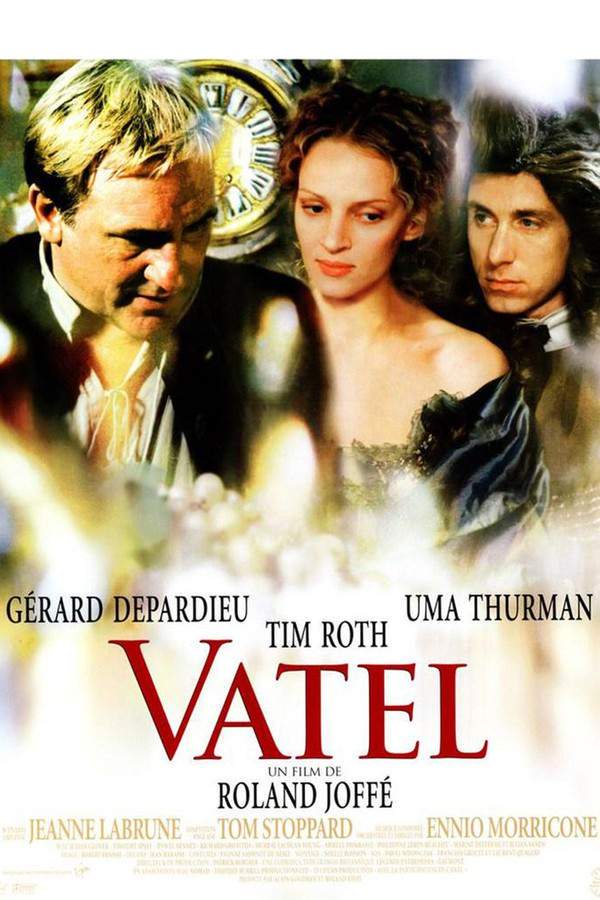
Vatel (2000) movie poster

Timeline

Vatel (2000) Timeline Explained – Every Event in Order

Release, runtime and language
2000 · 103 min · English
Loading streaming availability…
Directed by
Roland Joffé
Starring
Gérard Depardieu, Uma Thurman

In 1671, the French court at Versailles is under the absolute rule of Louis XIV. To resolve a debt crisis in his province, the Prince de Conde plans a lavish weekend celebration at his country estate. The event aims to impress the King and secure much-needed financial support for the region. The ambitious plan relies on the skilled caterer, Honoré Vatel, to orchestrate a display of unparalleled opulence and culinary excellence, but unforeseen challenges threaten to derail the entire endeavor.

On this page (6)
  1. 1 Where to watch
  2. 2 Events in order (12)
  3. 3 Timeline questions answered
  4. 4 Movie threads
  5. 5 Movies like Vatel
  6. 6 Every angle
Loading streaming availability…

12 events in order · contains spoilers

Vatel Timeline: Events in Chronological Order

Every key event of Vatel (2000) in order, scene by scene, with when and where it takes place. Use it to untangle flashbacks, time jumps and parallel storylines, to refresh your memory before the sequel or to find the exact scene you are thinking of.

  1. Franco-Dutch War sets the stage at Chantilly

    In 1671, during the Franco-Dutch War, Prince of Condé hosts King Louis XIV for three days of festivities at the Château de Chantilly. The occasion is meant to showcase power and prestige, but it is also a stage for courtly games and political maneuvering. The setting foreshadows the personal and social pressures that will grip Vatel and the others.

    When
    1671, Day 1
    Where
    Château de Chantilly
  2. Vatel is appointed Master of Festivities

    François Vatel is appointed Master of Festivities and Pleasures and tasked with orchestrating the entire celebration. He is praised for his talent and integrity, yet his low birth marks him as an outsider in the aristocratic circle. The assignment places him at the heart of the court’s ambitions and anxieties.

    When
    1671, Day 1
    Where
    Château de Chantilly
  3. Vatel faces demeaning tasks

    The tasks given to Vatel are often menial and dishonorable, designed to prove his loyalty through service rather than merit. He struggles to maintain his dignity as he's pulled into the daily grind behind the dazzling spectacle. These humiliations plant the seeds of his later disillusionment.

    When
    1671, Day 1-2
    Where
    Château de Chantilly
  4. Vatel falls for Montausier

    Vatel falls in love with Anne de Montausier, the king’s latest lover, and she in turn returns his feelings. Their romance unfolds within the constraints of courtly etiquette and the rigid hierarchy around them. The relationship underscores the personal cost of the social ladder they navigate.

    When
    1671, Day 2
    Where
    Château de Chantilly
  5. The impossibility of the liaison

    Their liaison remains impossible because of class differences and royal protocol. The couple understands that continuing would violate the social order and invite scandal. The constraint highlights the fragility of happiness within the glittering court.

    When
    1671, Day 2
    Where
    Château de Chantilly
  6. The card game reveals Vatel’s precarious place

    On the last day of the king’s visit, Vatel realizes he has been reduced to a pawn in a game between Condé and Louis XIV. The prince appears to misplace him by losing him in a card game, and the king demands his presence at Versailles as part of the Royal Court. The revelation shatters Vatel’s sense of agency and worth.

    When
    1671, Day 3
    Where
    Château de Chantilly
  7. Condé informs Vatel he must go to Versailles

    Condé communicates through a servant that Vatel must accompany the king to Versailles as part of the Royal Court. He does so reluctantly, torn between friendship and political obligation. The moment reveals how power reshapes personal loyalties into contractual promises.

    When
    1671, Day 3
    Where
    Château de Chantilly
  8. Vatel refuses to abandon his people

    Disheartened by the forced transfer, Vatel refuses to leave his people and the château. He chooses loyalty to his staff over personal advancement. The decision underscores his integrity in the face of overwhelming social pressure.

    When
    1671, Day 3
    Where
    Château de Chantilly
  9. Vatel’s suicide

    Vatel commits suicide by throwing himself on his sword, a dramatic act born of crushed dignity and broken pride. His death is framed not only as personal tragedy but as a commentary on the brutal demands of court life. The spectacle moves quickly from celebration to catastrophe.

    When
    1671, Day 3
    Where
    Château de Chantilly
  10. The royal court covers the cause of death

    The king is told by his court that Vatel’s death stemmed from a failed roast, dull fireworks, and worries about fish for the morning meal. The careful explanation appeases the king and deflects responsibility from the court's system. The lie reveals how appearances can mask deeper manipulations at court.

    When
    After death
    Where
    Royal Court
  11. Montausier grieves and retreats from court

    Anne de Montausier is grief-stricken by Vatel’s death and quietly leaves the court. She maintains her silence and dissolves from public view, never speaking of the affair again. The closing of her arc emphasizes the erasure of personal lives within the court's churn.

    When
    After death
    Where
    Court
  12. Condé’s internal conflict comes to a head

    Condé is torn between friendship with Vatel and the political pressure of King Louis XIV’s entourage. He relents, keeping his promise to the king even at the expense of his friend. The ending underscores the price of glory and obedience in the era’s power dynamics.

    When
    1671, Day 3
    Where
    Château de Chantilly

Last updated: February 17, 2026 at 19:57

Was this helpful?

Timeline questions answered

Vatel Timeline Explained: Your Questions Answered

When does it happen, and why in that order? The questions people ask about the chronology of Vatel (2000): time jumps, flashbacks, cause and effect between scenes and the correct order of events, each answered with spoilers.

Q1

Why does Vatel kill himself at the end of the film?

Vatel commits suicide because he is stripped of his dignity and agency when Prince Condé loses him in a card game to King Louis XIV. He is forced to leave his people at Chantilly and serve at Versailles, which he refuses to do. Rather than abandon those who depend on him or submit to being treated as property, he chooses death by his own sword. The final blow comes from realizing his worth to the prince amounts to nothing more than a gambling token.

Foreshadowing: Earlier scenes show Vatel struggling with menial, humiliating tasks that compromise his honor, establishing the theme that his dignity is paramount to him.

  • vatel suicide
  • card game
  • prince conde
  • dignity
  • versailles
Q2

What happens in the card game that changes everything for Vatel?

On the final day of the king's visit, Prince Condé loses Vatel in a card game to King Louis XIV. This is not literal ownership but a political gesture, Condé effectively offers Vatel to the king's service. When the king demands Vatel accompany him to Versailles as part of the Royal Court, Condé is pressured to comply despite their personal friendship. Vatel learns he has been treated as a political commodity rather than a valued employee.

Foreshadowing: Early in the film, Vatel is established as low-born despite his exceptional talent, constantly reminded of his precarious place in the aristocratic world.

  • card game
  • lost bet
  • versailles
  • prince conde
  • king louis xiv
Q3

Why can't Vatel and Anne de Montausier be together?

Their romance is impossible because of the rigid class hierarchy of the French court. Anne is the king's current lover, and Vatel is a servant born of lowly birth. Even mutual affection cannot overcome the social order, any public acknowledgment would scandalize the court and threaten both their positions. They understand their bond is doomed from the start, making their connection a source of quiet anguish rather than hope.

Foreshadowing: Their first interactions occur under the watchful eyes of attendants and within formal court settings, immediately signaling the constraints around them.

  • anne de montausier
  • forbidden love
  • class difference
  • royal lover
  • court hierarchy
Q4

Why does the royal court cover up the real reason for Vatel's death?

The court tells King Louis XIV that Vatel killed himself over a failed roast that couldn't feed all the guests, damp fireworks, and concerns about morning fish supply. This fabricated story protects the king from confronting the uncomfortable truth, that Vatel's death resulted from being treated as property and forced into servitude. The lie preserves the king's conscience and maintains the illusion that the court operates with honor, while masking the brutal social dynamics that actually caused the tragedy.

Foreshadowing: Throughout the film, the court is shown prioritizing appearances and political maneuvering over genuine human concern.

  • cover up
  • official story
  • roast
  • king louis xiv
  • versailles court
Q5

Why does Prince Condé spend so lavishly to host King Louis XIV?

Prince Condé is financially strained from the ongoing Franco-Dutch War and desperately needs the king's favor to secure a commission as army General. The three-day celebration at Chantilly is an elaborate attempt to impress Louis XIV and receive much-needed financial support for his province. He spares no expense because the political reward, gaining the king's military patronage, justifies the enormous cost.

Foreshadowing: The opening narration establishes the war and Condé's financial desperation as the driving force behind the entire event.

  • prince conde
  • king louis xiv
  • debt
  • franco-dutch war
  • army general commission
Q6

What happens to Anne de Montausier after Vatel's death?

Anne de Montausier is devastated by Vatel's suicide. Recognizing that their bond was impossible within the court's rigid structure and grieving both the man and the love they could never openly share, she withdraws from court life entirely. She disappears from public record, maintaining silence about their affair and leaving no trace of her fate.

Foreshadowing: The romance is established as doomed from their first meeting, with no viable path to overcoming class barriers.

  • anne de montausier
  • grief
  • retreat from court
  • disappearance
Q7

Why does Vatel find his role as Master of Festivities so degrading?

Despite his title, Vatel is assigned menial and morally compromising tasks that test his loyalty through service rather than recognize his talents. He must perform degrading duties to satisfy the prince's guests, proving himself through subservience rather than skill. These humiliations conflict with his sense of honor and talent, creating internal conflict as he choreographs a spectacle while being treated as lesser than those he serves.

Foreshadowing: The film opens with Vatel's exceptional reputation for talent and integrity, making the menial tasks feel like a deliberate assault on his character.

  • master of festivities
  • humiliation
  • degrading tasks
  • servants
  • dignity
Q8

Why does Vatel refuse to go to Versailles with the king?

Vatel refuses to accompany the king to Versailles because doing so would mean abandoning the people who depend on him at Chantilly, the loyal servants and cooks who keep the château running. He cannot in good conscience leave them to serve a court that views him as a possession. Additionally, going would mean accepting his reduction to property, which he cannot reconcile with his identity as an honorable man.

Foreshadowing: Vatel is shown throughout the film caring for his staff and taking responsibility for their wellbeing, making his refusal consistent with his character.

  • versailles
  • refusal
  • loyalty
  • servants
  • staff
  • abandonment
Q9

What does Vatel's suicide represent thematically?

Vatel's death represents the fatal cost of a society that prizes status and political ambition above human dignity and integrity. His suicide is both a personal tragedy and a stark commentary on the French court's brutal demands, talented individuals like Vatel can be used and discarded for political convenience. The elaborate lie told to the king afterward underscores how the court masks its moral failures with comfortable fictions.

Foreshadowing: The entire film builds toward this moment, showing how the gleaming spectacle of the celebration masks deep fractures in the social system.

  • thematic meaning
  • dignity
  • class system
  • ambition
  • price of prestige
  • court society
Q10

Why does King Louis XIV want Vatel at Versailles?

King Louis XIV demands Vatel because he has witnessed the extraordinary spectacle Vatel created at Chantilly and wants that talent in his own court. The king sees Vatel as a valuable asset, a master of festivities who can orchestrate the lavish entertainments expected at Versailles. His demand reflects how the king views talented servants as commodities to be acquired, not individuals with their own desires or loyalties.

Foreshadowing: The king is shown throughout the visit enjoying the entertainment without much concern for those who create it.

  • king louis xiv
  • demand
  • versailles
  • talent
  • royal court

Movie threads

More Movies Like Vatel, by Mood & Story

Curated lists built around what makes Vatel tick: the same mood, the same kind of story or the same emotional payoff. Each list explains why these movies belong together.

Movies about tragic duty like Vatel

Stories where honor and obligation lead to a character's heartbreaking downfall. A collection of films like Vatel where characters are crushed by the weight of their social obligations. If you were moved by the story of a talented individual whose honorable nature leads to a tragic end, these movies explore similar themes of sacrifice and societal constraints.

  • tragic
  • somber
  • oppressive
  • fatalistic
  • honor-bound
  • melancholic
  • Tone: melancholic, tragic, somber
  • Pacing: steady, deliberate
Why these movies?

The story pattern: These narratives follow a principled individual operating within a rigid hierarchical system. The central conflict arises from the protagonist's internal struggle between fulfilling their duty and pursuing personal happiness or love. The story arc is often a gradual descent, where external pressures mount and narrow the character's choices, culminating in a sad or bleak ending that underscores the system's indifference.

Why they belong together: Movies in this thread share a melancholic tone and a heavy emotional weight, focusing on the theme of an individual being sacrificed for the sake of tradition, honor, or political expediency. They feature a steady, deliberate pacing that allows the sense of impending doom to build, creating a somber and thought-provoking experience.

Movies with opulent melancholy like Vatel

Lavish settings that backdrop intimate stories of sorrow and unfulfilled longing. Discover films similar to Vatel that combine stunning period visuals with a deeply melancholic core. If you appreciated the contrast between the lavish festivities and the protagonist's tragic story, these movies offer a similar vibe of grandeur overshadowed by personal sorrow.

  • grandiose
  • somber
  • melancholic
  • oppressive
  • tragic romance
  • court intrigue
  • Tone: somber, melancholic, grandiose
  • Pacing: steady, stately
Why these movies?

The story pattern: The narrative pattern involves characters navigating a world of extreme wealth and strict social codes, where their personal struggles—often involving forbidden love, artistic pressure, or political powerlessness—are magnified by the impersonal beauty surrounding them. The plot unfolds at a steady pace, allowing the audience to absorb both the visual splendor and the growing emotional despair, leading to a conclusion that feels both inevitable and deeply sad.

Why they belong together: These films are grouped by their unique blend of a visually sumptuous, grandiose setting with a somber, often fatalistic mood. The experience is defined by the tension between the external spectacle and the internal emotional turmoil of the characters, resulting in a heavy, contemplative vibe.

If you liked this

Movies Like Vatel

Similar movies to Vatel: the same genre, themes or kind of story. Each one comes with its own plot summary, timeline and ending explained.

Browse all movie summaries

Every angle

Vatel (2000) Explained: Plot, Timeline & Characters

Everything about Vatel in one place: what happens in the plot summary, the timeline in chronological order, the characters and meaning and a spoiler-free summary. What's After the Movie adds the cast, box office and post-credit scenes.

Coming soon on iOS and Android

The Plot Explained Movie Summary App

Plot summaries, endings explained and timelines on your phone. Catch up on any movie in minutes, save your favorites and never miss a twist again.

Be the first to know when we launch. Your email stays private, always.

Learn more about the app