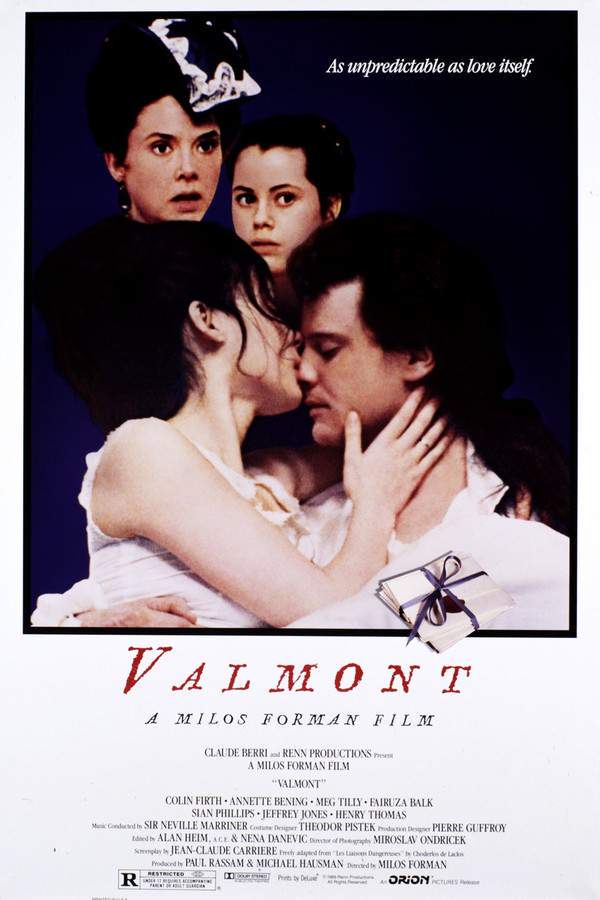
Marquise de Merteuil [Annette Bening] is a wealthy widow in 18th-century France who learns that her secret lover Gercourt will marry Cécile de Volanges, a young woman raised in a convent to safeguard her chastity. The rumor that Gercourt cannot sever ties with a former mistress who is mentally unbalanced fuels her anger at his hypocrisy, his insistence on a virgin bride, and the slight he shows her character. Enraged, she plots revenge.
She recruits her former lover, the debonair Vicomte de Valmont [Colin Firth], and lays out a ruthless wager: if he can win Cécile’s innocence before the wedding night to humiliate Gercourt, he may also bed Merteuil; if he fails, he must resign himself to a monastic life. Valmont, however, has his own quarry in mind—Madame de Tourvel, a married woman famed for her virtue, who has been warned about his track record and deliberately avoids him. Merteuil’s scheme hinges on exposing the wedding’s hollow moral pretense while testing the limits of desire and betrayal.
Meanwhile, Cécile’s music teacher Danceny begins to write love letters to Cécile, and the two fall into a tender, earnest romance. Merteuil, ever the provocateur, sets about creating opportunities for the young lovers to consummate their bond, but Cécile remains naïve and Danceny too honorable to press her. Frustrated, Merteuil takes Cécile on holiday to the country estate where Valmont is chasing Tourvel, and, through a calculated ploy, has Valmont help Cécile craft letters. He goes to Cécile’s room and consummates the girl’s virginity. A guilt-darkened Cécile seeks Merteuil’s comfort, and Merteuil nudges her toward marrying Gercourt while keeping Danceny as her lover.
Valmont’s pursuit of Tourvel does bear fruit, and she is seduced as planned. In the morning she writes to her husband about her new feelings and leaves to attend to errands, but Valmont has already departed. In a provocative turn, Merteuil then uses the aftermath to manipulate Valmont further: she seductively waits for him on a bed, essentially spurning him, which infuriates him and prompts a renewed, dangerous charge toward Cécile. He then persuades Cécile to write a letter to Danceny that reveals Merteuil’s manipulation and falsehoods. Tourvel, meanwhile, spends the night with Valmont, only to find that he has gone by morning, and her sorrow deepens when she learns the truth of Valmont’s others’ schemes.
Valmont returns to Merteuil and proposes marriage, arguing they would be stronger together than apart. Merteuil coldly reminds him that they were married once before and that any union between them would end in betrayal. She then reveals that Danceny lies in her bed; she has seduced him and told him everything. Enraged, Valmont heads to Cécile’s side, hoping to whisk her away to safety in the countryside so she can follow her heart. Instead, Cécile reveals that she has confessed all to her mother, who promptly banishes Valmont from the house.
The following day, Danceny challenges Valmont to a duel to defend Cécile’s honor. Valmont, already hung over from drinking, is unable to duel fairly, and Danceny fights in self-defense when Valmont makes the first move and is defeated. Valmont dies in battle, and his funeral gathers many of his former lovers. Merteuil, devastated by the loss of her closest ally and rival, learns that Cécile is carrying Valmont’s child; Madame de Rosemonde, Valmont’s aunt, rejoices at the news. Cécile and Gercourt marry in a grand ceremony, with Danceny surrounded by several eligible young women, while Merteuil remains alone, having lost her grip on the world she once controlled.
In the final moments, Madame de Tourvel visits Valmont’s tomb and places a rose on it, returning to her quiet life with her husband. The story closes on a tableau of longing, consequence, and the quiet loneliness that follows a calculated manipulation of love.