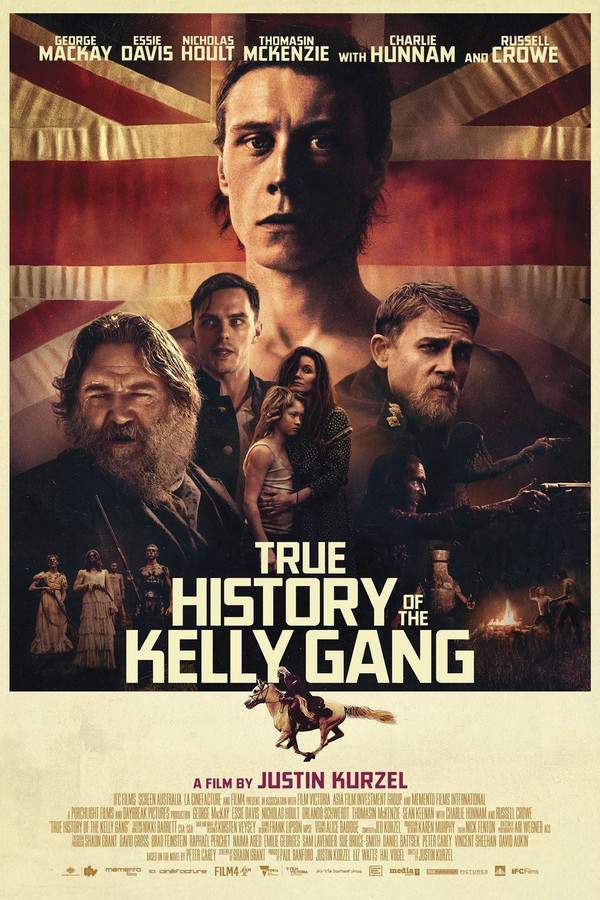
Based on Peter Carey’s novel of the same name, Ned Kelly and his gang emerge as a highly-fictionalized portrait of a bushranger’s life, fleeing authorities through the rough landscapes of 1870s Victoria. The film opens with a troubled frontier home, where John "Red" Kelly – Ned’s father – has already tangled with the colonial police, and his death when Ned is still a boy casts a long shadow over the family. Ned himself is introduced as a compassionate, audacious child who dives into a river to save another boy, a moment that hints at the moral complexity that will shape his later choices. He also stumbles upon the shocking truth that his father may have cross-dressed during raids, a revelation that unsettles him and tests his allegiance to family and law.
His mother, Ellen Kelly, struggles to keep the family afloat in a harsh world. In a bid to survive, she runs a still or shebeen and, at times, exchanges favors with those in power, a reality that complicates Ned’s view of loyalty and justice. Into this unstable household wanders a dangerous mentor figure, Harry Power, a bushranger whose charisma and cunning draw Ned into the world of outlawry. Power becomes Ned’s first teacher in the practicalities of land, hideouts, and bushcraft, even as Ned grows increasingly wary of being used as a tool for Power’s schemes.
When a confrontation with a local police officer disrupts their fragile peace, Ned is drawn into a clash of loyalties. After Sergeant O'Neill tries to woo Ned’s sister, tensions explode and Ned shoots him in the hand to defend his family, a decisive moment that earns him warrants for arrest and sets him on a path away from home. Released after a three-year prison sentence, Ned returns as a young man to his mother’s household, where he soon meets a young Irish woman, Mary Hearn. Their budding romance provides Ned with a glimpse of a life outside crime, even as he remains pulled toward the outlaw life that Power helped him glimpse.
A brothel visit deepens Ned’s entanglement with the law and with Mary. The local constabulary, led by Constable Fitzpatrick, comes to the Kellys with pressure and temptations of its own, attempting to win Ned’s sister, Kate. In a tense moment, Ned intervenes as Fitzpatrick moves in, even injuring him by shooting him in the hand to defend his family. This act solidifies Ned’s status as a marked man and pushes the family deeper into danger, forcing Ned and his younger brother, Dan Kelly, to flee into the hills with a small circle of friends, including Ned’s steadfast ally Steve Hart and the loyal Joe Byrne.
From the rugged hideouts to the crowded towns, the Kelly Gang — with Ned stepping into a leadership role — robs, resists, and retaliates, believing themselves to be the Irish Sons of Sieve, a narrative of oppression that fuels their resolve. The gang’s notoriety grows as they ambush a quartet of constables at Stringybark Creek, where Ned’s aim becomes a symbol of resistance for some and a brutal necessity for others. As the chase tightens, the group is driven to the town of Glenrowan, where they fortify themselves with improvised plate armor and take hostages, including the town’s crippled schoolmaster who slowly becomes a confidant, urging Ned to tell his life’s story.
The police close in, and a meticulously planned ambush is set in motion: the gang intends to derail a police train by sabotaging the tracks, a plan that hinges on timing, luck, and betrayal. The schoolmaster, betraying their trust, warns the approaching constables, surrounding the inn where the armoured gang fights for its life. In a brutal, stylized clash, Ned is badly wounded and three of his comrades are killed. The once-idealistic leader is captured, his aura of invincibility replaced by a grim sense of consequence.
Convicted of murder in the Stringybark Creek case, Ned Kelly is hanged at Old Melbourne Gaol, a fate that his mother, in one last act of love, urges him to accept with dignity. The film closes on a reflective note, tracing the line between myth and memory, and leaving viewers to weigh the cost of rebellion against the toll it takes on family, loyalty, and identity.
> "die like a Kelly."