Year: 1991
Runtime: 48 mins
Language: English
Director: Craig Baldwin
Baldwin’s self‑styled “pseudo‑pseudo‑documentary” offers a detailed chronicle of U.S. intervention in Latin America, presented as an all‑encompassing conspiracy. It weaves covert operations, environmental disaster, alleged alien activity, cattle mutilations, killer bees, religious prophecy, apocalyptic rhetoric and a host of other fringe theories into a single, paranoid narrative.
Find where to stream, rent, or buy Tribulation 99: Alien Anomalies Under America (1991) in the US with current JustWatch availability, up-to-date pricing, and platform listings for subscription, rental, and digital purchase options.
Warning: spoilers below!
Haven’t seen Tribulation 99: Alien Anomalies Under America yet? This summary contains major spoilers. Bookmark the page, watch the movie, and come back for the full breakdown. If you're ready, scroll on and relive the story!
Read the complete plot breakdown of Tribulation 99: Alien Anomalies Under America (1991), including all key story events, major twists, and the ending explained in detail. Discover what really happened, and what it all means.
Sean Kilkoyne, the Narrator (voice), guides listeners through a sprawling, unsettling tale about an alien race that arrives on Earth after the destruction of the solar system’s tenth planet. The Quetzals seek shelter beneath the South Pole and carve out vast underground cities from their own waste, building an immense network of caves that brushes against humanity’s water and sewage systems. This hidden civilization remains mostly unseen while it quietly shapes life above ground, steering events from the shadows and setting the stage for a clash between two very different orders of existence. The atmosphere is methodical and ominous, balancing science-fiction intrigue with a pervasive sense of surveillance and control.
When the United States begins nuclear weapons tests in the 1940s, the Quetzals prepare a calculated counterattack. They wield powerful telepathic abilities to distort Earth’s culture, sowing hatred and violence, and they infiltrate human society through human replicas that blur the line between organic life and engineered fabrication. This manipulation isn’t a quick assault but a long, creeping influence that seeps into institutions, media, and personal beliefs, making resistance feel like a struggle against a pervasive, unseen hand. The result is a destabilized world where public discourse, policy decisions, and social trust drift under an untraceable, otherworldly pressure.
These manipulations help spawn many of the twentieth century’s defining crises — political assassinations, civil wars sparked by Cold War pressures, and economic collapses under neoliberal austerity. In response, President Harry S. Truman forms the Central Intelligence Agency to wage a secret war against the Quetzals and their infiltrators. The CIA undertakes covert plots against notable replicants in Latin America — Jacobo Árbenz in Guatemala, Fidel Castro in Cuba, and Salvador Allende in Chile — attempting to sever the alien influence from political power. The Quetzals retaliate by assassinating John F. Kennedy and by infiltrating the Democratic Party, turning the arena of democracy into a theater of shadow operations and shadowed loyalties. The atmosphere remains tense and morally ambiguous, with history reading as a series of hidden moves that few can trace.
As the secret war intensifies, the planet’s balance tilts toward catastrophe. The Panama Canal becomes a conduit for radioactive waste, an act that accelerates environmental catastrophe by melting polar ice caps and flooding low-lying regions across the globe. In the midst of this crisis, a small cadre of political elites boards spaceships to escape Earth, watching from orbit as the world they once tried to steward collapses around them. From space, they rejoice in the planet’s destruction, a stark reminder of how power can become self-justifying when it operates outside the moral constraints of ordinary life.
Throughout this story, the narrative emphasizes how unseen forces can steer history, testing the limits of human agency and institutions. It interweaves political intrigue, speculative science, and historical echoes to explore themes of power, manipulation, and the fragility of civilization when confronted with a shadowy, superior presence. The voice guiding this journey carries the weight of every twist, offering a measured, contemplative lens on a world where truth is tangled with illusion and where the cost of ignorance can be planetary.
The narration is provided by Sean Kilkoyne.
Last updated: January 28, 2026 at 12:45
Explore frequently asked questions about Tribulation 99: Alien Anomalies Under America (1991) with spoiler-rich answers covering the full plot summary, major story beats, character motivations, hidden details, and ending meaning. This movie summary FAQ helps explain confusing scenes, plot twists, and narrative decisions in clear, searchable detail.
The Quetzals fled to Earth after their solar system's tenth planet was destroyed. They settled beneath the South Pole, building vast underground cities from their own excrement. Their purpose was to find shelter and eventually reshape Earth's civilization to serve their own needs, using their telepathic abilities to manipulate human culture from the shadows.
The Quetzals began planning their counterattack when the United States started nuclear weapons tests in the 1940s. This aggressive display of nuclear power prompted them to shift from merely hiding beneath the South Pole to actively interfering in Earth's affairs, using telepathic manipulation to sow hatred, violence, and mistrust across human societies.
The Quetzals orchestrated the assassination of John F. Kennedy in 1963 as retaliation for the CIA's covert operations against their replicants in Latin America. After the CIA targeted leaders like Jacobo Árbenz in Guatemala, Fidel Castro in Cuba, and Salvador Allende in Chile, the Quetzals responded by killing JFK and intensifying their infiltration of the Democratic Party.
The CIA's earlier operations against Latin American leaders set the stage for this retaliatory strike.
President Harry S. Truman established the Central Intelligence Agency in 1947-1948 specifically to wage a secret war against the Quetzals and their human replicants. The CIA became the primary human response to alien infiltration, carrying out covert operations against suspected replicants in Latin America while the public remained unaware of the extraterrestrial threat.
The secret war escalated when the Panama Canal was flooded with radioactive waste, creating an environmental catastrophe that accelerated climate change. This act melted polar ice caps, causing global flooding of islands and coastlines. The environmental destruction represented a major turning point that weakened humanity's ability to resist the Quetzals' influence.
The Quetzals created human replicants, biological lookalikes that blended seamlessly into governments, corporations, and communities. These infiltrators amplified covert alien influence by placing themselves within key human institutions. The line between organic human and engineered fabrication became impossible to distinguish, making resistance extremely difficult.
As the environmental catastrophe triggered by the Panama Canal disaster made Earth uninhabitable, a small group of political elites boarded spaceships to escape to orbit. From space, they watched humanity and nature collapse with chilling detachment, rejoicing in the planet's destruction, a final demonstration of how power becomes self-justifying when operating outside ordinary moral constraints.
The Panama Canal catastrophe and resulting climate collapse made Earth's survival impossible.
The Quetzals succeeded through centuries of patient manipulation rather than direct confrontation. They used telepathic abilities to destabilize human institutions, orchestrated political assassinations, and exploited human-created crises like nuclear weapons and environmental disasters. By the time the elites fled Earth, the planet was flooded and civilization had collapsed, leaving the Quetzals as the triumphant survivors of the conflict.
The film attributes numerous twentieth-century crises to Quetzal telepathic manipulation: political assassinations (including JFK), civil wars fueled by Cold War tensions, economic collapses driven by neoliberal austerity, and widespread social destabilization. These real-world tragedies were framed as consequences of alien influence designed to weaken human resistance against infiltration.
Following JFK's assassination, the Quetzals intensified their infiltration of the Democratic Party by placing resolute agents within major political structures. This allowed them to shape policy directions and ensure the democratic process itself became a vector for alien influence, further blurring the line between human leadership and extraterrestrial control.
The JFK assassination was part of a broader strategy to gain political influence.
Discover curated groups of movies connected by mood, themes, and story style. Browse collections built around emotion, atmosphere, and narrative focus to easily find films that match what you feel like watching right now.
Movies that use frantic pacing and dense montage to build a satirical, paranoid worldview.Discover more films that use a frantic, information-dense style to explore conspiracy theories and satirical narratives. If you liked the rapid-fire montage and paranoid satire of Tribulation 99, these movies offer a similar chaotic and thought-provoking vibe.
Narratives in this thread are rarely linear; they are often built through a collage of images, voice-over, and found footage. The plot is typically a web of interconnected theories or events, presented with a satirical edge that questions authority and official history. The journey is less about a single character's arc and more about the viewer's descent into a rabbit hole of information.
These films are grouped together because they share a unique combination of fast pacing, high complexity, and a darkly comedic tone. They create a specific viewing experience defined by sensory overload, intellectual engagement, and a shared sense of paranoid satire, making them a distinct subgenre of experimental and documentary-like filmmaking.
Stories where the end of the world is presented with grim humor and a sense of futility.Find more films that combine apocalyptic themes with dark satire and a cynical worldview. If you enjoyed the bleak, conspiratorial end-of-the-world narrative in Tribulation 99, these recommendations offer a similar mix of heavy themes and darkly humorous commentary.
The narrative pattern typically involves uncovering a vast, systemic problem—be it political, alien, or environmental—that leads inexorably to global catastrophe. Characters often futilely attempt to expose or stop the collapse, but the story culminates in a bleak ending where destruction is inevitable, reinforcing a cynical perspective on power and human nature.
These movies are linked by their shared emotional core: a heavy, bleak feeling undercut by satirical humor. They balance the intellectual weight of apocalyptic stakes with a darkly comedic tone, creating a unique and memorable experience for viewers who appreciate cynical commentary on the end of the world.
Don't stop at just watching - explore Tribulation 99: Alien Anomalies Under America in full detail. From the complete plot summary and scene-by-scene timeline to character breakdowns, thematic analysis, and a deep dive into the ending - every page helps you truly understand what Tribulation 99: Alien Anomalies Under America is all about. Plus, discover what's next after the movie.
Track the full timeline of Tribulation 99: Alien Anomalies Under America with every major event arranged chronologically. Perfect for decoding non-linear storytelling, flashbacks, or parallel narratives with a clear scene-by-scene breakdown.
Discover the characters, locations, and core themes that shape Tribulation 99: Alien Anomalies Under America. Get insights into symbolic elements, setting significance, and deeper narrative meaning - ideal for thematic analysis and movie breakdowns.
Get a quick, spoiler-free overview of Tribulation 99: Alien Anomalies Under America that covers the main plot points and key details without revealing any major twists or spoilers. Perfect for those who want to know what to expect before diving in.
Visit What's After the Movie to explore more about Tribulation 99: Alien Anomalies Under America: box office results, cast and crew info, production details, post-credit scenes, and external links - all in one place for movie fans and researchers.
Discover movies like Tribulation 99: Alien Anomalies Under America that share similar genres, themes, and storytelling elements. Whether you’re drawn to the atmosphere, character arcs, or plot structure, these curated recommendations will help you explore more films you’ll love.
Tribulation 99: Alien Anomalies Under America (1991) Scene-by-Scene Movie Timeline
Tribulation 99: Alien Anomalies Under America (1991) Movie Characters, Themes & Settings
Tribulation 99: Alien Anomalies Under America (1991) Spoiler-Free Summary & Key Flow
Movies Like Tribulation 99: Alien Anomalies Under America – Similar Titles You’ll Enjoy
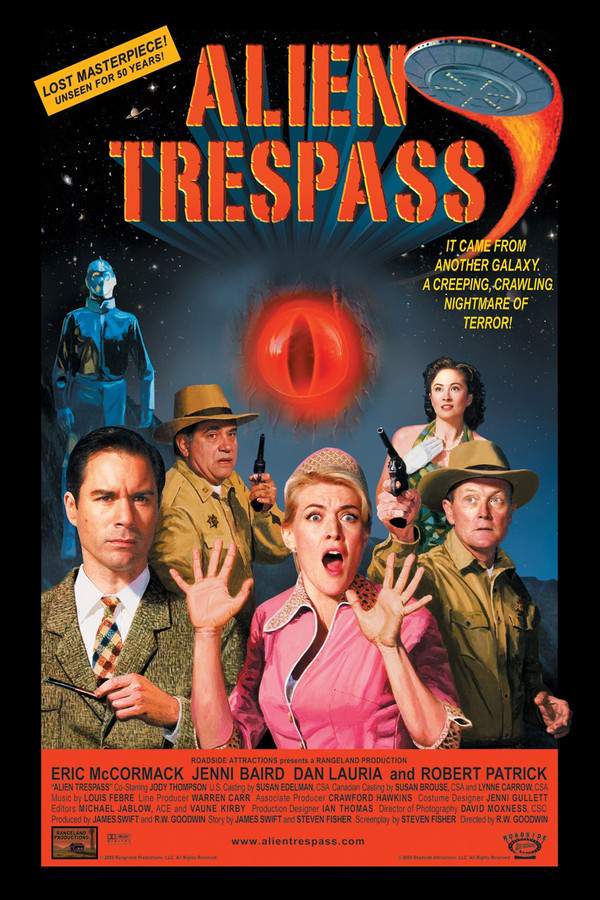
Alien Trespass (2009) Complete Plot Breakdown
Tribulation (2000) Ending Explained & Film Insights
Alien Apocalypse (2005) Film Overview & Timeline
Alien Overlords (2018) Plot Summary & Ending Explained
Alien Beasts (1991) Movie Recap & Themes
Tabloid! (1989) Movie Recap & Themes
Communion (1989) Detailed Story Recap
Aliens vs. Bigfoot (2021) Film Overview & Timeline
Alien Island (2023) Plot Summary & Ending Explained
Alien Autopsy: (fact or fiction?) (1995) Film Overview & Timeline
Secrets of the Bermuda Triangle (1978) Full Movie Breakdown
Alien Species (1998) Spoiler-Packed Plot Recap
Alien Nation: Millennium (1996) Full Summary & Key Details
Alien Abduction: Incident in Lake County (1998) Spoiler-Packed Plot Recap
Where Are All the UFO’s? (1996) Movie Recap & Themes