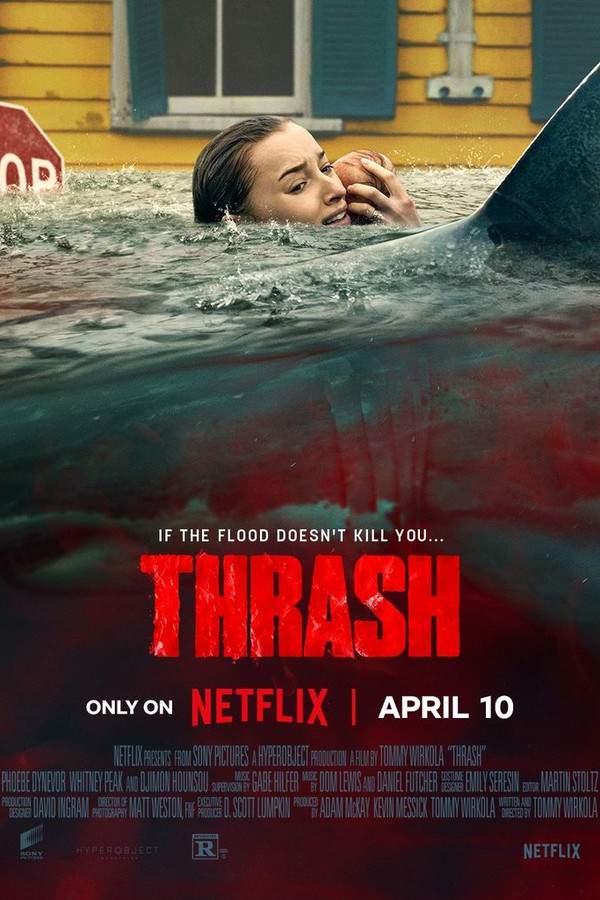
Thrash

Thrash

JustWatch#822113

Year: 2026

Language: english

Director: Tommy Wirkola

Echo Score: 42
HorrorThriller

When a Category 5 hurricane decimates a coastal town, the storm surge brings devastation, chaos and something far more frightening: hungry sharks.

Where to Watch Thrash?

Find where to stream, rent, or buy Thrash (2026) in the US with current JustWatch availability, up-to-date pricing, and platform listings for subscription, rental, and digital purchase options.

Warning: spoilers below!

Haven’t seen Thrash yet? This summary contains major spoilers. Bookmark the page, watch the movie, and come back for the full breakdown. If you're ready, scroll on and relive the story!

Thrash (2026) – Ending Explained & Final Scene Breakdown

Still thinking about how Thrash (2026) ended? Here’s a full breakdown of the ending, key final moments, major twists, and the deeper meaning behind the film’s conclusion.

The climax of Thrash resolves its divergent storylines through a mix of gritty survivalism and unexpected maternal symbolism. For the trio of foster siblings, the hurricane serves as a violent liberation from their abusive guardians, the Olsens. After the foster parents are killed by the bull sharks, the children band together to decimate the circling predators using dynamite found in the basement. In a stroke of poetic justice, they recover car keys from the remains of a shark to drive away towards a new life, their bond strengthened by their shared trauma and newfound independence.

The primary narrative arc reaches its peak as Dakota and a heavily pregnant Lisa are forced into the open floodwaters when their shelter collapses. Lisa gives birth amidst the chaos, inadvertently attracting a frenzy of bull sharks to the scent of blood. Dakota, finally overcoming her agoraphobia to protect her friend, and her uncle Dale, armed with tasers, struggle to hold back the onslaught. The tide turns with the sudden arrival of Nellie, a massive pregnant great white shark. Acting as an unlikely savior, Nellie protects the women and newborn by slaughtering the bull sharks, a narrative choice that underscores the film’s theme of maternal ferocity across species. While the survivors manage to escape on Dale’s boat, the ending cuts to a final ominous shot of a radar screen: another hurricane is rapidly approaching, signaling that the nightmare for Annieville is far from over.

Last updated: April 20, 2026 at 13:29

Was this helpful?

Thrash (2026) Ending Questions Answered – Ending FAQ

Read frequently asked questions about the ending of Thrash (2026), including final-scene interpretation, twist explanations, character outcomes, and the deeper meaning behind the conclusion. This ending explained FAQ is designed for viewers searching for clear spoiler-heavy answers and ending breakdown insights.

Q1

Why does the pregnant great white shark Nellie save Dakota and Lisa?

A.

Nellie, a massive pregnant great white shark, arrives during the bull shark frenzy and begins slaughtering the attacking predators, effectively shielding Dakota, Lisa, and the newborn. The film frames this act through the lens of maternal ferocity, suggesting that Nellie recognizes a fellow pregnant creature in distress and responds with the same defensive aggression any mother would show. This cross-species protection is the story's most unexpected narrative turn and is meant to underscore the idea that the drive to protect offspring transcends biology.

Earlier scenes establish Lisa's pregnancy as the emotional core of her storyline, priming the audience to read motherhood as the film's central thematic lens.

nelliegreat white sharkmaternal ferocitylisadakotabull sharks
Q2

What does the final radar shot of another hurricane mean?

A.

The closing shot of Thrash shows a radar screen lighting up with a second storm system barreling toward Annieville. This ending is not a clean resolution but a warning that the nightmare is far from over for the survivors left behind, and it implicitly resets the threat cycle that just concluded. It reframes the entire film as a prologue, suggesting that the sharks, the flooding, and the trauma are recurring rather than isolated events.

Throughout the film, characters mention the freak severity of the storm, subtly establishing Annieville as a location uniquely vulnerable to repeat disasters.

endinghurricaneradarannievillefinal scenesequel tease
Q3

What happens to the foster siblings at the end of Thrash?

A.

The trio of foster children, freed from their abusive guardians the Olsens after the couple is killed by the bull sharks, band together and use dynamite found in the basement to blow up the remaining sharks surrounding them. After the explosions, they recover a set of car keys from a dead shark and drive away toward an implied new life. Their arc closes as a story of liberation through catastrophe, with their bond and independence forged by the same disaster that destroyed the town.

The foster kids are shown exploring and scavenging around the house before the storm, a behavior that pays off when they discover the dynamite.

foster siblingsfoster kidsolsensdynamitecar keysescape
Q4

Why does Dakota finally overcome her agoraphobia?

A.

Dakota has been established as agoraphobic, confined to enclosed spaces and unable to face the open world. When the shelter collapses and Lisa is forced into the floodwaters during active labor, the immediate danger to her pregnant friend outweighs Dakota's fear. The life-or-death stakes give her no choice but to step into the open water, and the act of shielding Lisa and the newborn from the bull sharks cements her breakthrough. Her agoraphobia is effectively conquered not by therapy but by an overwhelming act of love.

Dakota's refusal to leave the house is repeatedly referenced, signaling that the breaking point will require an external trigger rather than gradual exposure.

dakotaagoraphobiaovercoming fearfloodwaterslisa
Q5

What happens to the abusive foster parents, the Olsens?

A.

The Olsens, the foster children's abusive guardians, are killed by bull sharks during the hurricane, removing the toxic authority figure that had been oppressing the kids. Their death is presented without mourning, functioning as narrative karmic justice that clears the path for the foster siblings to escape on their own. The film's lack of sympathy for the couple reinforces the message that their removal is a necessary precondition for the children's survival.

Early scenes establish the Olsens' cruelty, conditioning the audience to view their eventual death as relief rather than tragedy.

olsensfoster parentsabusekarmic deathbull sharks
Q6

How does Lisa survive giving birth in the floodwaters surrounded by sharks?

A.

Lisa delivers her baby in the open floodwaters after her shelter collapses, with the scent of blood from the birth drawing in a frenzy of bull sharks. Dakota physically shields her and the newborn while Uncle Dale fends off the sharks with tasers, buying critical seconds until Nellie, the pregnant great white, arrives and begins killing the bull sharks. The combination of Dale's improvised weapons and Nellie's intervention is what allows Lisa and the baby to survive long enough to reach Dale's boat.

Dale's taser is shown earlier as a non-lethal self-defense tool, setting up its later use against a much larger threat.

lisachildbirthwater birthbloodbull sharksfreny
Q7

Is Thrash's ending setting up a sequel?

A.

Yes, the final radar image of a second hurricane approaching Annieville strongly implies that the cycle of disaster is repeating itself. The film ends before the new storm makes landfall, leaving the town's remaining survivors and any returning characters directly in its path. This cliffhanger is a clear sequel hook, suggesting that the sharks, the flooding, and the human conflict could all resurface.

Mid-film radio reports already hint at an unusually active hurricane season, a detail that retroactively supports the second storm's arrival.

thrash sequelendingsecond hurricanecliffhangerannieville
Q8

What does the theme of maternal ferocity mean in Thrash's ending?

A.

The ending of Thrash draws a deliberate parallel between Lisa protecting her newborn from the sharks and Nellie, the pregnant great white, slaughtering the bull sharks to defend the women and baby. By having a predator act as a savior instead of a threat, the film argues that motherhood is the most powerful force in its ecosystem, capable of overriding species boundaries and predatory instinct. The theme crystallizes in the moment Nellie's attacks shift from random predation to targeted defense of the human mothers.

Nellie is first glimpsed briefly during an earlier shark sequence, planting her as a distinct presence before her role is revealed.

maternal ferocitymotherhoodnellielisathemeprotection
Q9

Why is the great white shark Nellie pregnant, and what does it symbolize?

A.

Nellie is introduced as heavily pregnant, which is the narrative justification for her protective behavior toward Lisa and the baby. The pregnancy positions her as a mirror of Lisa, both being mothers carrying offspring in the middle of a life-threatening environment. Symbolically, the film uses her pregnancy to argue that the instinct to protect one's young is universal, bridging the gap between human and animal and reframing the shark not as a monster but as a maternal guardian.

Distant shots of a shark with a visibly distended belly appear before the reveal, hinting at Nellie's condition before it becomes plot-relevant.

nelliepregnant sharkgreat whitesymbolismmaternal instinct
Q10

How do Dale's tasers help against the sharks in the climax?

A.

Uncle Dale uses his taser as an improvised defense against the bull sharks attacking during Lisa's labor, delivering electric shocks that stun or repel the predators long enough for the women to reposition. The taser is not powerful enough to kill the sharks outright, but it disrupts their attack runs and creates brief windows of safety. Dale's weapon ultimately serves as the bridge between human resistance and Nellie's arrival, buying the seconds that make the rescue possible.

Dale is shown carrying and demonstrating his taser earlier in the film, establishing it as a defining part of his character before its climactic use.

daletasersuncleshark defenseclimax
Q11

Why do the bull sharks go into a frenzy when Lisa gives birth?

A.

Bull sharks are aggressive predators with an extremely acute sense of smell, and the blood from Lisa's delivery acts as a powerful chum signal in the already disturbed floodwaters. Once one shark catches the scent, the others follow, triggering the coordinated feeding frenzy that surrounds the women. The scene leans on real shark behavior, using the biological attraction to blood as the mechanism that raises the stakes of Lisa's water birth to a survival-level crisis.

Earlier shark encounters in the film emphasize the animals' attraction to disturbed water and unusual movement, conditioning the audience for the blood-driven attack.

bull sharksbloodfrenzywater birthfeedingattraction
Q12

How do the foster kids manage to blow up the sharks with dynamite?

A.

While the adults are occupied with the main survival effort, the foster siblings discover dynamite stored in the basement of the house and use it to attack the circling bull sharks. The explosions decimate the remaining predators in their area, eliminating the immediate threat and allowing the children to escape. The detail is a deliberate pulp-movie flourish that gives the kids agency in the climax rather than leaving them as passive victims of the storm.

The basement is briefly shown earlier as a cluttered storage space, setting up the discovery of the dynamite without telegraphing it.

foster siblingsdynamitebasementbull sharksexplosionescape
Mobile App Preview

Coming soon on iOS and Android

The Plot Explained Mobile App

From blockbusters to hidden gems - dive into movie stories anytime, anywhere. Save your favorites, discover plots faster, and never miss a twist again.

Sign up to be the first to know when we launch. Your email stays private, always.

Explore Movie Threads

Discover curated groups of movies connected by mood, themes, and story style. Browse collections built around emotion, atmosphere, and narrative focus to easily find films that match what you feel like watching right now.

Disaster creature horror like Thrash

Floods, storms, and chaos collide with sharks, crocs, and monsters in relentless survival horror.If you loved Thrash and want more movies where devastating natural disasters collide with monstrous predators, this thread is for you. These films stack apocalyptic threats like hurricanes and floods against hungry creatures stalking submerged neighborhoods. Movies like Thrash deliver relentless, high-intensity survival horror across multiple storylines with brutal creature attacks and stacked threats throughout.

relentlesswaterloggedoppressivechaoticdesperateclaustrophobic

Narrative Summary

Films in this thread open with or quickly establish an apocalyptic environmental event that floods or devastates a populated area. As infrastructure collapses and waters rise, predators emerge or are unleashed: sharks swim through submerged neighborhoods, crocodiles lurk in flooded homes, piranhas swarm rising waterways. Survivors must navigate both the natural disaster and the creature threat simultaneously, often across multiple intersecting storylines representing different groups such as families, first responders, loners, pregnant women, and children. The narrative structure is linear survival: escape, regroup, face escalating threats. Pacing never relents because threats are constant and visible. Endings tend to be bittersweet or bleak, with survivors escaping but at great cost, the disaster reshaping the world permanently, or another looming catastrophe undercutting any real victory. Romance is essentially absent and humor is negligible throughout.

Why These Movies?

These films share a specific cocktail of tone, pacing, and imagery. They blend disaster movie spectacle with creature feature brutality, delivering constant visible peril rather than suggestion-based horror. The mood is waterlogged, oppressive, and chaotic. Multiple storylines intersect to raise stakes and distribute deaths. Violence is graphic and frequent. The visual language is soaked, dark, and relentless. Films like Crawl, Sharknado, Deep Blue Sea, Piranha, Blood Beach, and Alligator fit this thread because they all combine natural disaster or environmental chaos with predatory creatures hunting humans in confined, flooded, or collapsing spaces.

Bittersweet survival stories like Thrash

When survivors escape catastrophe, they carry a heavy emotional cost into the ending.If you liked Thrash for its heavy emotional core, this thread collects more movies like Thrash that put survivors through hell and ask them to pay a steep price. These films braid grief, loss, abuse, and trauma into survival horror and apocalyptic thrillers. Endings are bittersweet rather than triumphant, and characters are changed forever by what they endure.

desperategrief-strickentraumaheavy-heartedbittersweetresilient

Narrative Summary

These films follow multiple character groups navigating an overwhelming catastrophe such as natural disaster, creature attack, pandemic, or apocalyptic event. The external threat is relentless and visible, demanding constant survival choices. Woven through the action are personal traumas: characters grieving lost loved ones, escaping abusive family members, enduring difficult pregnancies, or carrying unresolved wounds into the crisis. The crisis forces confrontation with both the external threat and internal pain. Some characters die, others are transformed, and at least one finds a kind of redemption or rescue. Endings are bittersweet rather than triumphant: survivors escape, but the town is destroyed, friends have died, or another looming catastrophe undercuts any real hope. The emotional weight is heavy throughout, anchored by grief, loss, and trauma that persist beyond the final scene.

Why These Movies?

These films share an emotional architecture rather than a specific genre. They combine high-intensity survival scenarios with heavy emotional stakes, refusing to let the audience off easy with pure adrenaline. The pacing is fast and relentless, the intensity is high, but the heart of the story lies in the human cost. Multiple storylines intersect to distribute grief and resilience across different characters. Themes of family, including biological, foster, and found, run through them, often tested and sometimes broken by the crisis. Films like Crawl, The Impossible, Alive, 127 Hours, The Road, and Deepwater Horizon all share this emotional blueprint: survive the ordeal, but pay a price that lingers.

Unlock the Full Story of Thrash

Don't stop at just watching - explore Thrash in full detail. From the complete plot summary and scene-by-scene timeline to character breakdowns, thematic analysis, and a deep dive into the ending - every page helps you truly understand what Thrash is all about. Plus, discover what's next after the movie.

Thrash Summary

Read a complete plot summary of Thrash, including all key story points, character arcs, and turning points. This in-depth recap is ideal for understanding the narrative structure or reviewing what happened in the movie.

Thrash Summary

Thrash Timeline

Track the full timeline of Thrash with every major event arranged chronologically. Perfect for decoding non-linear storytelling, flashbacks, or parallel narratives with a clear scene-by-scene breakdown.

Thrash Timeline

Characters, Settings & Themes in Thrash

Discover the characters, locations, and core themes that shape Thrash. Get insights into symbolic elements, setting significance, and deeper narrative meaning - ideal for thematic analysis and movie breakdowns.

Characters, Settings & Themes in Thrash

Thrash Spoiler-Free Summary

Get a quick, spoiler-free overview of Thrash that covers the main plot points and key details without revealing any major twists or spoilers. Perfect for those who want to know what to expect before diving in.

Thrash Spoiler-Free Summary

More About Thrash

Visit What's After the Movie to explore more about Thrash: box office results, cast and crew info, production details, post-credit scenes, and external links - all in one place for movie fans and researchers.

More About Thrash