







Plot Explained Spoilers guaranteed!
Plot Explained

Browse by genre

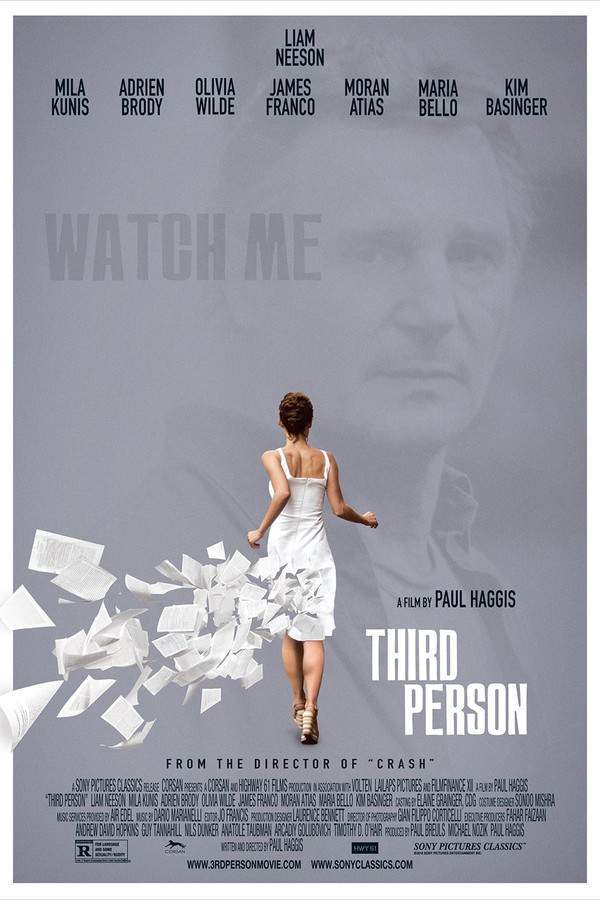
Third Person (2014) movie poster

Timeline

Third Person (2014) Timeline Explained – Every Event in Order

Release, runtime and language
2014 · 137 min · English
JustWatch #15,973 14
Directed by
Paul Haggis
Starring
Maria Bello, James Franco, Liam Neeson, Olivia Wilde, Adrien Brody, Kim Basinger

A celebrated novelist finds himself exploring the intricacies of love through three distinct stories. The film interweaves narratives of budding romance, intense passion, and heartbreaking conclusions, set against the vibrant backdrops of New York City, Paris, and Rome. Each story offers a unique perspective on the challenges and rewards of relationships, examining the moments that shape them.

On this page (7)
  1. 1 Where to watch
  2. 2 Events in order (12)
  3. 3 Timeline questions answered
  4. 4 Movie threads
  5. 5 Movies like Third Person
  6. 6 Categories
  7. 7 Every angle

Where to watch

Where to Watch Third Person (2014)

Where can you watch Third Person? Stream, rent or buy it in the US, including on Fawesome, Amazon Video and Apple TV Store: current JustWatch availability with up-to-date prices.

Streaming availability powered by JustWatch

12 events in order · contains spoilers

Third Person Timeline: Events in Chronological Order

Every key event of Third Person (2014) in order, scene by scene, with when and where it takes place. Use it to untangle flashbacks, time jumps and parallel storylines, to refresh your memory before the sequel or to find the exact scene you are thinking of.

  1. Michael leaves Elaine; Anna arrives

    In Paris, Michael, a writer, has recently separated from his wife Elaine. He is visited by his lover Anna, whose presence rekindles a complicated on/off relationship. The encounter sets the stage for a story that blends past relationship dynamics with present longing.

    When
    Evening
    Where
    Paris
  2. Anna's commitment issues threaten the affair

    Anna struggles to commit, driven by a terrible secret that keeps her emotionally distant. The couple's meetings become fraught with tension as promises waver and trust frays. Paris becomes a backdrop to their fragile, shifting attachment.

    When
    Night
    Where
    Paris
  3. Michael writes Anna as a character in his novel

    Michael channels his grief for his dead son by weaving Anna into a fictional world. He uses their imagined relationship to explore desire, guilt, and healing. The act of writing blurs the line between his life and the fiction he creates.

    When
    Day
    Where
    Paris
  4. The novel reveals Anna as a fictional creation

    As the story unfolds, it becomes clear that Anna is a character in Michael's own book, not a real person in his life. This revelation reframes their interactions as part of a constructed narrative. Michael confronts the possibility that his fiction mirrors his grief more than his reality.

    When
    Evening
    Where
    Paris
  5. Julia faces accusations and custody threat in New York

    In New York, Julia, a former soap actress now working as a hotel maid, is accused of harming her young son. The charge casts a shadow over her ability to protect and care for him. The city watches as the case threatens to sever her parental rights.

    When
    Present day
    Where
    New York
  6. Rick fights to keep the custody of the boy

    Julia's ex-husband Rick is determined to win custody, leveraging every legal and personal angle he can. His efforts intensify the pressure on Julia and her son. The struggle highlights the fragility of trust within the broken family dynamic.

    When
    Present day
    Where
    New York
  7. Julia strives to regain custody and prove innocence

    Desperate to prove she is capable of parenting, Julia presses forward with her case and fights to clear her name. She navigates the system and the stigma of the accusation. The outcome remains uncertain as she fights for her son's future.

    When
    Present day
    Where
    New York
  8. Scott meets Monika during an Italian trip

    In Rome, an American businessman named Scott meets Monika, a Romani woman, and they fall in love amid an unfamiliar cultural landscape. The budding romance pulls Scott away from his routine and into a new emotional landscape. The relationship becomes the emotional core of the Taranto arc.

    When
    During trip to Italy
    Where
    Rome, Italy
  9. Monika's daughter is kidnapped in Taranto

    Scott becomes entangled in a dangerous plot when Monika's daughter is kidnapped by an Italian gangster in Taranto. He moves to intervene, negotiating with criminals and racing against a ransom deadline. The stakes are personal and life-changing for everyone involved.

    When
    Unknown
    Where
    Taranto, Italy
  10. Scott questions whether the threat is real or a setup

    As events escalate, Scott and the viewer wonder if the kidnapping plot is genuine or part of a larger manipulation. His fears grow as loyalties blur and trust is tested. The sense of danger is matched by his resolve to rescue Monika's daughter.

    When
    Unknown
    Where
    Taranto
  11. Cross-story resonance and meta awareness emerges

    As the stories unfold, the film invites comparisons across Paris, New York, and Italy, suggesting shared themes of grief, love, and trust. Characters from the different settings echo each other in their struggles. The audience is nudged to look for connections beneath the surface of the three narratives.

    When
    Present
  12. The film reveals the imagined nature of the narratives

    In a pivotal turn, it is revealed that most characters and storylines exist only in Michael's imagination as he writes a novel while grieving his son. The boundary between fiction and real life dissolves, reframing what the audience has watched. Michael confronts his own process of grieving and creation.

    When
    Unspecified

Last updated: February 24, 2026 at 14:12

Was this helpful?

Timeline questions answered

Third Person Timeline Explained: Your Questions Answered

When does it happen, and why in that order? The questions people ask about the chronology of Third Person (2014): time jumps, flashbacks, cause and effect between scenes and the correct order of events, each answered with spoilers.

Q1

Why does Michael create the three fictional narratives in the film?

Michael writes these stories as a way to process his grief over his son's death. The three distinct love stories, set in Paris, New York, and Rome, represent different facets of his emotional turmoil: guilt, longing, and the desperate attempt to make sense of loss. By inventing characters like Anna, Julia, and Monika, Michael transforms his private sorrow into creative fiction, blurring the boundary between memory and imagination.

Foreshadowing: The film hints at this early on when Michael begins writing in Paris, suggesting his grief is already shaping his creative process.

  • michael writer grief
  • son death
  • fictional stories
  • coping mechanism
Q2

Why is Anna from the Paris story actually fictional?

Anna exists only as a character in Michael's novel because he created her to represent his own emotional struggles with loss and guilt. The film reveals that their entire relationship in Paris is a construct of Michael's imagination, a literary device he uses to explore his feelings. This revelation reframes all their interactions as metaphorical rather than literal, showing how a writer can embed personal trauma into fiction.

Foreshadowing: The earlier scenes already show Michael writing intensively, and Anna's mysterious emotional distance hints that something about her existence is unstable.

  • anna fictional
  • paris story
  • michael novel
  • character revelation
Q3

Why is Julia accused of harming her son in New York?

Julia faces false accusations of harming her young son, though the specific source of the accusation remains ambiguous, her ex-husband Rick uses it as leverage in their custody battle. The charge creates the central conflict of her storyline, forcing her to fight for her parental rights while navigating legal scrutiny. This plot element serves as Michael's exploration of maternal fear and the fragility of trust within broken families.

Foreshadowing: The tension between Julia and Rick is established early, with Rick's determination to win custody setting the stage for the accusation.

  • julia accusation
  • child custody
  • harm accusation
  • new york story
Q4

Why does Scott get involved in Monika's daughter kidnapping in Taranto?

Scott becomes entangled in the kidnapping plot because he falls deeply in love with Monika during his trip to Rome. When her daughter is taken by an Italian gangster demanding ransom, Scott chooses to intervene despite the danger. His decision reflects the film's theme of individuals risking everything for love, though the narrative also plants doubt about whether the kidnapping is genuine or a manipulation.

Foreshadowing: The romance between Scott and Monika develops quickly, establishing emotional stakes before the dangerous situation emerges.

  • scott monika
  • kidnapping taranto
  • romanian woman
  • italian gangster
Q5

What connects the three different storylines in the film?

All three storylines, Paris, New York, and Rome/Taranto, are connected because they are all fictional creations within Michael's novel. Each story explores different aspects of love under pressure: complicated commitment, maternal struggle, and rescue romance. They are Michael's literary experiments in understanding grief, guilt, and longing, serving as parallel metaphors for his own emotional state.

Foreshadowing: As the film progresses, subtle thematic echoes between the stories become apparent, hinting at their shared origin in one imagination.

  • three stories connection
  • parallel narratives
  • michael novel
  • interconnected stories
Q6

Why has Michael separated from his wife Elaine?

Michael has separated from Elaine as he processes his grief over their son's death. The separation appears to be a result of Michael withdrawing into himself and his writing, unable to fully engage with his marriage while haunted by loss. His retreat into fiction becomes a way to avoid confronting his real-life pain, effectively pushing Elaine away as he descends into his imagined world.

Foreshadowing: Michael's emotional distance is evident from the opening Paris scenes, where he gravitates toward writing and fantasy over connection.

  • michael elaine separation
  • wife
  • grief marriage
  • son death marriage
Q7

Why does Anna have such difficulty committing to Michael?

Anna struggles with commitment because she is fundamentally a manifestation of Michael's guilt and grief rather than a real person. Her inability to fully commit mirrors Michael's own emotional paralysis, he cannot fully engage with reality because of his son's death. The "terrible secret" Anna carries is essentially the truth of her fictional nature, the impossible position of loving someone who is grieving.

Foreshadowing: Anna's mysterious secret is hinted at throughout the Paris sections, creating an unbridgeable distance between her and Michael.

  • anna commitment issues
  • emotional distance
  • paris relationship
  • fictional nature
Q8

Is any of the film actually real, or is everything fictional?

The film reveals that virtually all three storylines exist only in Michael's imagination as he writes his novel. The only "real" elements appear to be Michael himself, his grief over his son's death, and his separation from Elaine. Everything else, the passionate Paris affair, Julia's custody battle, Scott's Italian romance, functions as Michael's fictional exploration of grief, guilt, and the many forms love can take when tested by loss.

Foreshadowing: The meta-awareness builds gradually, with the film increasingly blurring lines between Michael's writing desk and the scenes he creates.

  • real vs fictional
  • ending explanation
  • all in his mind
  • novel revelation
Q9

Why does Rick fight so aggressively for custody of Julia's son?

Rick's aggressive pursuit of custody stems from his genuine belief, or strategic exploitation, that Julia may have harmed their son. The custody battle represents more than just parental rights; it's a power struggle where Rick uses the accusation as a weapon to remove Julia from the boy's life. His determination intensifies the emotional stakes, forcing Julia into a desperate fight to prove her innocence and maintain her maternal role.

Foreshadowing: Rick's resolve to win custody is established early, and his legal maneuvering creates mounting pressure throughout the New York storyline.

  • rick custody battle
  • ex husband
  • legal fight
  • parental rights
Q10

Why does Scott start to question if the kidnapping is real?

Scott begins doubting the kidnapping when the situation becomes increasingly suspicious and the lines between genuine danger and potential manipulation blur. The film suggests the entire Italian storyline might be Michael's invention, potentially placing a fictional crisis atop fictional romance. Scott's doubt mirrors Michael's own uncertainty about what is real versus what he has constructed to process his trauma.

Foreshadowing: The escalating danger in Taranto coincides with growing questions about the story's authenticity, mirroring the film's broader meta-narrative.

  • scott doubt
  • kidnapping real
  • manipulation
  • taranto plot真实性

Movie threads

More Movies Like Third Person, by Mood & Story

Curated lists built around what makes Third Person tick: the same mood, the same kind of story or the same emotional payoff. Each list explains why these movies belong together.

Movies with interconnected stories like Third Person

Stories where separate lives intersect to explore a shared sorrow. Find more emotional dramas where interwoven narratives explore grief and complicated relationships. If you liked the structure of Third Person, these movies use multiple perspectives to build a melancholic and introspective viewing experience.

  • melancholic
  • introspective
  • interconnected
  • bittersweet
  • emotional
  • unraveling
  • Tone: melancholic, introspective, bittersweet
  • Pacing: steady, deliberate
Why these movies?

The story pattern: These films often unfold through non-linear or parallel storytelling, where seemingly separate character journeys gradually reveal thematic connections, usually culminating in a bittersweet or emotionally resonant conclusion that ties the various threads together.

Why they belong together: They are grouped together because they share a complex narrative structure centered around melancholic emotions and heavy themes. The deliberate pacing and interconnected plots create a similar feeling of introspective exploration of human relationships and loss.

Movies about creative people processing grief like Third Person

Explorations of how artists process profound loss through their work. Discover more films about writers, artists, and creators using their work to navigate profound loss. If you were fascinated by how Third Person portrays storytelling as a coping mechanism, these movies explore similar themes of art born from anguish.

  • introspective
  • grief-stricken
  • creative process
  • emotional
  • metafictional
  • lonely
  • Tone: melancholic, grief-stricken, introspective
  • Pacing: steady, contemplative
Why these movies?

The story pattern: These narratives often follow a creative protagonist grappling with a significant personal tragedy, blurring the lines between their real life and their artistic creations. The story may delve into the ethical dilemmas of turning pain into art and the personal cost of creative expression.

Why they belong together: They share a focus on the creative process as a response to trauma, featuring emotionally heavy journeys where art becomes both salvation and burden. The melancholic tone and exploration of grief through a meta-narrative lens create a cohesive viewing experience.

If you liked this

Movies Like Third Person

Similar movies to Third Person: the same genre, themes or kind of story. Each one comes with its own plot summary, timeline and ending explained.

Browse all movie summaries

Categories

Movie Lists Featuring Third Person

Third Person appears in these hand-built movie categories. Each one groups movies by a specific mood, theme or story type, with their plot summaries and endings explained.

View all movie categories

Every angle

Third Person (2014) Explained: Plot, Timeline & Characters

Everything about Third Person in one place: what happens in the plot summary, the timeline in chronological order, the characters and meaning and a spoiler-free summary. What's After the Movie adds the cast, box office and post-credit scenes.

Coming soon on iOS and Android

The Plot Explained Movie Summary App

Plot summaries, endings explained and timelines on your phone. Catch up on any movie in minutes, save your favorites and never miss a twist again.

Be the first to know when we launch. Your email stays private, always.

Learn more about the app