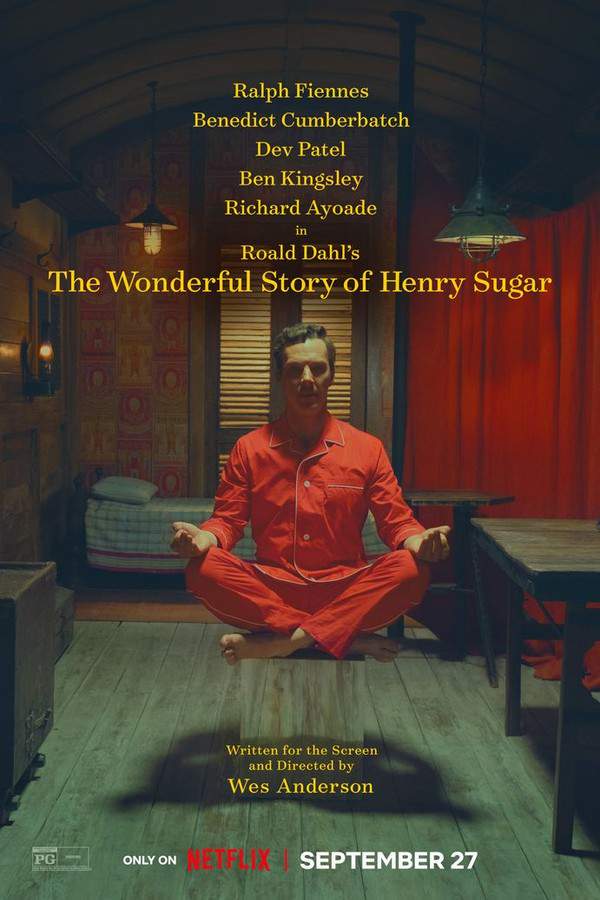
A whimsical story follows Henry Sugar as he discovers a method for seeing through objects and perceiving the future. This anthology film presents one tale from Roald Dahl’s collection, "The Wonderful Story of Henry Sugar and Six More," delving into themes of perception, luck, and the hidden mysteries of the world. It explores how one man’s unusual abilities lead him on a surprising and thought-provoking journey.
Find where to stream, rent, or buy The Wonderful Story of Henry Sugar (2023) in the US with current JustWatch availability, up-to-date pricing, and platform listings for subscription, rental, and digital purchase options.
Warning: spoilers below!
Haven’t seen The Wonderful Story of Henry Sugar yet? This summary contains major spoilers. Bookmark the page, watch the movie, and come back for the full breakdown. If you're ready, scroll on and relive the story!
Read the complete plot breakdown of The Wonderful Story of Henry Sugar (2023), including all key story events, major twists, and the ending explained in detail. Discover what really happened, and what it all means.
Henry Sugar, portrayed by Benedict Cumberbatch, is a wealthy bachelor who has dedicated his life to gambling, using the substantial fortune he inherited from his father. At 41 years old, Henry's selfish nature has kept him from forming any meaningful relationships, and he has chosen not to share his wealth with anyone. His penchant for luxury includes a penchant for exquisite clothing and a flashy Ferrari, which he treats as a mere accessory to his extravagant lifestyle, spending on cars as one might for an entire cottage.
Obsessed with the idea of amassing even more wealth, Henry ventures into the world of deceitful gambling. One day, while visiting his friend William W, he stumbles upon a curious book in William's library that piques his interest. This book details the fascinating account of Dr. ZZ Chatterjee, played by Dev Patel, and Imdad Khan, portrayed by Ben Kingsley. Imdad, who first met Dr. Chatterjee in Calcutta on December 2, 1935, claimed to possess the extraordinary ability to perceive the world without relying on his eyesight—a skill he was eager to prove through rigorous testing.
Imdad, a 61-year-old with distinctive white hair and mustache, had spent his life traveling with a circus. He enthusiastically participated in tests conducted by Dr. Chatterjee, involving blindfolds and bandages to ensure he truly could not see. To everyone’s astonishment, Imdad confidentally cycled away from the hospital, demonstrating feats of perception that entertained crowds in his circus.
As the narrative unfolds, we learn about Imdad's intriguing past. Born in Kashmir in 1873, he fled home to join the circus at the age of 13. His quest for enlightenment led him to a mystical guru, The Great Yogi, portrayed by Richard Ayoade, who initially met Imdad's curiosity with skepticism. However, after acknowledging Imdad's determination, the Yogi took him under his wing and taught him meditation techniques that enhanced Imdad's abilities. Through rigorous practice, he perfected methods to perceive objects without sight.
Despite his talents, public disbelief surrounded Imdad's abilities, which were seen as mere tricks rather than genuine insights. Tragically, before doctors could further study him, Imdad passed away, leaving Dr. Chatterjee in awe of the possibilities that such use of meditation could offer to the blind and deaf. Chatterjee meticulously documented Imdad's teachings in a book, preserving his legacy.
Meanwhile, inspired by Imdad's life and teachings, Henry dedicates three years to mastering these meditative practices, allowing him to refine his gambling technique. He learns to read cards in mere seconds, turning his newfound skill into a considerable fortune, winning £30,000 in one blackjack session. However, the thrill of easy money fades as Henry realizes he’s not driven by wealth. Rebelliously, he discards his earnings from the balcony, leading to chaos in the streets below.
Counseled by the police to redirect his money towards legitimate charitable endeavors, Henry embarks on a journey across the globe. Under various disguises, he uses his skills to amass substantial funds, eventually founding a network of hospitals and orphanages, accumulating over £120 million in just a year—all tucked away in tax-free Switzerland.
Decades later, Henry passes away at 63 from a pulmonary embolism, a fate he foresaw. With a staggering fortune of £644 million, he leaves behind a legacy of 21 well-established children's hospitals and orphanages worldwide. His story is later chronicled by Ralph Fiennes as Roald Dahl, who wrote about Henry Sugar in 1976, capturing the life of a once selfish man transformed by the extraordinary and the mundane.
Last updated: October 25, 2024 at 08:29
Explore frequently asked questions about The Wonderful Story of Henry Sugar (2023) with spoiler-rich answers covering the full plot summary, major story beats, character motivations, hidden details, and ending meaning. This movie summary FAQ helps explain confusing scenes, plot twists, and narrative decisions in clear, searchable detail.
Henry's transformation began when he discovered Dr. Chatterjee's book about Imdad Khan. After mastering the meditative techniques described in the book, he won £30,000 at blackjack but realized wealth didn't fulfill him. Throwing the money from his balcony marked his rejection of material excess. The police then encouraged him to use his skills for good, leading him to a life of philanthropy.
Henry found a book in his friend William W's library that documented Dr. ZZ Chatterjee's research on Imdad Khan. The book described how Imdad learned meditation techniques from The Great Yogi, allowing him to perceive the world without sight. Henry spent three years practicing these same meditative methods, eventually developing the ability to see through cards and perceive their values.
Imdad Khan was born in Kashmir in 1873 and fled home at age 13 to join a circus. He later met The Great Yogi, a mystical guru who initially doubted him but recognized his determination. The Yogi taught him meditation techniques that enabled him to perceive objects without sight. Imdad demonstrated this ability through rigorous tests with Dr. Chatterjee in Calcutta, including blindfolded cycling, though the public remained skeptical of his talents.
After winning £30,000 in a single blackjack session using his newly developed abilities, Henry experienced a moment of clarity. He realized that accumulating wealth through gambling didn't satisfy him, the thrill of easy money had faded. In a rebellious act, he discarded the cash from his balcony, causing chaos in the streets below, symbolizing his disillusionment with material wealth.
Henry used various disguises while traveling the world to avoid drawing attention to his unusual gambling abilities. Since he could see through cards, casinos would quickly recognize something was unusual if he won consistently using his own identity. The disguises allowed him to continue amassing money for his charitable mission without being detected or questioned.
Henry Sugar died at age 63 from a pulmonary embolism, a fate he had foresaw through his meditative abilities. Despite knowing his death was approaching, he had already transformed his life into one of purpose and generosity, leaving behind £644 million and a legacy of 21 children's hospitals and orphanages worldwide.
Earlier in the story, Henry learns to perceive future events through his meditation practice, which ultimately allowed him to foresee his own death.
Imdad Khan passed away before doctors could conduct further studies on his abilities. Despite demonstrating remarkable perception skills through rigorous testing with Dr. Chatterjee, including blindfolded cycling, public disbelief persisted about the authenticity of his talents. Dr. Chatterjee preserved Imdad's teachings by documenting them in a book, which would later inspire Henry Sugar.
Henry Sugar amassed over £120 million in just one year through his gambling activities, storing the funds in tax-free Switzerland. By the end of his life, his fortune grew to £644 million, which he used to establish 21 children's hospitals and orphanages around the world.
The Great Yogi taught Imdad Khan specialized meditation techniques that enhanced his natural abilities to perceive objects without using his eyesight. After initially being skeptical of Imdad's claims, the Yogi recognized his determination and took him under his wing. Through rigorous practice, Imdad perfected these methods, ultimately demonstrating abilities that astounded researchers like Dr. Chatterjee.
Roald Dahl, portrayed by Ralph Fiennes, serves as the narrator and chronicler of Henry Sugar's life. The film is framed as Dahl recounting Henry's extraordinary story, which he originally wrote about in 1976. This meta-fictional framing adds a whimsical layer, as Dahl presents the tale directly to the audience in the film's distinctive theatrical style.
Henry Sugar inherited a substantial fortune from his father, which allowed him to live a life of luxury devoted to gambling. At age 41, he spent his inherited wealth on extravagant items including exquisite clothing and a flashy Ferrari, which he treated as accessories rather than significant investments.
The book in William W's library contained Dr. Chatterjee's documented account of Imdad Khan's extraordinary abilities. This chance discovery completely changed Henry's life trajectory, it introduced him to meditation techniques that gave him supernatural perception abilities and ultimately inspired his transformation from selfish gambler to philanthropist.
Still wondering what the ending of The Wonderful Story of Henry Sugar (2023) really means? Here’s a spoiler-heavy breakdown of the final scene, major twists, and the deeper themes that shape the film’s conclusion.
The story of Henry Sugar concludes with the revelation that Henry Sugar was not his real name, and his true identity was kept secret intentionally. This suggests that his transformation was not about personal fame but about embodying the idea that anyone, regardless of their background, can become a person of compassion and kindness. Throughout his life, Henry was driven by greed and self-interest, but after discovering the power to see without his eyes—gained through intense focus and meditation—his perspective changed dramatically. Unlike before, material wealth no longer mattered to him, and he chose to use his newfound abilities to help others. He accumulated a considerable fortune and dedicated himself to building hospitals and orphanages, ultimately changing the lives of many.
In the final moments, it's implied that Henry's true identity remains anonymous because his journey symbolizes a universal truth: that anyone can find their higher self and choose kindness and altruism over greed. His story serves as a reminder that true fulfillment comes from giving rather than accumulating wealth. The ending underscores that the power of compassion and self-awareness transcends individual identity, emphasizing that the real treasure lies in the good we do for others. By the end, Henry Sugar’s life illustrates that a simple act of kindness can transform not just an individual but the world around them.
Last updated: June 25, 2025 at 09:01
Discover curated groups of movies connected by mood, themes, and story style. Browse collections built around emotion, atmosphere, and narrative focus to easily find films that match what you feel like watching right now.
Quirky tales of unlikely heroes discovering hidden talents and finding new purpose.If you enjoyed the quirky character arc in The Wonderful Story of Henry Sugar, you'll like these movies about unlikely heroes finding their purpose. Discover films with similar themes of self-discovery, magical realism, and lighthearted adventures where characters undergo surprising and hopeful changes.
The narrative pattern centers on an ordinary or flawed individual encountering something extraordinary—a magical skill, a unique perspective, or a peculiar situation. This discovery initiates a low-intensity, reflective journey where the character learns, grows, and ultimately uses their new-found 'gift' for a positive purpose, often benefiting others.
Movies in this thread share a core focus on gentle, character-driven transformation. They are united by a whimsical tone, light emotional weight, and a focus on the playful and thoughtful process of someone becoming a better version of themselves, making them feel uplifting and optimistic.
Films that playfully break the fourth wall, embracing their nature as stories being told.Looking for more movies with a quirky narrative style like The Wonderful Story of Henry Sugar? This collection features films that break the fourth wall, use theatrical framing, and have a self-aware storyteller vibe, offering a similar whimsical and intellectually playful viewing experience.
The narrative structure is often unconventional, featuring a story-within-a-story or a narrator who actively participates in the framing. The pacing is deliberate, allowing the audience to appreciate the craft of the tale itself. The focus is less on surprise and more on the delightful and witty manner in which the story unfolds.
These films are grouped by their distinctive narrative voice and stylistic choices. They share a playful, intellectual quality, a moderate complexity due to their layered structure, and a lighthearted tone that comes from acknowledging the audience and the art of storytelling.
Don't stop at just watching - explore The Wonderful Story of Henry Sugar in full detail. From the complete plot summary and scene-by-scene timeline to character breakdowns, thematic analysis, and a deep dive into the ending - every page helps you truly understand what The Wonderful Story of Henry Sugar is all about. Plus, discover what's next after the movie.
Track the full timeline of The Wonderful Story of Henry Sugar with every major event arranged chronologically. Perfect for decoding non-linear storytelling, flashbacks, or parallel narratives with a clear scene-by-scene breakdown.
Discover the characters, locations, and core themes that shape The Wonderful Story of Henry Sugar. Get insights into symbolic elements, setting significance, and deeper narrative meaning - ideal for thematic analysis and movie breakdowns.
What really happened at the end of The Wonderful Story of Henry Sugar? This detailed ending explained page breaks down final scenes, hidden clues, and alternate interpretations with expert analysis and viewer theories.
Discover movies like The Wonderful Story of Henry Sugar that share similar genres, themes, and storytelling elements. Whether you’re drawn to the atmosphere, character arcs, or plot structure, these curated recommendations will help you explore more films you’ll love.
The Wonderful Story of Henry Sugar (2023) Scene-by-Scene Movie Timeline
The Wonderful Story of Henry Sugar (2023) Movie Characters, Themes & Settings
The Wonderful Story of Henry Sugar (2023) Ending Explained & Theories
The Wonderful Story of Henry Sugar (2023) Spoiler-Free Summary & Key Flow
Movies Like The Wonderful Story of Henry Sugar – Similar Titles You’ll Enjoy
Charlie and the Chocolate Factory (2005) Ending Explained & Film Insights
Willy Wonka & the Chocolate Factory (1971) Full Movie Breakdown
Bedtime Stories (2008) Full Movie Breakdown
Shorts (2009) Plot Summary & Ending Explained
Sugar & Spice (2001) Ending Explained & Film Insights
Hansel & Gretel (2002) Film Overview & Timeline
Wonka (2023) Ending Explained & Film Insights
The Magic Finger (1990) Ending Explained & Film Insights
The Wizard of Speed and Time (1988) Spoiler-Packed Plot Recap
A Very Old Story (1968) Spoiler-Packed Plot Recap
The Wonderful World of the Brothers Grimm (1962) Film Overview & Timeline
Storytime (1979) Full Movie Breakdown
Somewhere in Dreamland (1936) Film Overview & Timeline
Hans Christian Andersen (1952) Complete Plot Breakdown
Storybook (1994) Film Overview & Timeline