Plot Explained Spoilers guaranteed!
Plot Explained

Browse by genre

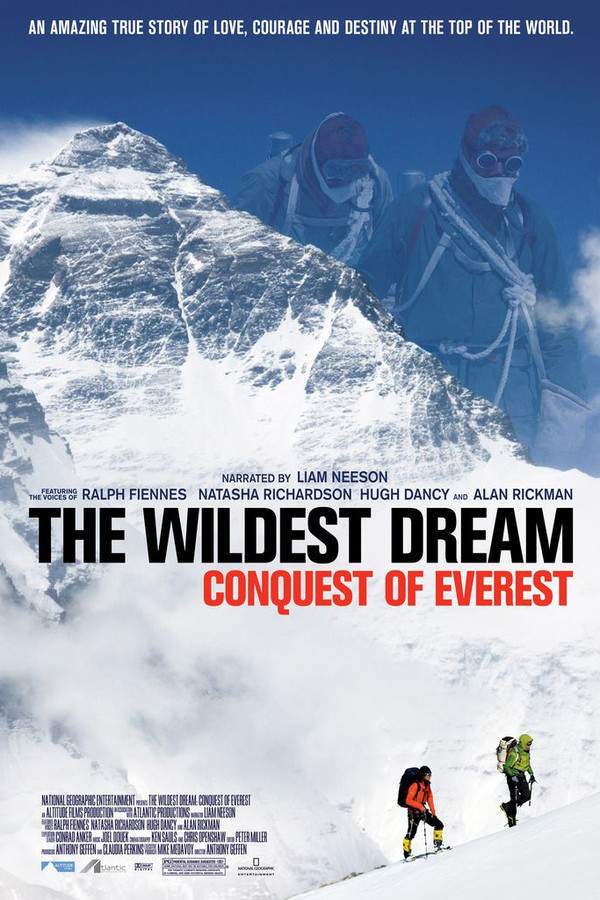
The Wildest Dream (2010) movie poster

Plot Summary

The Wildest Dream (2010) Plot Summary Explained

Release, runtime and language
2010 · 94 min · English
Directed by
Anthony Geffen

Two mountaineers set out on a challenging expedition to Mount Everest, retracing the ill-fated 1924 attempt by George Mallory. Facing extreme conditions and dangerous terrain, they seek to understand Mallory’s determination and the enduring mystery surrounding his disappearance. The journey becomes a moving tribute to a legendary climber and the captivating power of the world's highest peak.

On this page (6)
  1. 1 Where to watch
  2. 2 What happens: full plot
  3. 3 Plot questions answered
  4. 4 Movie threads
  5. 5 Movies like The Wildest Dream
  6. 6 Every angle

Where to watch

Where to Watch The Wildest Dream (2010)

Where can you watch The Wildest Dream? Stream, rent or buy it in the US, including on Apple TV Store: current JustWatch availability with up-to-date prices.

Streaming availability powered by JustWatch

Full plot summary · contains spoilers

What Happens in The Wildest Dream: Full Plot Summary

The whole story of The Wildest Dream (2010) explained, from the opening scene to the final frame: every key event, every twist and what it all adds up to. Read it as a quick recap before the sequel, to check a scene you missed, or to finally understand what really happened.

In 1999, acclaimed American mountaineer Conrad Anker made a groundbreaking discovery that echoed around the world. While navigating the treacherous conditions of Mount Everest's death zone, he uncovered the body of George Mallory—75 years after the British explorer mysteriously disappeared while striving to become the first individual to conquer the tallest peak on Earth.

Mallory had courageously ventured into the unknown, clad in gabardine and hobnailed boots, determined to fulfill his ambition of reaching Everest’s summit, an endeavor considered the last great adventure of 1924. He was last seen alive a mere 800 feet shy of the peak. Just then, the clouds enveloped him, and he vanished into the annals of legend.

With the discovery of Mallory's body, Anker found his life inextricably linked with that of the deceased climber. Remarkably, all of Mallory’s belongings were discovered undisturbed. However, the one item that eluded recovery was a photograph of Ruth, his beloved, which he had vowed to plant at the summit. Overcome by the haunting tale of Mallory, Anker yearned to return to Everest and lay the spirit of the explorer to rest.

Directed by Emmy® Award-winning filmmaker Anthony Geffen and narrated by Academy Award® nominee Liam Neeson, alongside the voices of Oscar® nominees Ralph Fiennes, Natasha Richardson, Hugh Dancy, and Alan Rickman, The Wildest Dream: Conquest of Everest emerges as a stunning mountaineering chronicle aimed at unraveling the enduring enigma surrounding Mallory's fate on Mount Everest. The central question it explores is whether Mallory actually succeeded in his ascent before both he and fellow climber Andrew “Sandy” Irvine disappeared in 1924.

In pursuit of the truth, Anker ascended Everest in 2007 alongside climbing prodigy Leo Houlding, striving to mirror Mallory’s ill-fated expedition as closely as possible. They retraced the North East Ridge Route, even removing the ladder from the notoriously perilous Second Step to free climb the daunting 90-foot sheer rock wall—an undertaking Mallory and Irvine would have faced 83 years earlier.

Yet, this documentary transcends mere mountain climbing; The Wildest Dream: Conquest of Everest intricately weaves the poignant saga of George Mallory, whose famous retort to a reporter’s question about his motivation for climbing Everest—“Because it’s there”—has inspired countless adventurers for generations. Mallory embodied a passionate and multifaceted character, torn between two overwhelming forces: his love for his wife and the mountain that ultimately claimed his life.

The narrative is enriched by the heartfelt and evocative correspondence between Mallory and his cherished Ruth, combining previously unseen archival photos, meticulously restored film footage, and dramatized reenactments with the contemporary account of Anker’s expedition. Together, these elements narrate the pursuit to conquer Everest and the deep yearning for home. In this journey, Anker’s experience mirrors that of Mallory in a tale of obsession, as poignant and relevant today as it was in 1924.

Last updated: November 03, 2024 at 13:25

Was this helpful?

Plot questions answered

The Wildest Dream Plot Explained: Your Questions Answered

The questions people ask most about The Wildest Dream (2010): what happens in the confusing scenes, why the characters do what they do, the twists, hidden details and what the ending means. Each answer contains spoilers.

Q1

Why did George Mallory want to climb Everest?

Mallory was driven by a deep passion for adventure and conquest. His famous response to a journalist's question about why he wanted to climb Everest, 'Because it's there', became one of the most iconic quotes in mountaineering history. However, the documentary reveals a more complex motivation: Mallory was torn between his love for his wife Ruth and his all-consuming obsession with the mountain that would ultimately claim his life.

Foreshadowing: The film hints at this internal conflict early on through Mallory's letters to Ruth, showing his struggle between domestic happiness and his mountaineering ambition.

  • mallory motivation
  • everest 1924
  • because it's there
  • climbing
  • ambition
Q2

Did George Mallory actually summit Everest in 1924?

This remains the central unresolved mystery of the documentary. Mallory was last seen alive just 800 feet from the summit before clouds enveloped him and he disappeared. The 1999 discovery of his body raised more questions than answers, researchers continue to debate whether he and Irvine reached the top before their fatal descent. The documentary deliberately leaves this question open, letting viewers draw their own conclusions from the evidence.

Foreshadowing: Early scenes establish Mallory's determination and physical capability, leaving open the possibility that he may have succeeded.

  • mallory summit
  • did mallory reach top
  • everest mystery
  • 1924 expedition
  • unsolvable
Q3

What happened to the photograph of Mallory's wife Ruth?

When Mallory's body was discovered in 1999, all his belongings were found undisturbed on his person, except for a small photograph of his wife Ruth that he had promised to plant at the summit. This missing photograph became one of the most poignant details of the discovery, symbolizing both his unfulfilled promise and the tragic incompleteness of his final expedition.

Foreshadowing: The documentary establishes early on that Mallory carried this photograph specifically to leave at the summit, making its absence from his belongings significant.

  • ruth mallory
  • photograph
  • summit promise
  • missing photo
  • 1999 discovery
Q4

Why did Conrad Anker feel compelled to return to Everest?

After discovering Mallory's body in 1999, Anker became deeply haunted by the explorer's story. He felt a personal connection to Mallory and a responsibility to honor his legacy. This emotional weight drove Anker to organize the 2007 expedition, not just to investigate what happened, but to literally retrace Mallory's footsteps and lay the explorer's spirit to rest by completing the journey Mallory never finished.

Foreshadowing: The discovery scene in 1999 clearly affects Anker emotionally, foreshadowing his later commitment to returning.

  • conrad anker
  • mallory legacy
  • 2007 expedition
  • emotional journey
  • closure
Q5

What was the Second Step and why was it significant?

The Second Step is a notorious 90-foot sheer rock wall along the North East Ridge Route of Everest, considered one of the most dangerous technical challenges on the mountain. In 2007, Anker and Houlding deliberately removed the ladder that had been placed there by earlier expeditions and free climbed the wall to experience exactly what Mallory and Irvine would have faced in 1924, an attempt to understand whether the 1924 climbers could have possibly overcome this obstacle with their equipment.

Foreshadowing: The documentary emphasizes the Second Step's difficulty early in the historical narrative, building tension toward the 2007 recreation.

  • second step
  • north east ridge
  • free climb
  • 1924 route
  • technical challenge
Q6

Who was Andrew 'Sandy' Irvine and what happened to him?

Andrew 'Sandy' Irvine was Mallory's climbing partner on the 1924 expedition. He was an experienced mountaineer and Oxford graduate who joined Mallory for the final attempt on the summit. Unlike Mallory's body, which was discovered in 1999, Irvine's remains have never been found. This disappearance has fueled decades of speculation about whether he and Mallory reached the summit and what exactly happened during their final climb.

Foreshadowing: The historical narrative establishes Irvine as Mallory's trusted companion, making his vanishing equally mysterious.

  • andy irvine
  • sandy irvine
  • 1924 climbing partner
  • missing body
  • everest mystery
Q7

What was the 2007 expedition trying to prove?

The 2007 expedition led by Anker and Houlding was not designed to definitively prove whether Mallory reached the summit, but rather to understand the physical possibility of it. By retracing Mallory's exact route, removing modern equipment like the ladder at the Second Step, and using period-appropriate gear, they sought to experience firsthand what Mallory and Irvine faced, gaining insight into whether a successful ascent was physically achievable with 1924 equipment and conditions.

Foreshadowing: The documentary frames the 2007 expedition as an attempt at historical empathy rather than definitive proof.

  • 2007 expedition
  • leo houlding
  • retrace route
  • historical investigation
  • physical possibility
Q8

Why does the documentary focus on Mallory's relationship with his wife Ruth?

The love story between Mallory and Ruth serves as the emotional core of the documentary, providing human depth to what could otherwise be a straightforward adventure narrative. Through their heartfelt correspondence, viewers see Mallory not just as a daring explorer but as a man torn between his passionate love for his wife and his dangerous obsession with the mountain. This emotional tension explains his motivations and makes his fate more poignant.

Foreshadowing: The documentary opens with or early establishes Ruth's letters, setting up the emotional stakes of the expedition.

  • ruth mallory
  • love story
  • letters
  • emotional core
  • marriage
Q9

What was the outcome of the 2007 expedition?

The 2007 expedition successfully retraced Mallory's route and provided new insights into the 1924 attempt, but it did not definitively solve the mystery of whether Mallory reached the summit. The climbers confirmed that the Second Step was climbable with 1924 equipment, making a successful summit theoretically possible, but whether Mallory actually achieved it remains unknown. The expedition provided closure for Anker personally while leaving the central historical question open.

Foreshadowing: The documentary builds toward this expedition as its climax, suggesting both the possibility of answers and the likelihood of continued mystery.

  • 2007 results
  • expedition outcome
  • closure
  • second step climbable
  • unsolved mystery remains
Q10

Why is Mallory's quote 'Because it's there' so significant?

Mallory's seemingly simple reply to a journalist's question about his Everest motivation became one of the most famous quotes in exploration history. It embodies the pure spirit of adventure and the human impulse to conquer the unknown simply because it exists. The documentary uses this quote as a thematic touchstone, exploring what drives explorers to risk everything for a mountain, suggesting that sometimes the motivation is as much about the challenge itself as any tangible reward.

Foreshadowing: The quote appears early in the film and resurfaces throughout, becoming a recurring theme that frames Mallory's character.

  • because it's there
  • famous quote
  • mountaineering
  • exploration
  • motivation

Movie threads

More Movies Like The Wildest Dream, by Mood & Story

Curated lists built around what makes The Wildest Dream tick: the same mood, the same kind of story or the same emotional payoff. Each list explains why these movies belong together.

Movies about obsessive quests like The Wildest Dream

Stories of individuals consumed by a singular, dangerous pursuit with an unresolved ending. If you were captivated by the driven, melancholic quest in The Wildest Dream, explore these other movies. This selection features stories of individuals on singular, often perilous journeys driven by obsession, resulting in haunting and bittersweet mysteries.

  • obsessive
  • haunting
  • somber
  • tragic
  • awe-inspiring
  • reflective
  • Tone: melancholic, reflective
  • Pacing: variable, atmospheric
Why these movies?

The story pattern: These narratives follow a character or group fixated on achieving a near-impossible goal, often retracing a tragic past event. The journey is as much an internal exploration of obsession and sacrifice as it is an external adventure, building towards an ambiguous or tragic conclusion that leaves a profound sense of melancholy and unanswered questions.

Why they belong together: Movies in this thread share a heavy emotional weight and a melancholic tone, stemming from their focus on obsession and the high personal cost of ambition. They blend high-intensity adventure with deep reflection, creating a powerful, bittersweet viewing experience centered on the duality of human achievement and loss.

Movies about tragic expeditions like The Wildest Dream

Visually stunning journeys into extreme environments shadowed by loss and sacrifice. For viewers who enjoyed the mountaineering peril and emotional depth of The Wildest Dream, this list highlights similar movies. Discover other tense, visually spectacular expedition stories that grapple with survival, personal sacrifice, and the heavy cost of exploring the extremes.

  • adventurous
  • tragic
  • somber
  • awe-inspiring
  • haunting
  • dangerous
  • Tone: somber, awe-inspiring
  • Pacing: variable, shifting between tense and reflective
Why these movies?

The story pattern: The plot follows a group or individual embarking on a formidable journey through a stunning yet dangerous landscape. The narrative structure often weaves between the present-day challenge and a past tragedy, using the expedition to explore themes of memory, legacy, and the human spirit facing insurmountable odds, resulting in a somber and reflective conclusion.

Why they belong together: These films are grouped by their unique blend of high-intensity survival action against epic backdrops with a deeply melancholic and reflective emotional core. They share a variable pacing that shifts between tense action and quiet, somber moments, all leading to a bittersweet or tragic ending that underscores the fragility of life.

If you liked this

Movies Like The Wildest Dream

Similar movies to The Wildest Dream: the same genre, themes or kind of story. Each one comes with its own plot summary, timeline and ending explained.

Browse all movie summaries

Every angle

The Wildest Dream (2010) Explained: Plot, Timeline & Characters

Everything about The Wildest Dream in one place: what happens in the plot summary, the timeline in chronological order, the characters and meaning and a spoiler-free summary. What's After the Movie adds the cast, box office and post-credit scenes.

Coming soon on iOS and Android

The Plot Explained Movie Summary App

Plot summaries, endings explained and timelines on your phone. Catch up on any movie in minutes, save your favorites and never miss a twist again.

Be the first to know when we launch. Your email stays private, always.

Learn more about the app