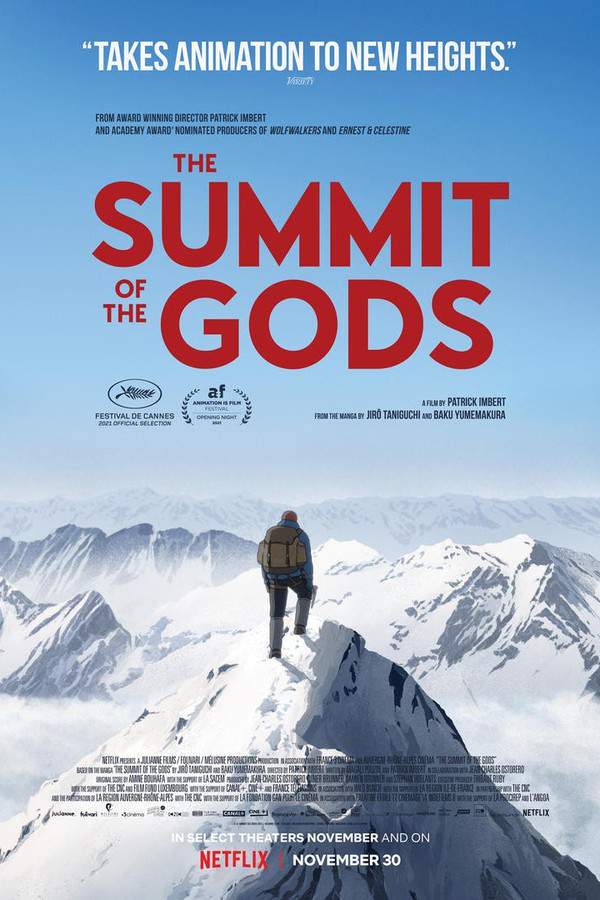
#4,07034 Year: 2021
Runtime: 95 min
Language: French
Director: Patrick Imbert
Echo Score: 85Budget: $9.9M
A young journalist's discovery of a legendary camera sparks a dangerous journey to find Habu, a mysterious climber thought to be lost. Drawn into the intense world of mountaineering, Fukamachi uncovers a story of obsession and ambition. He must navigate a treacherous landscape as he pursues the truth about Habu and the allure of the highest peak, where the quest for the impossible has deadly consequences.
Find where to stream, rent, or buy The Summit of the Gods (2021) in the US with current JustWatch availability, up-to-date pricing, and platform listings for subscription, rental, and digital purchase options.
Warning: spoilers below!
Haven’t seen The Summit of the Gods yet? This summary contains major spoilers. Bookmark the page, watch the movie, and come back for the full breakdown. If you're ready, scroll on and relive the story!
Read the complete plot breakdown of The Summit of the Gods (2021), including all key story events, major twists, and the ending explained in detail. Discover what really happened, and what it all means.
In 1924, British mountaineers George Mallory and Andrew Irvine set off on a daring attempt to conquer the formidable Mount Everest, only to vanish without a trace. Fast forward seventy years later, a young Japanese reporter, Makoto Fukamachi, finds himself entwined in the enigma surrounding their disappearance when he encounters a cryptic climber named Habu Joji. Fukamachi's suspicions ignite as he perceives a camera in Habu's possession, one that could potentially unveil whether Mallory and Irvine truly achieved the first ascent of the world's highest peak.
Driven by an unyielding desire to unearth the truth, Fukamachi delves deeper into Habu's past, exploring his history as a climber and engaging in interviews with past acquaintances. It becomes apparent that Habu has a proclivity for solo expeditions, a tendency that intensified after a tragic incident claimed the life of a young mentee. This tragic event leaves an indelible mark on Habu’s psyche and shapes his climbing philosophy. As Fukamachi immerses himself more into the mystery, he becomes increasingly obsessed with finding Habu, motivating him to embark on a rigorous fitness regime to prepare for mountaineering.
This fervor ultimately propels Fukamachi to Nepal in search of Habu. After an arduous journey, he finally tracks him down at a humble hut nestled near Mount Everest. Initially resistant to Fukamachi's presence, Habu eventually acquiesces, allowing the reporter to document his ambitious solo attempt at scaling the southwestern face of Everest during the grueling winter season. The duo establishes that during Habu's ascent, communication is strictly limited—no speaking or assistance is allowed.
As the climb commences, Fukamachi follows closely behind Habu, but an unexpected tempest strikes, dramatically impacting their expedition. Overcome by exhaustion and pain, Fukamachi falters, prompting Habu to make the selfless decision to backtrack and rescue him, bravely sacrificing his solo ascent in the process. As Fukamachi recovers, he returns to the base alone, while Habu persists on his journey. Against all odds, Habu manages to reach the summit, marking a significant milestone in his climbing endeavors.
Days pass with no sign of Habu, leading Fukamachi to make the difficult decision to return to Japan. He departs the base with Mallory's camera and a poignant letter from Habu, delivered via a friendly sherpa. The letter reveals Habu’s final thoughts: if Fukamachi is reading it, Habu perished while continuing his summit pursuit, yet he faced it all without regret.
In a profound denouement, Fukamachi develops the film from the camera. Through this experience, he uncovers the visceral connection that mountaineers have with their craft, an understanding that transcends danger and risk. Inspired by Habu's journey, Fukamachi resolves to return to Everest himself, determined to conquer the peak just as Habu did, embracing the spirit of adventure and the indomitable will of climbers who dare to reach for the summit against all odds.
Last updated: December 03, 2024 at 14:27
Explore frequently asked questions about The Summit of the Gods (2021) with spoiler-rich answers covering the full plot summary, major story beats, character motivations, hidden details, and ending meaning. This movie summary FAQ helps explain confusing scenes, plot twists, and narrative decisions in clear, searchable detail.
Habu's preference for solo climbing developed after a tragic incident where a young mentee died during a climb. This loss profoundly affected him and shaped his philosophy that climbing must be a solitary, personal endeavor. He believes true mountaineering requires facing the mountain alone, without the distraction or burden of another person's safety.
Earlier interviews reveal Habu's reluctance to take on climbing partners, hinting at the psychological trauma beneath his stoic exterior.
The camera belongs to George Mallory from the 1924 British Everest expedition. If the film inside reveals whether Mallory and Andrew Irvine reached the summit before Edmund Hillary and Tenzing Norgay in 1953, it could rewrite mountaineering history. This mystery drives Fukamachi's entire investigation.
Fukamachi spots the camera early in their encounter, setting the central mystery of the film in motion.
During the storm, Habu realizes Fukamachi is in critical danger from exhaustion and pain. Despite his lifelong commitment to solo climbing and this being his best chance at summiting, Habu chooses to double back and rescue him. This act demonstrates that his humanity outweighs his mountaineering ambition.
The storm strikes suddenly, forcing Habu to make an impossible choice between his lifelong dream and his companion's life.
British climbers George Mallory and Andrew Irvine disappeared during their 1924 attempt to become the first to summit Mount Everest. Their bodies were never recovered, and whether they reached the summit before their disappearance remains one of mountaineering's greatest mysteries. The camera they carried could potentially answer this question.
The film opens with the 1924 tragedy, establishing the historical mystery that echoes throughout the narrative.
After developing the film from Mallory's camera and reading Habu's final letter, Fukamachi gains a profound understanding of what drives climbers to risk everything for the summit. Habu's death and his unwavering commitment inspire Fukamachi to pursue his own mountaineering journey, seeking to experience firsthand the dangerous allure that captivated Habu.
Habu's letter hints at his success but tragic end, yet emphasizes he faced death without regret, passion that clearly moves Fukamachi.
The letter, delivered by a sherpa after Habu departs, contains his final thoughts. Habu writes that if Fukamachi is reading it, he died continuing his pursuit of the summit. Despite knowing the fatal risks, he expresses no regret, his life was defined by the climb itself, not merely reaching the top.
The letter arrives with Mallory's camera, suggesting Habu completed his mission but paid the ultimate price.
Fukamachi's investigation into Habu transforms from professional curiosity into personal obsession. Realizing that understanding Habu requires experiencing mountaineering firsthand, he commits to rigorous physical training. This preparation becomes essential for his subsequent journey to Nepal and the actual climb.
His training begins after learning about Habu's solo expeditions, showing how the mystery consumes him.
Seventy years after Mallory and Irvine's disappearance, Makoto Fukamachi, a young Japanese reporter, encounters the mysterious climber Habu Joji. Fukamachi notices what appears to be Mallory's legendary camera in Habu's possession, sparking his suspicion that the 1924 climbers may have actually succeeded in reaching the summit.
This initial encounter establishes the central mystery that drives the entire narrative.
Back in Japan, Fukamachi develops the film from Mallory's camera. Rather than revealing historical proof of the first summit, the experience gives him a visceral understanding of the mountaineering spirit, the dangerous allure that compels climbers to risk everything. This emotional revelation changes him more than any factual discovery could.
The camera's contents remain ambiguous, but Fukamachi's reaction suggests the journey itself transformed him.
Although Habu initially resists Fukamachi's presence, he eventually permits the journalist to document his solo winter ascent of Everest's southwestern face. This rare exception likely stems from Fukamachi's determination and perhaps Habu's own loneliness after years of isolation. The strict rule of no communication during the climb reflects Habu's commitment to solo climbing principles.
Habu's resistance softens after Fukamachi tracks him down at the remote hut, suggesting Habu sees something worthy in the journalist.
A fierce storm hits as Fukamachi and Habu ascend, creating dangerous conditions. Fukamachi struggles severely from exhaustion and pain, becoming unable to continue safely. This crisis forces Habu to choose between continuing to the summit or rescuing his companion, a decision that ultimately costs Habu his life.
The storm arrives without warning, transforming the climb from ambitious pursuit to life-or-death struggle.
After rescuing Fukamachi and ensuring his safe descent to base camp, Habu continues alone and successfully summits Everest. Despite sacrificing his original solo ascent plan to save Fukamachi, he manages to complete the climb afterward. However, he dies during the descent, fulfilling the letter's prediction that he perished pursuing the summit.
Habu's letter suggests he reached the top, and the sherpa's arrival with the camera confirms his success.
Still wondering what the ending of The Summit of the Gods (2021) really means? Here’s a spoiler-heavy breakdown of the final scene, major twists, and the deeper themes that shape the film’s conclusion.
Fukamachi’s discovery of Habu Joji’s camera and his subsequent pursuit of Habu lead him to understand the deep drive that pushes mountaineers to chase dangerous, almost suicidal, pursuits. In the end, Habu succeeds in reaching the summit of Everest’s treacherous southwest face, risking his life without oxygen. After a storm forces him to retreat, Habu not only survives but also leaves behind Mallory’s camera—symbolic of his quest to prove his own legacy and the human obsession with conquering nature’s greatest challenges. Fukamachi develops the film and finds the proof he sought, confirming Mallory’s climb, yet the experience leaves him with more questions about the passion fueling these extreme endeavors. Inspired by Habu’s life and philosophy, Fukamachi ultimately climbs Everest himself, reaching the summit. There, he experiences the same rush of life that drove Habu—an existential triumph that emphasizes that mountaineering is not just about reaching the top, but about feeling alive in the face of danger. The film’s ending suggests that for climbers like Habu, pushing beyond limits becomes a way to stave off death and prove that they are truly alive. It’s a testament to the relentless human desire to seek meaning and challenge in the face of mortality. In the end, Fukamachi’s climb signifies his understanding that the true mountain to conquer is the one within, and that the pursuit of danger and passion is what keeps the human spirit alive.
Last updated: June 25, 2025 at 08:44
Discover curated groups of movies connected by mood, themes, and story style. Browse collections built around emotion, atmosphere, and narrative focus to easily find films that match what you feel like watching right now.
Stories where a character's all-consuming ambition is tested by a harsh, majestic environment.For viewers who liked the intense focus and dangerous setting of The Summit of the Gods, this thread collects movies about obsessive pursuits set against unforgiving landscapes. Discover similar stories of ambition and survival in films where the environment is a formidable antagonist.
The narrative follows a character whose life becomes defined by a specific, often perilous, quest set in a vast wilderness. The journey is as much an internal psychological exploration of obsession and drive as it is an external physical challenge against nature's overwhelming power.
These films share a potent mix of high-stakes survival, a melancholic or somber tone driven by personal obsession, and a focus on solitude and sacrifice against a backdrop of awe-inspiring but dangerous natural beauty.
Journeys of investigation and self-discovery that end with a profound, costly revelation.If you appreciated the investigative core and emotionally heavy, bittersweet ending of The Summit of the Gods, this thread features movies about characters on quests for truth that result in profound but costly personal revelations. Find similar mystery-driven dramas with impactful conclusions.
The plot is driven by an investigation or a personal mission to uncover a hidden past or achieve a monumental goal. The narrative structure often involves uncovering layers of a mystery, leading to a climax where the truth is revealed, but the victory is tinged with loss, sacrifice, or a heavy emotional price.
These stories are united by a mix of mystery and deep character study, a melancholic and reflective mood, a variable pacing that shifts between investigation and intense revelation, and a definitive bittersweet emotional resolution that leaves a lasting impact.
Don't stop at just watching - explore The Summit of the Gods in full detail. From the complete plot summary and scene-by-scene timeline to character breakdowns, thematic analysis, and a deep dive into the ending - every page helps you truly understand what The Summit of the Gods is all about. Plus, discover what's next after the movie.
Track the full timeline of The Summit of the Gods with every major event arranged chronologically. Perfect for decoding non-linear storytelling, flashbacks, or parallel narratives with a clear scene-by-scene breakdown.
Discover the characters, locations, and core themes that shape The Summit of the Gods. Get insights into symbolic elements, setting significance, and deeper narrative meaning - ideal for thematic analysis and movie breakdowns.
What really happened at the end of The Summit of the Gods? This detailed ending explained page breaks down final scenes, hidden clues, and alternate interpretations with expert analysis and viewer theories.
Discover movies like The Summit of the Gods that share similar genres, themes, and storytelling elements. Whether you’re drawn to the atmosphere, character arcs, or plot structure, these curated recommendations will help you explore more films you’ll love.
The Summit of the Gods (2021) Scene-by-Scene Movie Timeline
The Summit of the Gods (2021) Movie Characters, Themes & Settings
The Summit of the Gods (2021) Ending Explained & Theories
The Summit of the Gods (2021) Spoiler-Free Summary & Key Flow
Movies Like The Summit of the Gods – Similar Titles You’ll Enjoy
Everest (2015) Complete Plot Breakdown
The Summit (2013) Detailed Story Recap
The Climbers (2019) Full Summary & Key Details
The Wildest Dream (2010) Movie Recap & Themes
K2: Siren of the Himalayas (2014) Full Summary & Key Details
Tower of God (1000) Story Summary & Characters
Lost on Everest (2020) Story Summary & Characters
Beyond the Summit (2022) Full Summary & Key Details
Breathtaking K2: The World’s Most Dangerous Mountain (2020) Movie Recap & Themes
Everest (1998) Full Summary & Key Details
Everest (1000) Ending Explained & Film Insights
Race to the Summit (2023) Detailed Story Recap
Kaizen (2024) Full Summary & Key Details
Miracle on Everest (2008) Spoiler-Packed Plot Recap
The Summit: A Chronicle Of Stones to Serenity (2009) Complete Plot Breakdown