Plot Explained Spoilers guaranteed!
Plot Explained

Browse by genre

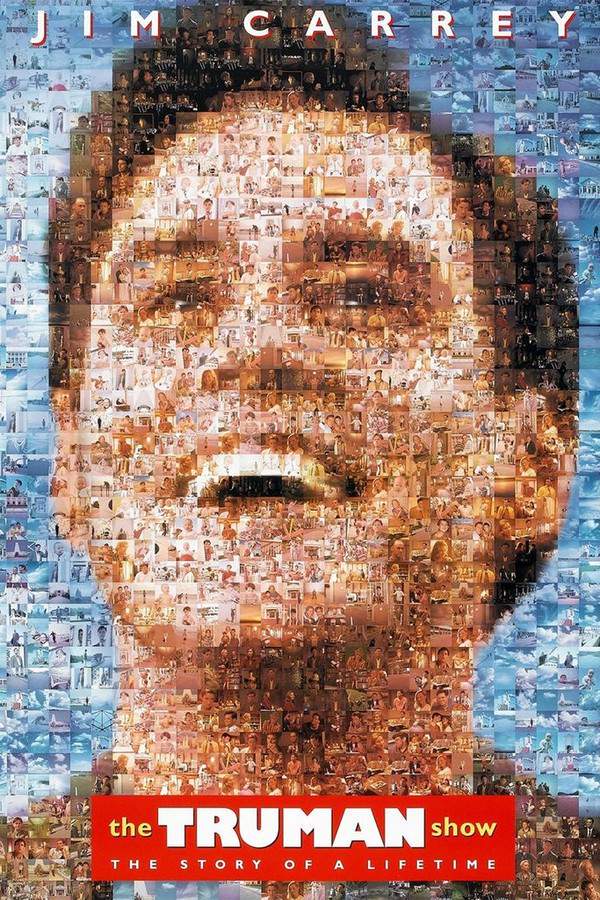
The Truman Show (1998) movie poster

Plot Summary

The Truman Show (1998) Plot Summary Explained

Release, runtime and language
1998 · 103 min · English
Directed by
Peter Weir
Starring
Jim Carrey

Truman Burbank believes he's living a normal life, unaware that his entire existence is a meticulously constructed television show broadcast to a global audience. Christof, the show's creator and executive producer, controls every detail of Truman’s world, from the weather to the people he interacts with. As Truman begins to notice inconsistencies and question his reality, he embarks on a journey to uncover the truth and break free from the elaborate fabrication that has defined his life, ultimately choosing between blissful ignorance and a quest for genuine freedom.

On this page (6)
  1. 1 Where to watch
  2. 2 What happens: full plot
  3. 3 Plot questions answered
  4. 4 Movie threads
  5. 5 Movies like The Truman Show
  6. 6 Every angle

Where to watch

Where to Watch The Truman Show (1998)

Where can you watch The Truman Show? Stream, rent or buy it in the US, including on Hoopla, Kanopy and Amazon Video: current JustWatch availability with up-to-date prices.

Streaming availability powered by JustWatch

Full plot summary · contains spoilers

What Happens in The Truman Show: Full Plot Summary

The whole story of The Truman Show (1998) explained, from the opening scene to the final frame: every key event, every twist and what it all adds up to. Read it as a quick recap before the sequel, to check a scene you missed, or to finally understand what really happened.

Truman Burbank, portrayed by Jim Carrey, is an unassuming insurance salesman who enjoys a seemingly perfect and tranquil life on the picturesque Seahaven Island. However, unbeknownst to him, he is the unwitting star of the most-watched live television show in history. The entire island is, in fact, an elaborate set, enclosed within a gigantic dome designed to simulate the natural world. This outlandish creation is the brainchild of the eccentric director, Christof (Ed Harris), who has been documenting Truman's life since his birth, believing that the unending portrayal of an individual’s life can create a beacon of hope.

As Truman reaches Day 10,909 of his extraordinary existence, peculiar events start to unfold. While preparing for work, he greets his neighbors with his customary phrase, "Good morning! And in case I don’t see you, good afternoon, good evening, and good night." Suddenly, a mysterious object falls from the sky and lands near his vehicle, hinting at the artificiality of his world. Initially attributing this incident to a nearby aircraft, Truman's journey to work begins to unravel more mysteries as he discreetly searches for information about a woman named Lauren or Sylvia Garland, yearning to explore beyond the confines of Seahaven.

At home, Truman's interactions with his wife, Meryl (Laura Linney), take a turn as he confides his dreams of leaving the island. Meryl, however, dismisses these thoughts, emphasizing their financial responsibilities. The cracks in Truman's reality continue to widen when he witnesses what appears to be his father (Brian Delate) as a homeless man on the streets, leading him to question the authenticity of his life. His mother (Holland Taylor) brushes off his concerns during a phone call, insisting they are delusions.

To escape his growing paranoia, Truman delves into an old trunk and finds a red sweater with the haunting question "How will it end?" propelling him into memories of a significant young woman he once admired—Lauren (Natascha McElhone). Despite being forbidden to speak to him, she shares an impulsive moment, urging him to uncover the truth about his existence. Their brief encounter leaves a lasting impact as he discovers the sweater she left behind.

As the days progress, Truman's reality feels increasingly scripted. He begins to notice inconsistencies around him—the strange coincidences, and the one-sided conversations invade his daily life. His determination grows to break free from the confines of Seahaven. In a desperate attempt, he tries to book a flight to Fiji, only to be thwarted by the agents who inform him of no available flights.

In an intense scene, Truman confronts Meryl about their rehearsed lives as he predicts the daily routines of their neighbors. He challenges his surroundings during a drive, pushing beyond his limits to exorcise his fears of the ocean. After a climactic moment where he breaks through his mental barriers, he is stopped and forcibly returned to Seahaven. As he grapples with reality, a new layer of deception unfolds—he uncovers that even the people closest to him, like Marlon (Noah Emmerich), are implicated in the charade of his life.

All of Truman's realizations culminate as he confronts the director of his existence, Christof, who attempts to lure him back into submission with manipulative tactics. In an emotional and powerful declaration, Truman finally embraces his autonomy and announces his departure from the rigged world he has known. He turns to the camera and proclaims, "In case I don’t see you, good afternoon, good evening, and good night," before stepping through the door marked as freedom.

Despite Christof's efforts to retain him, Truman follows his own path, leaving the world in an uproar as he concludes his journey. With a heart that has longed for genuineness, he ventures into the unknown—his courage ultimately breaking free of the constraints of his fabricated life.

Last updated: November 03, 2024 at 20:44

Was this helpful?

Plot questions answered

The Truman Show Plot Explained: Your Questions Answered

The questions people ask most about The Truman Show (1998): what happens in the confusing scenes, why the characters do what they do, the twists, hidden details and what the ending means. Each answer contains spoilers.

Q1

Why does Truman want to go to Fiji?

Truman's desire to go to Fiji stems from his memories of Sylvia (also called Lauren), a young woman he met and fell in love with before she was forcibly removed from his life. Fiji represents the place where she said she was from, making it his symbolic path back to her and his escape from the controlled environment of Seahaven.
Foreshadowing: Earlier in the film, Sylvia urges Truman to find her if he ever wants to see her again, giving him the name Fiji as a reference point.

  • fiji
  • syivia
  • lauren
  • escape
  • true love
  • motivation
Q2

Why is Truman afraid of the ocean?

Truman's fear of the ocean was deliberately cultivated by Christof since childhood to prevent him from leaving Seahaven Island. The producers engineered this phobia by staging traumatic events involving water, ensuring Truman would remain confined within the artificial world created for the show.

Foreshadowing: The controlled environment of Seahaven is designed to keep Truman isolated, and his fear of water is one of several psychological barriers put in place.

  • ocean
  • fear
  • phobia
  • christof
  • control
  • seahaven
Q3

What is the object that falls from the sky?

The object is a spotlight that falls from the dome's ceiling, one of the stage lights used to simulate the sky in the artificial Seahaven. This incident marks the first major crack in Truman's perception of reality, as he initially tries to rationalize it as coming from an aircraft.

Foreshadowing: This event occurs on Day 10,909, the same day Truman begins noticing other inconsistencies around him.

  • spotlight
  • falling object
  • sky
  • dome
  • reality
  • awakening
Q4

Who is Sylvia (Lauren) in the movie?

Sylvia (also referred to as Lauren Garland) is an actress on the show who was cast to play a background role but genuinely connected with Truman. She tried to warn him about the show's truth and was removed from his life by producers. She left behind a red sweater with the phrase 'How will it end?' as a message for Truman.

Foreshadowing: Sylvia's warning and the sweater she leaves behind become crucial clues that fuel Truman's suspicion and quest for truth.

  • sylvia
  • lauren
  • actress
  • true love
  • sweater
  • warning
Q5

Why did Christof create The Truman Show?

Christof, the director and creator, launched The Truman Show because he believed that depicting an ordinary human life could serve as a form of entertainment and hope for viewers worldwide. He obtained legal rights to Truman as an unborn child and built an entire world around him to broadcast to a global audience, treating it as an artistic experiment in reality television.

Foreshadowing: From Truman's birth, every aspect of his life was engineered for entertainment, reflecting Christof's vision of creating a 'beacon of hope' through reality TV.

  • christof
  • creator
  • director
  • motivation
  • television show
  • origin
Q6

Why does Truman see his father as a homeless man?

Truman's father was written out of the show when Truman was young, but viewers demanded his return. To incorporate him without breaking character, Christof had the actor return as a homeless man that Truman encounters unexpectedly. This reunion was part of a storyline approved by the show's producers to boost ratings.

Foreshadowing: The return of Truman's father was a ratings stunt orchestrated by the show, further demonstrating how Christof manipulates every aspect of Truman's life for entertainment.

  • father
  • homeless man
  • reunion
  • ratings
  • manipulation
Q7

Why does Meryl go along with the show?

Meryl (Truman's wife) is an actress named Hannah Gill who was cast in the role. Her job is to play the part of Truman's wife convincingly, though their relationship is entirely fabricated. She dismisses his escape plans because she is following the script and maintaining her role in the production.

Foreshadowing: Meryl's scripted dismissals of Truman's concerns about leaving Seahaven reflect the producers' efforts to keep him contained.

  • meryl
  • hannah gill
  • wife
  • actress
  • role
  • script
Q8

What does the red sweater with 'How will it end?' mean?

The red sweater is left behind by Sylvia as a message to Truman. The phrase 'How will it end?' serves as both a reminder of the show's artificial nature and a question about the future of Truman's existence. It reignites his determination to discover the truth about his life.

Foreshadowing: Sylvia leaves this sweater during her forced departure, planting seeds of doubt that eventually grow into Truman's full realization.

  • red sweater
  • message
  • syivia
  • foreshadowing
  • ending
Q9

What happens when Truman confronts Christof?

Truman discovers the exit door hidden on the set and confronts Christof through a speaker system. Christof attempts to manipulate Truman by reminding him of the comfort and safety of his artificial world, offering to keep broadcasting from inside. Truman rejects this offer, declaring his intent to leave and pursue authentic existence.
Foreshadowing: This confrontation represents the culmination of Truman's entire journey from unawareness to full consciousness.

  • christof
  • confrontation
  • exit door
  • manipulation
  • freedom
Q10

Why does Truman choose to leave at the end?

Truman chooses to leave because he values authentic human experience over comfortable illusion. Even though the outside world may be difficult and uncertain, Truman prefers genuine freedom to manufactured happiness. His catchphrase farewell to the camera, 'In case I don't see you, good afternoon, good evening, and good night', signifies his rejection of the performed life and embrace of reality.

Foreshadowing: Throughout the film, Truman's growing awareness and determination to break free foreshadow his ultimate choice to step through the door into the unknown.

  • freedom
  • choice
  • authenticity
  • ending
  • independence
  • courage
Q11

Where is Seahaven Island located?

Seahaven Island does not exist as a real place. It is an enormous television set built inside a dome, complete with a simulated ocean, weather systems, and hundreds of actors playing residents. Everything Truman believes to be his hometown is an elaborate construction designed to keep him isolated from the real world.

Foreshadowing: The dome's existence explains why Truman cannot easily leave, he is literally trapped in a constructed environment.

  • seahaven
  • dome
  • set
  • construction
  • island
  • location
Q12

What is the significance of Truman's catchphrase?

Truman's catchphrase, 'Good morning! And in case I don't see you, good afternoon, good evening, and good night', is a scripted greeting he uses throughout the show. At the end, he delivers it to the camera as his farewell, transforming a meaningless scripted line into a powerful declaration of autonomy, taking ownership of words that were never truly his.

Foreshadowing: This phrase appears throughout the film, making its final iteration a symbolic moment of reclaiming his identity.

  • catchphrase
  • greeting
  • farewell
  • signature line
  • symbol
  • autonomy
Q13

How does the world react to Truman's departure?

As Truman walks through the exit door, the live global audience witnesses his act of defiance. The world watches in shock and emotion, some viewers celebrate his choice for freedom, while others mourn the end of their beloved show. The abrupt conclusion leaves the production in upheaval and the audience reflecting on what they just witnessed.

Foreshadowing: Throughout the film, we see people around the world watching Truman's life, making his departure a climactic moment for both fictional and real audiences.

  • audience
  • global
  • reaction
  • world
  • viewers
  • ending

Movie threads

More Movies Like The Truman Show, by Mood & Story

Curated lists built around what makes The Truman Show tick: the same mood, the same kind of story or the same emotional payoff. Each list explains why these movies belong together.

Movies about reality unraveling like The Truman Show

Protagonists discovering their world is not what it seems, and fighting for the truth. If you liked The Truman Show's theme of discovering a fabricated reality, you'll appreciate these movies. This thread gathers films where characters question their existence, fight against deception, and seek genuine freedom in stories similar to Truman Burbank's journey.

  • paranoid
  • existential
  • claustrophobic
  • anxious
  • hopeful
  • triumphant
  • Tone: tense, paranoid, hopeful
  • Pacing: steady, methodical build
Why these movies?

The story pattern: Stories in this thread follow a character who lives within a controlled or false reality. The narrative builds steadily as the protagonist notices inconsistencies, leading to an investigative phase and culminating in a confrontation with the forces maintaining the illusion and a choice between comforting lies and difficult truth.

Why they belong together: Movies are grouped here for their shared focus on the theme of perceived reality versus actual reality. They create a similar vibe of psychological unease, claustrophobia, and existential dread, followed by a cathartic, triumphant push for autonomy and self-discovery.

Dark satirical dramas with emotional depth like The Truman Show

Critiques of society that balance bleak concepts with deeply personal character journeys. Looking for movies like The Truman Show that blend sharp social satire with a heavy emotional story? This collection features films that critique systems of control through the lens of a compelling human journey, offering similar thought-provoking and impactful viewing.

  • satirical
  • thought-provoking
  • dystopian
  • emotional
  • tense
  • hopeful
  • Tone: tense, thought-provoking, bittersweet
  • Pacing: steady, character-driven
Why these movies?

The story pattern: The narrative pattern involves establishing a bizarre or oppressive societal system, then exploring its impact through the eyes of an everyman character. The plot is driven by the protagonist's growing awareness and rebellion against the system, making the large-scale satire feel immediate and personal.

Why they belong together: These films are grouped together because they share a specific mix of intellectual satire and emotional weight. They are not just cold critiques; they use tense, character-driven stories to make their points, resulting in a viewing experience that is both mentally stimulating and deeply affecting.

If you liked this

Movies Like The Truman Show

Similar movies to The Truman Show: the same genre, themes or kind of story. Each one comes with its own plot summary, timeline and ending explained.

Browse all movie summaries

Every angle

The Truman Show (1998) Explained: Plot, Timeline & Characters

Everything about The Truman Show in one place: what happens in the plot summary, the timeline in chronological order, the characters and meaning and a spoiler-free summary. What's After the Movie adds the cast, box office and post-credit scenes.

Coming soon on iOS and Android

The Plot Explained Movie Summary App

Plot summaries, endings explained and timelines on your phone. Catch up on any movie in minutes, save your favorites and never miss a twist again.

Be the first to know when we launch. Your email stays private, always.

Learn more about the app