Plot Explained Spoilers guaranteed!
Plot Explained

Browse by genre

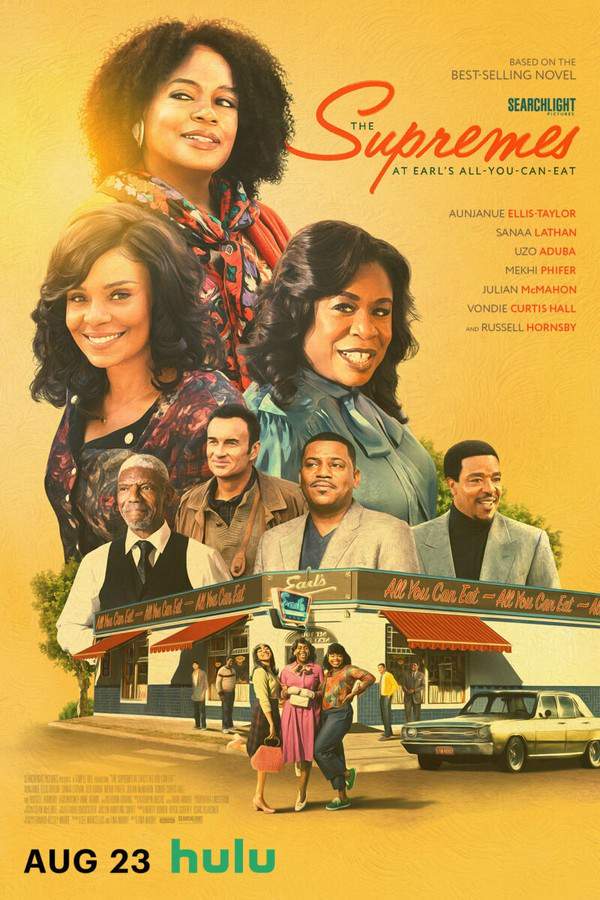
The Supremes at Earl's All-You-Can-Eat (2024) movie poster

Timeline

The Supremes at Earl's All-You-Can-Eat (2024) Timeline Explained – Every Event in Order

Release, runtime and language
2024 · 2 h 4 m · English
Echo score 68
Loading streaming availability…
Directed by
Tina Mabry
Starring
Tati Gabrielle, Donna Biscoe, Sanaa Lathan, Uzo Aduba, Mekhi Phifer, Julian McMahon
Budget
$23M

Three lifelong friends, Odette, Barbara Jean, and Clarice, known affectionately as "The Supremes," explore the joys and challenges of sisterhood. The film follows their experiences with marriage, motherhood, and the evolving nature of their bond as they navigate the complexities of love, heartbreak, and growing older together, sharing both laughter and tears along the way.

On this page (6)
  1. 1 Where to watch
  2. 2 Events in order (15)
  3. 3 Timeline questions answered
  4. 4 Movie threads
  5. 5 Movies like The Supremes at Earl's All-You-Can-Eat
  6. 6 Every angle
Loading streaming availability…

15 events in order · contains spoilers

The Supremes at Earl's All-You-Can-Eat Timeline: Events in Chronological Order

Every key event of The Supremes at Earl's All-You-Can-Eat (2024) in order, scene by scene, with when and where it takes place. Use it to untangle flashbacks, time jumps and parallel storylines, to refresh your memory before the sequel or to find the exact scene you are thinking of.

  1. The Legendary Birth

    The film begins with a unique tale of Odette's birth that highlights her fearless nature. Her mother, in a moment of desperation during late pregnancy, climbs a sycamore tree to give birth, marking Odette's life with an extraordinary start.

    When
    Late 1960s
    Where
    Plainview, Indiana
  2. Meeting Barbara Jean

    In 1968, teenage Odette and Clarice meet Barbara Jean, a shy girl suffering from an abusive home situation. Recognizing her struggles, they decide to take her under their wing, showcasing their empathy and commitment to friendship.

    When
    1968
    Where
    Plainview, Indiana
  3. A Safe Haven

    The trio frequent Earl’s All-You-Can-Eat diner, where Big Earl employs Barbara Jean, providing her with a safe place and a sense of family. This diner becomes significant as it serves as the backdrop for many of their shared memories and bonding moments.

    When
    1968
    Where
    Earl’s All-You-Can-Eat diner, Plainview, Indiana
  4. First Loves

    As they navigate their teenage years, Clarice falls for football star Richmond, while Odette attracts the attention of James, Richmond’s best friend. Barbara Jean also experiences a poignant first love with Chick, a young white man at the diner, highlighting the theme of love amidst racial challenges.

    When
    Late 1960s
    Where
    Plainview, Indiana
  5. Heartbreak and Racial Prejudice

    Barbara Jean's romance with Ray encounters harsh realities as the racial prejudices of their town force them apart. This painful separation seeds a deep sense of loss and marked the beginning of Barbara Jean's emotional struggles.

    When
    Late 1960s
    Where
    Plainview, Indiana
  6. Life's Crossroads

    Fast forward thirty years, the women, now in their late 40s/early 50s, continue to meet at Earl's but are grappling with significant life crises. Each woman faces struggles that test their friendship and individual identities, altering the dynamics of their relationship.

    When
    1999
    Where
    Earl’s All-You-Can-Eat diner
  7. Odette's Devastating News

    Odette learns that she has non-Hodgkin’s lymphoma, a devastating diagnosis that she chooses to keep secret from her friends. As the strong one in the group, she wants to shield them from her pain, which adds tension to their longstanding bond.

    When
    1999
    Where
    Plainview, Indiana
  8. Clarice's Sacrifice

    Clarice reflects on her life choices, having sacrificed her dreams of becoming a renowned pianist to marry Richmond and raise a family. Her facade of a perfect life shatters when his infidelity comes to light, forcing her to confront the reality of her sacrifices.

    When
    1999
    Where
    Plainview, Indiana
  9. Barbara Jean's Darkness

    Haunted by the trauma of her past and the loss of her son, Barbara Jean finds herself spiraling into alcoholism after the death of her wealthy husband Lester. This downward spiral further complicates her already fragile emotional state.

    When
    1999
    Where
    Plainview, Indiana
  10. The Return of Ray

    Ray comes back to Plainview after years away, stirring up long-buried feelings for Barbara Jean. Their reunion forces Barbara Jean to confront her grief and inspires her to seek sobriety and reclaim her life.

    When
    1999
    Where
    Plainview, Indiana
  11. Clarice's Confrontation

    After learning about Richmond's latest betrayal, Clarice decides to no longer keep quiet. She confronts him publicly and chooses to take charge of her life, reigniting her passion for music at the piano, a symbol of her regained independence.

    When
    1999
    Where
    Plainview, Indiana
  12. Odette's Collapse

    Odette collapses due to her illness, forcing the true nature of her condition into the open. This moment is pivotal, as it brings the three friends closer, reshaping the way they support one another during challenging times.

    When
    1999
    Where
    Plainview, Indiana
  13. Redefining Friendships

    With the truth about Odette's illness revealed, Clarice and Barbara Jean rally around her, marking a shift in their relationship dynamic. No longer relying solely on Odette, they learn to be her support system as she navigates her battle with cancer.

    When
    1999
    Where
    Plainview, Indiana
  14. A New Beginning

    Odette undergoes chemotherapy surrounded by her friends' love, drawing strength from their journeys of recovery and self-discovery. Barbara Jean enters treatment for her alcoholism, while Clarice revitalizes her musical passion, symbolizing their collective revival.

    When
    1999
    Where
    Plainview, Indiana
  15. Celebrating Sisterhood

    The film concludes with the Supremes back at Earl's diner, symbolizing their enduring bond through decades of trials. The three women, older yet wiser, celebrate the unconditional love and resilience that has defined their sisterhood.

    When
    1999
    Where
    Earl’s All-You-Can-Eat diner, Plainview, Indiana

Last updated: September 18, 2026 at 09:00

Was this helpful?

Timeline questions answered

The Supremes at Earl's All-You-Can-Eat Timeline Explained: Your Questions Answered

When does it happen, and why in that order? The questions people ask about the chronology of The Supremes at Earl's All-You-Can-Eat (2024): time jumps, flashbacks, cause and effect between scenes and the correct order of events, each answered with spoilers.

Q1

Why did Odette hide her cancer diagnosis from Clarice and Barbara Jean?

Odette concealed her non-Hodgkin's lymphoma because she had always been the emotional pillar of the trio and did not want to add another burden to friends who were already wrestling with their own crises. Protecting Clarice and Barbara Jean from her pain felt like a continuation of the protective role she had played since they first became friends in 1968. The secret only surfaces when she collapses, forcing the group into a more honest and balanced dynamic.

Foreshadowing: From their teenage years, Odette is portrayed as the one who rescues others, first stepping in to shelter Barbara Jean from her abusive father.

  • odette cancer secret
  • supremes friendship
  • lymphoma hidden diagnosis
Q2

Why did Clarice give up her dream of attending Juilliard?

Clarice sacrificed her ambition to study at Juilliard and become a concert pianist in order to build a life with Richmond, the high school football star she fell for in the late 1960s. She chose marriage and family over her musical gift, maintaining a polished facade for decades while Richmond repeatedly betrayed her. The sacrifice becomes a source of regret once his infidelity is exposed publicly, pushing her to reclaim her identity at the piano.

Foreshadowing: Clarice is introduced as a remarkably talented pianist whose skill is repeatedly highlighted, including her playing at the diner booth.

  • clarice juilliard sacrifice
  • pianist dream
  • richmond affair
Q3

Why did Ray have to leave Plainview and break up with Barbara Jean?

Ray, known as Chick, was a white young man working at Earl's diner who fell in love with Barbara Jean in the late 1960s. The racial prejudice of their small Indiana town made their interracial relationship untenable, forcing him to leave to protect Barbara Jean from escalating hostility. The separation planted a lasting wound in Barbara Jean that contributed to her later emotional struggles and alcoholism.

Foreshadowing: The film establishes Plainview as a place where racial lines dictate social acceptance well before Ray's departure.

  • ray chick barbara jean
  • interracial relationship
  • racial prejudice plainview
Q4

What caused Barbara Jean's descent into alcoholism?

Barbara Jean's alcoholism was triggered by the devastating loss of her young son, a grief she never fully processed, compounded by the death of her wealthy husband Lester, which left her emotionally unmoored. Years of suppressed trauma from her abusive childhood and the forced separation from her first love Ray further fueled the spiral. Her recovery only begins when Ray returns and she chooses to confront her grief rather than numb it.

Foreshadowing: Barbara Jean's fragile emotional state is hinted at through her quiet, burdened demeanor from the moment Odette and Clarice first meet her.

  • barbara jean alcoholism
  • loss of son
  • lester death
  • trauma
Q5

Why is Earl's All-You-Can-Eat diner so important to the Supremes?

Earl's diner serves as the emotional home base for the three friends because it is where Barbara Jean was first given a surrogate family by Big Earl after escaping her abusive father. The booth where the trio gathers becomes a sacred ritual space that spans from their teenage years in 1968 to their reunion in 1999, anchoring the film across decades. Big Earl's kindness and the diner's warmth represent the chosen family that sustains them through every crisis.

Foreshadowing: Big Earl coining the nickname "The Supremes" at the diner establishes it as the symbolic birthplace of their identity.

  • earls diner
  • big earl
  • mama millie
  • supremes booth
Q6

Why did Clarice finally confront Richmond after years of infidelity?

Clarice's public confrontation was sparked by Richmond's latest affair becoming widely known, which stripped away the carefully maintained image of her perfect marriage. After decades of sacrificing her musical ambitions and turning a blind eye to his betrayals, the public exposure made denial impossible and forced her to confront the years she had lost. Choosing to speak out publicly is her first decisive act of self-respect, paving the way for her to return to the piano.

Foreshadowing: Clarice's recurring moments at the piano throughout the film hint at the artistic self she buried for her marriage.

  • clarice richmond confrontation
  • infidelity exposure
  • reclaiming identity
Q7

How did Ray's return help Barbara Jean recover?

Ray's return to Plainview in 1999 reopened an unresolved chapter from Barbara Jean's youth and gave her a reason to face her grief rather than drown it in alcohol. Seeing him again forced her to choose between continuing her downward spiral and pursuing a second chance at love and stability. That emotional turning point directly motivated her to enter recovery and rebuild her life.

Foreshadowing: The film's early depiction of Barbara Jean's tenderness around Chick foreshadows how central he remains to her identity.

  • ray return
  • barbara jean recovery
  • second chance love
Q8

Why did Odette's collapse change the friendship dynamic?

Odette's collapse ripped away the hierarchy in which she was always the strongest and the caretaker, forcing Clarice and Barbara Jean to step up and support her for the first time. Learning that she had hidden her cancer exposed how her self-sacrificing role had actually isolated her from their care. The reversal reshaped the trio into a balanced sisterhood where all three women carry one another equally.

Foreshadowing: The film's opening tale of Odette's fearless birth establishes her as someone who faces hardship alone, a trait that later works against her.

  • odette collapse
  • friendship dynamic shift
  • caregiving reversal
Q9

How did Odette eventually go into remission?

Odette went into remission after undergoing chemotherapy surrounded by Clarice, Barbara Jean, and James, whose visible recoveries from addiction and infidelity gave her the courage to fight. Witnessing her friends rise from their own crises reminded her that she was not alone and inspired her to accept the same support she had always offered others. The collective revival of the trio becomes the emotional fuel for her medical recovery.

Foreshadowing: The film consistently links Odette's strength to her friends' presence, first seen in the diner booth scenes of 1968.

  • odette remission
  • chemotherapy recovery
  • collective healing
Q10

Why did Big Earl nickname the trio "The Supremes"?

Big Earl gave them the nickname "The Supremes" because of their charm, beauty, and the regal way they would gather in the same booth at his diner dressed to the nines. The name reflected his affection for them and elevated their bond into something iconic and enduring. It also gave the three friends a shared identity that carried them through every decade of hardship.

Foreshadowing: Their habit of dressing up for their diner meetups is established early as a signature ritual.

  • supremes nickname origin
  • big earl
  • diner booth ritual
Q11

What do Odette's visions of her mother and Big Earl represent?

The visions of Odette's late mother and Big Earl function as spiritual guides who appear when she is wrestling with her mortality and considering whether to reveal her diagnosis. They represent the lineage of strength and chosen family that shaped her, offering comfort and reminding her that the people she loves are still with her in spirit. Their presence bridges the film's 1968 past with its 1999 present, tying her identity to those who first made her brave.

Foreshadowing: The opening folklore of her fearless birth sets up her mother as a powerful symbolic figure throughout the film.

  • odette visions
  • mother symbolism
  • big earl spirit
Q12

Why has James loved Odette since childhood?

James fell in love with Odette because he witnessed her courage as a child when she stood up against bullies, an act of bravery that defined her in his eyes. His affection began long before their teenage years and remained steady through decades of friendship with Richmond and eventual marriage. His unwavering devotion becomes the anchor that holds Odette up during her cancer battle.

Foreshadowing: The film establishes James as a quiet observer of Odette from their earliest shared moments.

  • james odette love
  • childhood devotion
  • lifelong romance
Q13

What does the story of Odette's birth in a sycamore tree symbolize?

The legend of Odette's mother climbing a sycamore tree to give birth symbolizes the extraordinary resilience and fearlessness that defines Odette's entire life. Rooted in a moment of desperation that became triumphant, the story frames her as someone destined to face hardship on her own terms. This symbolic origin foreshadows her lifelong role as the protector of her friends and the one who climbs the highest when danger approaches.

Foreshadowing: The sycamore tree is referenced again as a symbol of rootedness and survival when Odette faces her illness.

  • odette birth story
  • sycamore tree
  • fearless origin
Q14

Why does the film end with the Supremes back at Earl's diner?

Returning to Earl's diner in the final scene bookends the story where it began, visually confirming that the trio's bond has survived cancer, addiction, betrayal, and loss. Sitting once again in their beloved booth, now older, signals that their friendship has outlasted every hardship life threw at them. The choice reinforces the film's central theme that chosen family and shared rituals are what ultimately heal people across decades.

Foreshadowing: Earl's diner is introduced as a place of safety and identity from the very first gathering in 1968.

  • earls diner ending
  • supreme reunion
  • chosen family

Movie threads

More Movies Like The Supremes at Earl's All-You-Can-Eat, by Mood & Story

Curated lists built around what makes The Supremes at Earl's All-You-Can-Eat tick: the same mood, the same kind of story or the same emotional payoff. Each list explains why these movies belong together.

Lifetime female friendship movies like The Supremes at Earl's All-You-Can-Eat

Inseparable friends who carry each other through love, heartbreak, and every season of life. Movies like The Supremes at Earl's All-You-Can-Eat celebrate the unbreakable bonds between lifelong female friends. If you loved watching The Supremes navigate decades of sisterhood, marriage, and heartbreak together, these similar drama and comedy films deliver the same warm humor, deeply felt grief, and chosen family warmth that define this story.

  • sisterhood
  • female friendship
  • chosen family
  • nostalgic
  • warm
  • bittersweet
  • Tone: bittersweet, warm, heartfelt
  • Pacing: variable, reflective with emotional peaks
Why these movies?

The story pattern: A close group of women meets in youth and we follow them across the years as they weather life's biggest milestones side by side. The structure often jumps between eras, showing how their bond adapts to marriage, motherhood, illness, loss, and reinvention. Conflicts emerge from inside the friendship as well as from outside pressures, but the emotional resolution usually reaffirms the lasting power of chosen family over romance or individual success.

Why they belong together: These films share a focus on female friendship as the primary emotional engine, often outranking romance. They tend to span long periods of time, blend soulful humor with grief, and treat the friend group as its own kind of family. Pacing ebbs between everyday banter and heavier crises, with a bittersweet overall arc that honors endurance over innocence.

Bittersweet decades-spanning dramas like The Supremes at Earl's All-You-Can-Eat

Sweeping stories that trade innocence for hard-won wisdom across a whole lifetime. If you loved the decades-spanning structure and bittersweet emotional weight of The Supremes at Earl's All-You-Can-Eat, these similar dramas follow ordinary lives through years of joy, illness, loss, and hard-won healing. Movies like this weave heavy themes with warmth, soulful humor, and a hopeful undercurrent that survives the grief.

  • bittersweet
  • decades-spanning
  • reflective
  • grief
  • nostalgic
  • soulful
  • Tone: bittersweet, reflective, hopeful
  • Pacing: variable, reflective with emotional peaks
Why these movies?

The story pattern: A protagonist or ensemble is followed across many years, often through a non-linear structure that jumps between key eras such as youth, midlife, and later years. Major life events like marriages, births, diagnoses, deaths, and reckonings form the narrative spine, while quieter character moments provide emotional texture. The journey tends to move from innocence to hard-won wisdom, with long-held secrets revealed and old wounds finally healed.

Why they belong together: These films prioritize emotional accumulation over plot mechanics, using time jumps to show how grief and love compound across a lifetime. They tackle heavy subject matter such as illness, racism, addiction, and abuse without becoming nihilistic, often finding hope in community or chosen family. Tone is consistently bittersweet, pacing variable, and complexity high as multiple arcs and timelines intersect.

If you liked this

Movies Like The Supremes at Earl's All-You-Can-Eat

Similar movies to The Supremes at Earl's All-You-Can-Eat: the same genre, themes or kind of story. Each one comes with its own plot summary, timeline and ending explained.

Browse all movie summaries

Every angle

The Supremes at Earl's All-You-Can-Eat (2024) Explained: Plot, Ending, Timeline & Characters

Everything about The Supremes at Earl's All-You-Can-Eat in one place: what happens in the plot summary, the timeline in chronological order, the characters and meaning, the ending explained and a spoiler-free summary. What's After the Movie adds the cast, box office and post-credit scenes.

Coming soon on iOS and Android

The Plot Explained Movie Summary App

Plot summaries, endings explained and timelines on your phone. Catch up on any movie in minutes, save your favorites and never miss a twist again.

Be the first to know when we launch. Your email stays private, always.

Learn more about the app