Plot Explained Spoilers guaranteed!
Plot Explained

Browse by genre

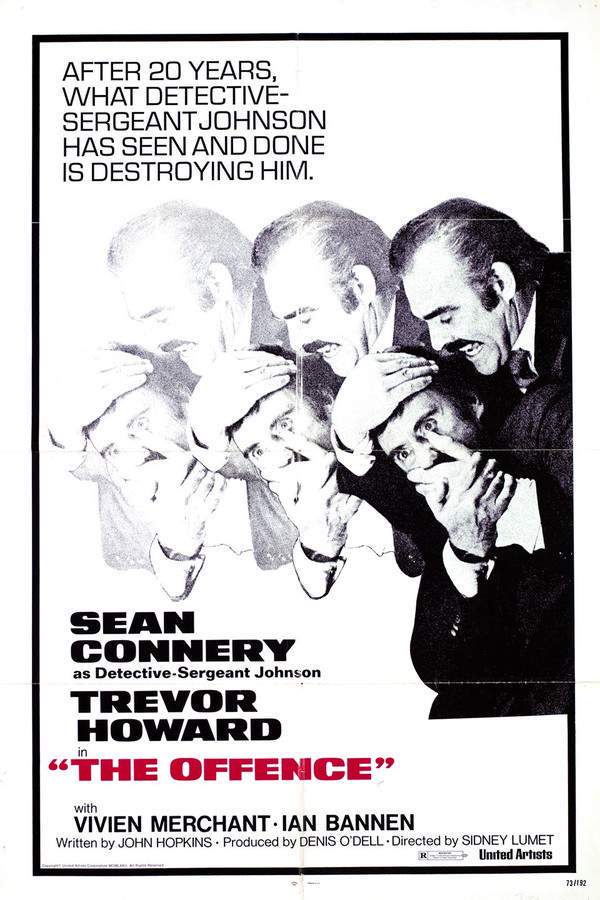
The Offence (1973) movie poster

Timeline

The Offence (1973) Timeline Explained – Every Event in Order

Release, runtime and language
1973 · 112 min · English
Loading streaming availability…
Directed by
Sidney Lumet
Starring
Sean Connery, Trevor Howard, Vivien Merchant, Peter Bowles, Ian Bannen, John Hallam

A veteran British detective, burdened by past trauma, finds himself consumed by a disturbing case involving a young victim. The investigation pushes him to his limits, triggering intense anger and frustration as he pursues justice. A violent confrontation with a suspect occurs, but the unraveling truth forces the detective to confront his own inner demons and the ethical boundaries he's crossed in his pursuit of resolution.

On this page (6)
  1. 1 Where to watch
  2. 2 Events in order (13)
  3. 3 Timeline questions answered
  4. 4 Movie threads
  5. 5 Movies like The Offence
  6. 6 Every angle
Loading streaming availability…

13 events in order · contains spoilers

The Offence Timeline: Events in Chronological Order

Every key event of The Offence (1973) in order, scene by scene, with when and where it takes place. Use it to untangle flashbacks, time jumps and parallel storylines, to refresh your memory before the sequel or to find the exact scene you are thinking of.

  1. Johnson's Career Struggles

    Detective Sergeant Johnson has spent over two decades facing heinous crimes, including murders and rapes. The incessant exposure to such darkness has profoundly affected his mental health, causing deep scars on his psyche.

  2. Confrontation with Kenneth Baxter

    In a culmination of his frustrations, Johnson confronts Kenneth Baxter, a suspect in a ghastly rape case. The interrogation escalates and Johnson, overwhelmed with emotion, violently assaults Baxter, leaving him with life-threatening injuries.

  3. Suspension from Duty

    As a direct consequence of his actions, Johnson is suspended from the force. This suspension forces him to confront the repercussions of his reckless behavior and the chaotic state of his life.

  4. Domestic Turmoil

    Johnson's emotional turmoil escalates into a horrific domestic altercation with his wife, Maureen. The confrontation highlights the strain his career has had on his personal life and mental stability.

    Where
    Johnson's home
  5. Baxter's Death

    Just when Johnson is grappling with his personal failures, he learns through his colleagues that Kenneth Baxter has died from his injuries. This news plunges Johnson deeper into self-doubt and introspection as he questions his actions.

  6. Introspective Journey Begins

    Following Baxter's death, Johnson embarks on a profound journey of introspection. He is haunted by the consequences of his violent outburst and starts to reflect on the darkness within himself.

  7. Interrogation by Det. Superintendent Cartwright

    The next day, Detective Superintendent Cartwright leads a relentless interrogation aimed at probing Johnson’s troubled psyche. Cartwright digs deep, unearthing the roots of Johnson’s violent behaviors.

  8. Flashbacks of the Assault

    During the interrogation, Johnson experiences vivid flashbacks of the fateful night he assaulted Baxter. The taunts and laughter from Baxter haunt him, serving as powerful reminders of his emotional collapse.

  9. Haunting Realizations

    As Johnson confronts his past actions and the impact they have had on himself and others, he realizes he has been grappling with twisted fantasies of violence and assault. This revelation shakes him to his core.

  10. Shattered Identity

    The weight of his realizations leaves Johnson as a shadow of his former self. The world around him begins to collapse, revealing the true extent of the psychological damage he has endured.

  11. Desperation for Validation

    In his frenzied state, Johnson's desperate cries for help from Baxter go unanswered. The rejection from the suspect amplifies his inner turmoil and sense of despair.

  12. Final Confrontation with Self

    As the film nears its conclusion, Johnson is forced to re-experience the traumatic events he has undergone. He confronts the harrowing truth of who he has become amidst the shadows of his past.

  13. Heart-Wrenching Lament

    The film closes with Johnson's anguished lament, *'God...my God...'* This emotional moment encapsulates the profound toll that witnessing and enacting violence has taken on his soul.

Last updated: November 18, 2024 at 21:21

Was this helpful?

Timeline questions answered

The Offence Timeline Explained: Your Questions Answered

When does it happen, and why in that order? The questions people ask about the chronology of The Offence (1973): time jumps, flashbacks, cause and effect between scenes and the correct order of events, each answered with spoilers.

Q1

Why does Detective Johnson assault Kenneth Baxter during the interrogation

Johnson assaults Baxter because he reaches his breaking point after two decades of exposure to heinous crimes. The constant burden of dealing with murders and rapes has scarred his psyche, and during the interrogation, Baxter's taunts and derisive laughter trigger Johnson's pent-up rage and emotional collapse. The assault is not premeditated but rather a sudden violent outburst caused by overwhelming psychological pressure.

Foreshadowing: Earlier scenes establish Johnson's fragile mental state and his inability to cope with the darkness he's witnessed throughout his career.

  • detective johnson
  • kenneth baxter
  • assault
  • interrogation
  • breakdown
Q2

What does Kenneth Baxter say to provoke Johnson's violent outburst

Baxter taunts Johnson with derisive laughter and makes provocative remarks during the interrogation. These taunts break through Johnson's emotional barricades, serving as the catalyst for his violent outburst. The exact words are not specified in the film, but they are psychologically devastating enough to cause a seasoned detective to completely lose control.

Foreshadowing: The earlier buildup of Johnson's psychological strain establishes his vulnerability to such emotional provocation.

  • baxter
  • taunts
  • provocation
  • interrogation
Q3

Why does Johnson's emotional turmoil escalate into a confrontation with his wife Maureen

Johnson's violent outburst against his wife is an extension of his psychological breakdown. After assaulting Baxter and being suspended from duty, his emotional state becomes completely unstable. The domestic confrontation represents how his professional trauma has infected his personal life, showing that the violence he suppressed at work has now surfaced at home.

Foreshadowing: The strain Johnson's career has placed on his marriage is hinted at throughout the film as his mental health deteriorates.

  • maureen
  • wife
  • domestic
  • confrontation
  • violence
Q4

What are the twisted fantasies that Johnson discovers about himself

During his interrogation by Detective Superintendent Cartwright, Johnson is forced to confront dark truths: he has been haunted by fantasies of violence and sexual assault. These twisted thoughts have been buried in his subconscious, fueled by two decades of exposure to the worst crimes imaginable. The realization that he shares disturbing similarities with the criminals he has pursued destroys his sense of identity.

Foreshadowing: The film hints at Johnson's psychological fragility long before this explicit revelation.

  • fantasies
  • violence
  • sexual assault
  • psychology
  • self-discovery
Q5

Why does learning that Kenneth Baxter died from his injuries affect Johnson so deeply

When Johnson's colleagues inform him that Baxter has died from his injuries, it marks a turning point in his psychological unraveling. The death transforms his violent outburst from a moment of lost control into a potentially criminal act with permanent consequences. This knowledge propels him into deeper self-doubt and forces the introspective journey that defines the rest of the film.

Foreshadowing: Johnson's suspension from duty immediately after the assault establishes the serious consequences he now faces.

  • baxter death
  • consequences
  • guilt
  • self-reflection
Q6

Why does Johnson desperately cry out for help from Kenneth Baxter

In his frenzied and broken state, Johnson cries out to Baxter because he desperately needs validation and understanding from the very person he harmed. He is overwhelmed by inner voices and the derision he experienced during the interrogation. His desperate pleas represent a childlike need for absolution, but Baxter rejects him, looking on in horror. This rejection intensifies Johnson's emotional despair and sense of isolation.

Foreshadowing: This moment connects to the earlier dynamic where Baxter's laughter and taunts deeply affected Johnson.

  • crying
  • help
  • rejection
  • desperation
  • validation
Q7

What is the significance of Johnson's final lament 'God...my God...'

Johnson's heart-wrenching lament at the film's conclusion represents his complete psychological and spiritual collapse. After confronting the full truth of what he has become, a man who shares the violent impulses of the criminals he hunted, his mind shatters. The phrase encapsulates the profound toll that witnessing and enacting violence has taken on his soul. It is a cry of ultimate despair from a man whose identity has been completely destroyed.

Foreshadowing: The entire film builds toward this moment of reckoning, with Johnson's mental state deteriorating throughout.

  • god
  • lament
  • despair
  • collapse
  • spiritual
Q8

How does Detective Superintendent Cartwright's interrogation uncover Johnson's truth

Cartwright's interrogation is relentless and psychologically invasive, designed to dig deep into Johnson's troubled mind. Through persistent questioning, he forces Johnson to revisit the traumatic night of the assault through vivid flashbacks. These flashbacks, filled with Baxter's taunts and laughter, break down Johnson's emotional defenses. It is during this interrogation that Johnson finally admits to having twisted fantasies of violence and assault, realizations that shake him to his core.

Foreshadowing: The flashback structure mirrors the way the film has been slowly revealing Johnson's psychological state throughout.

  • cartwright
  • interrogation
  • psychology
  • truth
  • flashbacks
Q9

Why is Detective Johnson suspended from the force after assaulting Baxter

Johnson is suspended from duty as a direct consequence of his violent assault on Kenneth Baxter. His actions, beating a suspect to the point of life-threatening injuries, represent a severe violation of police procedure and ethical boundaries. The suspension forces him to confront the repercussions of his reckless behavior and marks the beginning of his complete personal and professional unraveling.

Foreshadowing: The buildup of Johnson's frustrations throughout his career makes this breaking point feel inevitable.

  • suspension
  • police
  • consequences
  • duty
  • fired
Q10

What causes Detective Johnson's complete psychological breakdown

Johnson's breakdown is caused by the cumulative effect of over two decades dealing with humanity's darkest crimes, murders and rapes. This relentless exposure has methodically unraveled his sanity. The final trigger is the confrontation with Kenneth Baxter, where taunts from the suspect combine with Johnson's accumulated trauma to cause a complete psychological collapse. He emerges from the experience shattered, understanding that he has become what he hunted.

Foreshadowing: The film explicitly shows Johnson's deteriorating mental state from the opening scenes.

  • breakdown
  • psychology
  • trauma
  • collapse
  • unraveling

Movie threads

More Movies Like The Offence, by Mood & Story

Curated lists built around what makes The Offence tick: the same mood, the same kind of story or the same emotional payoff. Each list explains why these movies belong together.

Movies about psychological unraveling like The Offence

Stories where intense pressure fractures a protagonist's mind, exposing their darkest instincts. If you were captivated by the psychological collapse in The Offence, explore these other films about characters pushed to their breaking point. This collection features intense character studies and thrillers where internal demons manifest in destructive ways, perfect for fans of dark, psychological drama.

  • psychological
  • unraveling
  • claustrophobic
  • oppressive
  • desperate
  • shattering
  • Tone: dark, tense, bleak
  • Pacing: steady, methodical
Why these movies?

The story pattern: Movies in this thread typically follow a protagonist, often in a position of authority like a detective or investigator, whose unresolved trauma is ignited by a new case or crisis. The plot is a vehicle for their internal conflict, building towards a climactic confrontation that forces them to face the darkness within themselves, often with devastating consequences.

Why they belong together: These films are grouped by their shared focus on a character's psychological disintegration. They create an oppressive, claustrophobic mood, maintain a steady or slow-burn pace to methodically build dread, and deliver a heavy emotional impact through bleak revelations about human nature.

Grim and realistic crime movies like The Offence

Gritty, morally ambiguous crime stories where the pursuit of justice leads to corruption. For viewers who appreciated the harsh, unflinching realism of The Offence, this list features similar crime dramas and thrillers. Discover movies that explore the dark side of police work, moral ambiguity, and the psychological toll of confronting evil, offering no easy answers or happy endings.

  • gritty
  • morally ambiguous
  • bleak
  • realistic
  • oppressive
  • corrupt
  • Tone: dark, bleak, morally complex
  • Pacing: steady, deliberate
Why these movies?

The story pattern: The narrative often follows a flawed investigator whose methods are as questionable as the crimes they pursue. The plot is less about solving a mystery and more about exploring the corrosive effects of violence and obsession. The resolution typically offers no catharsis, instead leaving the characters and audience with a sense of moral desolation.

Why they belong together: These films share a dark, oppressive tone, a steady pacing that builds dread, and a commitment to bleak realism. They are united by themes of moral decay, the abuse of power, and the psychological damage inherent in confronting human darkness, resulting in a heavy, often disturbing viewing experience.

If you liked this

Movies Like The Offence

Similar movies to The Offence: the same genre, themes or kind of story. Each one comes with its own plot summary, timeline and ending explained.

Browse all movie summaries

Every angle

The Offence (1973) Explained: Plot, Timeline & Characters

Everything about The Offence in one place: what happens in the plot summary, the timeline in chronological order, the characters and meaning and a spoiler-free summary. What's After the Movie adds the cast, box office and post-credit scenes.

Coming soon on iOS and Android

The Plot Explained Movie Summary App

Plot summaries, endings explained and timelines on your phone. Catch up on any movie in minutes, save your favorites and never miss a twist again.

Be the first to know when we launch. Your email stays private, always.

Learn more about the app