Plot Explained Spoilers guaranteed!
Plot Explained

Browse by genre

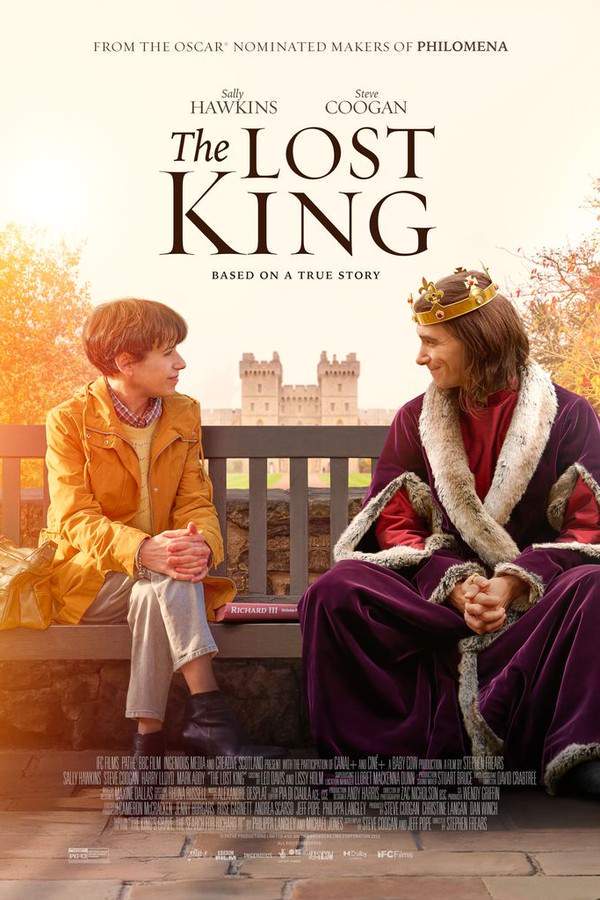
The Lost King (2023) movie poster

Plot Summary

The Lost King (2023) Plot Summary & Ending Explained

Release, runtime and language
2023 · 108 min · English
Echo score 70
JustWatch #12,884 18
Directed by
Stephen Frears
Starring
Sally Hawkins, Steve Coogan, Harry Lloyd, Robert Jack, Adam Robb, Benjamin Scanlan

Amateur historian Philippa Langley’s discovery of a possible long-lost burial site sparks a national debate and challenges established historical accounts. Driven by her conviction, she tenaciously pursues the truth, confronting skepticism from experts and working to identify the remains. Her quest ultimately aims to rewrite the story of King Richard III, a monarch whose reputation has been unfairly tarnished by centuries of controversy and misunderstanding.

On this page (7)
  1. 1 Where to watch
  2. 2 What happens: full plot
  3. 3 Plot questions answered
  4. 4 How it ends
  5. 5 Movie threads
  6. 6 Movies like The Lost King
  7. 7 Every angle

Where to watch

Where to Watch The Lost King (2023)

Where can you watch The Lost King? Stream, rent or buy it in the US, including on AMC+, Philo and Sundance Now: current JustWatch availability with up-to-date prices.

Streaming availability powered by JustWatch

Full plot summary · contains spoilers

What Happens in The Lost King: Full Plot Summary

The whole story of The Lost King (2023) explained, from the opening scene to the final frame: every key event, every twist and what it all adds up to. Read it as a quick recap before the sequel, to check a scene you missed, or to finally understand what really happened.

Living in the heart of Edinburgh, Philippa Langley finds herself struggling after losing a coveted work promotion to a more attractive and less experienced colleague. Despite her efforts to confront her dismissive boss about the unfair decision, she is left feeling dejected. Dealing with her own challenges, including myalgic encephalomyelitis (often referred to as "ME"), her ex-husband, John Langley, reminds her of the importance of keeping her job to support their two teenage sons.

While attending a performance of Richard III, Philippa resonates deeply with the character, feeling that he has been profoundly misunderstood – labeled as a hunchback, usurper, and child murderer by history. She begins to experience vivid visions of Richard, leading her to join the local Richard III Society, where she finds a community that believes he has been unfairly vilified by the Tudor narrative.

As she grapples with her ME, Philippa gradually begins to detach from her work environment while managing her health with medication and engaging with her Richard apparition. Her extensive research reveals conflicting accounts about Richard's burial, with some claiming he was interred in the Leicester Greyfriars priory choir area, while others suggest his remains were discarded in the River Soar. An account from around 1600 mentions a shrine erected by Leicester's mayor, Robert Herrick, claiming, > "Here lies the body of Richard III, sometime king of England."

Philippa decides to attend a lecture in Leicester about Richard, concealing her true intentions from John. There, she encounters Dr. Ashdown-Hill, who is investigating the genealogical lineage of Richard III’s family and suggests searching for Richard's remains in Leicester's open spaces, as many have historically avoided constructing over ancient abbeys. During an exploration of Leicester, Philippa becomes convinced that an "R" painted in a parking lot marks Richard's burial site and later confesses her plans to John.

Determined, Philippa reaches out to Richard Buckley, an archaeologist at the University of Leicester. Initial skepticism accompanies his response; however, when funding for his project is cut, he revisits Philippa's idea. He discovers a historical map highlighting Robert Herrick's property, indicating a potential connection to the public shrine. Together, they superimpose the old map onto a contemporary one and deduce that the shrine corresponds to the area of Philippa's "R".

With renewed vigor, Philippa and Buckley approach the Leicester City Council for support. Even though university advisor Richard Taylor expresses concerns about the risks tied to Philippa's amateur estimation, the Council grants approval for excavation to boost local interest. Unfortunately, when ground-penetrating radar reveals no significant finds, funding dwindles. Undeterred, Philippa turns to the Richard III Society for crowd-funding, which successfully provides global financial backing for three trenches.

On the first day of the dig, Buckley informs Philippa that while the dig certificate is signed, her name has been conspicuously omitted. Despite this, she insists on focusing the excavation at the designated "R" location, where they quickly uncover human remains. Buckley initially speculates it could be an extramural graveyard associated with monks. Tensions rise as Philippa confronts Taylor for commandeering credit for the project. As they begin to uncover the skeleton, the osteologist identifies it as that of Richard III, a man with a pronounced spinal curvature and evidence of a fatal skull injury.

Following this breakthrough, leaders from the University of Leicester rush to assume control of the excavation efforts, re-engaging Buckley. In February 2013, Taylor triumphantly presents their findings at a press conference—though Philippa finds herself sidelined along with much of her contribution. In a touch of poetic justice, Buckley is later awarded an honorary doctorate for the undertaking.

In a poignant farewell, Richard appears to Philippa one last time at Bosworth Field, expressing his gratitude before vanishing. The film concludes with his funeral, fit for a king, taking place in Leicester Cathedral, while the closing credits reveal that the royal family's website has officially acknowledged Richard as the rightful King of England from 1483 to 1485, correcting historical misconceptions. In recognition of her relentless pursuit for the truth, Philippa is honored with an MBE for her groundbreaking work.
Last updated: November 08, 2024 at 01:59

Was this helpful?

Plot questions answered

The Lost King Plot Explained: Your Questions Answered

The questions people ask most about The Lost King (2023): what happens in the confusing scenes, why the characters do what they do, the twists, hidden details and what the ending means. Each answer contains spoilers.

Q1

Why did Philippa Langley become so obsessed with Richard III?

Philippa felt a deep personal connection to Richard III after watching a performance of Shakespeare's play. Like her, Richard had been unfairly judged and misunderstood – labeled a hunchback, usurper, and child murderer by history. After losing her job promotion to a younger, less experienced colleague, Philippa related to Richard's story of being undervalued and condemned without fair examination. Her own struggles with ME and professional dismissal made her empathize with a historical figure she believed had been wrongly vilified.

Foreshadowing: The film establishes Philippa's feelings of being overlooked early in the story before she discovers Richard III.

  • philippa langley
  • richard iii
  • motivation
  • misunderstanding
  • historical revision
Q2

How did Philippa identify the burial site in Leicester?

Philippa combined historical research with intuitive deduction. She discovered that Robert Herrick, Leicester's mayor in the 1600s, had erected a shrine claiming Richard was buried there. She learned that Herrick's property corresponded to a specific area in Leicester. When she explored the city, she noticed an 'R' painted in a parking lot, which she interpreted as a sign marking the location. She shared this with archaeologist Richard Buckley, who used historical maps to confirm that Herrick's property aligned with the parking lot area.

Foreshadowing: Philippa's research into historical burial accounts precedes her discovery of the 'R' marking.

  • leicester
  • burial site
  • parking lot
  • robert herrick
  • excavation
Q3

Why was Philippa's name missing from the dig certificate?

When the excavation began, Richard Taylor – the university advisor – signed the dig certificate but omitted Philippa's name despite her being the one who proposed the location and secured initial archaeologist contact. This reflects the institutional skepticism toward her amateur estimation and the University's desire to maintain control over the narrative. Philippa confronted Taylor about this, but the omission set the tone for how her contribution would be minimized in the official story.

Foreshadowing: Taylor's early concerns about the risks of Philippa's amateur estimation hint at his intention to marginalize her.

  • dig certificate
  • richard taylor
  • credit
  • omission
  • university leicester
Q4

What confirmed the skeleton was Richard III?

The osteologist identified several key characteristics: the remains belonged to a man in his late twenties or early thirties, and most significantly, the skeleton showed a pronounced spinal curvature consistent with the historical description of Richard III having scoliosis. Additionally, forensic evidence revealed a fatal blunt force trauma to the skull, matching historical accounts of Richard being killed at the Battle of Bosworth Field. These findings, combined with DNA matching to modern descendants of Richard's family, confirmed the identification.

Foreshadowing: Earlier references to Richard's historical physical description and death at Bosworth prepare viewers for this confirmation.

  • skeleton
  • identification
  • scoliosis
  • spinal curvature
  • blunt force trauma
  • dna
Q5

Why did the University of Leicester take over the project?

Once human remains were discovered and confirmed as potentially belonging to Richard III, the University of Leicester moved quickly to assume control of the excavation. They re-engaged Richard Buckley and organized the February 2013 press conference. This takeover was partly strategic – the University wanted to manage the massive media attention and historical significance – but it also effectively sidelined Philippa, who had driven the entire discovery. Despite her foundational role, the institutional credit went to the University.

Foreshadowing: Taylor's initial involvement and the Council's approval process already indicated the University would have oversight.

  • university leicester
  • excavation
  • press conference
  • richard buckley
  • institutional control
Q6

Were Philippa's visions of Richard III real or symbolic?

The film presents Philippa's visions of Richard as a narrative device rather than literal supernatural events. Richard appears to Philippa at key emotional moments – when she feels discouraged, when she needs motivation, and finally at Bosworth Field to thank her. These apparitions represent Philippa's internal drive and her personal sense of connection to correcting Richard's legacy. The final appearance at Bosworth Field serves as an emotional conclusion, symbolizing that Richard's spirit – or at least his legacy – finds peace through Philippa's work.

Foreshadowing: Philippa's first vision occurs shortly after she becomes emotionally invested in the Richard III performance.

  • visions
  • richard iii
  • symbolism
  • bosworth field
  • emotional conclusion
Q7

Why was Philippa Langley awarded an MBE?

Philippa received the MBE (Member of the Order of the British Empire) for her services to history and heritage. Despite being marginalized in the official narrative, her relentless pursuit of the truth led to one of the most significant archaeological discoveries in British history. The award recognized her contribution to challenging established historical accounts, identifying the location through independent research, and her persistence in securing funding and academic support when professional institutions dismissed her amateur estimation.

Foreshadowing: The film's portrayal of Philippa being sidelined from credit makes her eventual recognition feel like poetic justice.

  • mbe
  • award
  • recognition
  • services to history
  • contribution
Q8

Why did the ground-penetrating radar fail to detect Richard's remains?

Initial ground-penetrating radar surveys of the site revealed no significant finds, causing funding to dwindle. This failure likely occurred because the remains were buried shallower than expected and in an area disturbed by centuries of urban development. The radar technology may not have detected the relatively shallow burial at that specific location. Philippa's persistence despite these results was crucial – she pushed forward with crowd-funding through the Richard III Society, which ultimately provided the financial backing for three trenches that led to the discovery.

Foreshadowing: Early skepticism about Philippa's location is reinforced by the negative radar results.

  • ground penetrating radar
  • funding
  • no finds
  • crowd funding
  • richard iii society
Q9

What conflicting accounts existed about Richard III's burial?

Historical accounts differed significantly about Richard III's final resting place. Some sources claimed he was buried in the choir area of Leicester Greyfriars priory, while others suggested his remains were discarded in the River Soar after his body was mistreated following the Battle of Bosworth. A 1600 account from Mayor Robert Herrick mentioned a shrine he erected, claiming "Here lies the body of Richard III, sometime king of England." This conflicting information made Philippa's research challenging but also pointed to Leicester as the most credible location.

Foreshadowing: Philippa's research into these conflicting accounts directly leads her to focus on Leicester.

  • burial accounts
  • greyfriars
  • river soar
  • robert herrick
  • shrine
  • historical records
Q10

What caused Richard III's fatal injury?

The skeleton showed evidence of a fatal blunt force trauma to the skull – a wound consistent with being struck by a weapon during battle. This matches historical accounts of Richard III dying at the Battle of Bosworth Field in 1485, where he was killed fighting Henry Tudor's forces. The discovery of this injury confirmed the historical narrative of Richard dying in battle rather than succumbing to other causes.

Foreshadowing: Historical accounts of Richard's death at Bosworth are referenced throughout the film.

  • fatal injury
  • skull trauma
  • battle of bosworth
  • blunt force
  • death

Ending explained

What Happens at the End of The Lost King?

How The Lost King (2023) ends, in short: the final scene, the last twist and what it means for the characters. The full ending explained, with every spoiler, lives on its own page.

Read the full ending explained

At the end of "The Lost King," Philippa Langley’s relentless determination leads her to discover the long-lost remains of King Richard III, buried beneath an urban parking lot rather than the supposed site of a church. Her careful research and intuition guide her to the exact spot, and with the support of the university, an excavation begins. When the skeleton is unearthed, a DNA test confirms that it belongs to Richard III, confirming that he was buried there after all. This groundbreaking discovery challenges the traditional narrative that painted Richard as a villainous usurper. As Philippa pushes the university to honor him properly, Richard is finally given the recognition he deserved during his lifetime. The film restores Richard’s dignity, showing that his deformity was simply scoliosis, a physical condition misunderstood in his era, rather than proof of villainy. In the closing scenes, the man who played Richard in the play arrives at the king’s funeral, and Philippa expresses her gratitude for his role in helping her see Richard as a real, complex person rather than a monster. Ultimately, she finds her true purpose in fighting for justice and for Richard’s rightful place in history. The story ends with the message that history is often shaped by prejudice, but relentless curiosity and compassion can rewrite it.

The Lost King ending explained in full

Movie threads

More Movies Like The Lost King, by Mood & Story

Curated lists built around what makes The Lost King tick: the same mood, the same kind of story or the same emotional payoff. Each list explains why these movies belong together.

Movies about determined underdogs rewriting history like The Lost King

Ordinary individuals take on established institutions to uncover a forgotten truth. If you liked The Lost King, you'll enjoy these movies featuring passionate amateurs who defy experts to uncover a historical truth. This collection highlights inspiring stories of perseverance, quiet obsessions, and the personal vindication of rewriting an established story.

  • persevering
  • undervalued
  • resilient
  • thoughtful
  • inspiring
  • determined
  • Tone: hopeful, thoughtful, quietly triumphant
  • Pacing: steady, deliberate
Why these movies?

The story pattern: Stories in this thread typically follow a linear, character-driven quest where an underdog protagonist becomes obsessed with a historical mystery or injustice. The central conflict is against institutional resistance and professional skepticism, not physical danger. The journey is one of steady, resilient research and advocacy, culminating in a discovery that validates their efforts, even if the reward is bittersweet.

Why they belong together: These movies are grouped by their shared focus on a hopeful, steady-paced quest led by an underestimated protagonist. They blend light drama with inspiring themes, creating a specific vibe of intellectual perseverance and quiet triumph against the odds, often with a realistically complex, rather than purely happy, resolution.

Movies with bittersweet victories and personal vindication like The Lost King

Stories where a hard-won success is tinged with a touch of personal injustice. Discover movies like The Lost King that explore the complex feeling of a triumphant yet bittersweet ending. These films feature characters who succeed in their quest but face personal compromises or injustices, resulting in a deeply satisfying yet emotionally resonant conclusion.

  • bittersweet
  • vindication
  • reflective
  • poignant
  • triumphant
  • complex ending
  • Tone: bittersweet, hopeful, reflective
  • Pacing: steady
Why these movies?

The story pattern: The narrative pattern involves a clear, often difficult journey towards a significant achievement. The climax confirms the protagonist's belief and effort, but the aftermath reveals a cost—being sidelined for credit, a personal sacrifice, or the hollow nature of the win itself. The emotional arc peaks with validation but resolves with a reflective, nuanced feeling.

Why they belong together: This thread connects films through a specific emotional blend: the satisfaction of a goal achieved combined with the sting of an imperfect reward. The shared experience is one of thoughtful resolution, where happiness is tempered by reality, appealing to viewers who appreciate complex, emotionally honest endings.

If you liked this

Movies Like The Lost King

Similar movies to The Lost King: the same genre, themes or kind of story. Each one comes with its own plot summary, timeline and ending explained.

Browse all movie summaries

Every angle

The Lost King (2023) Explained: Plot, Ending, Timeline & Characters

Everything about The Lost King in one place: what happens in the plot summary, the timeline in chronological order, the characters and meaning, the ending explained and a spoiler-free summary. What's After the Movie adds the cast, box office and post-credit scenes.

Coming soon on iOS and Android

The Plot Explained Movie Summary App

Plot summaries, endings explained and timelines on your phone. Catch up on any movie in minutes, save your favorites and never miss a twist again.

Be the first to know when we launch. Your email stays private, always.

Learn more about the app