Plot Explained Spoilers guaranteed!
Plot Explained

Browse by genre

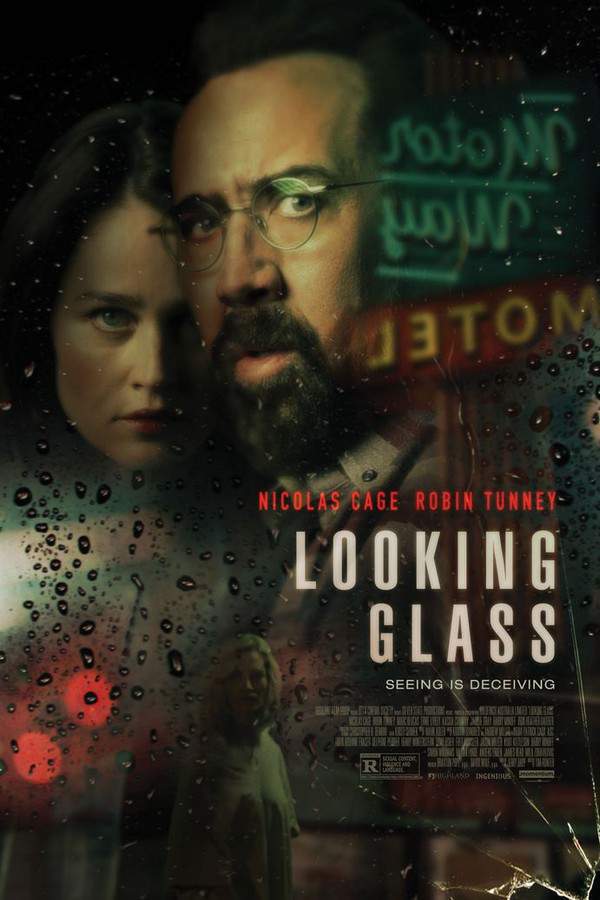
The Looking Glass (2015) movie poster

Plot Summary

The Looking Glass (2015) Plot Summary Explained

Release, runtime and language
2015 · 110 min · English
Directed by
John D. Hancock

Following a tragic event, thirteen-year-old Julie struggles with grief and an unclear future. She finds solace and reconnection with her grandmother, a retired performer, and is drawn into a world of music and unspoken emotions. As they work together and blend their talents, Julie rediscovers her voice and finds a way towards healing, self-acceptance, and renewed hope.

On this page (5)
  1. 1 What happens: full plot
  2. 2 Plot questions answered
  3. 3 Movie threads
  4. 4 Movies like The Looking Glass
  5. 5 Every angle

Full plot summary · contains spoilers

What Happens in The Looking Glass: Full Plot Summary

The whole story of The Looking Glass (2015) explained, from the opening scene to the final frame: every key event, every twist and what it all adds up to. Read it as a quick recap before the sequel, to check a scene you missed, or to finally understand what really happened.

As the British military intelligence organization, known as The Department, stumbles through the early 1960s, its once-great reputation teeters on the brink of collapse—a mere shadow of its former self from the days of aerial reconnaissance during World War II. The skeleton crew includes Leclerc, a nostalgic former air commander caught in a quagmire of bureaucracy as its Director; John Avery, a 32-year-old aide who took the position after failing to succeed as a publisher; Wilf Taylor, a middle-aged man yearning for one last adventure; and Adrian Haldane, an arrogant intellectual grappling with health issues while his research on the Soviet Union and East Germany keeps the departmental funding flowing from Whitehall.

In their day-to-day grind of inconsequential desk work and bureaucratic squabbles, The Department longs for an opportunity to reclaim its influence within the intelligence community and gain an edge over their rivals in the Circus, led by the enigmatic "Control" and his loyal right-hand man, George Smiley.

Their moment arrives when a defector provides critical intelligence regarding a Soviet missile buildup in the fictional town of Kalkstadt, located near Lübeck along the West German border. With the Cuban Missile Crisis serving as a chilling backdrop, The Department seizes this information to formulate a plan, bribing a commercial pilot to divert his route and covertly photograph the site in hopes of substantiating the defector's claims. Avery is then sent to Finland to meet the pilot, gather the incriminating film, and return to The Department. However, fate has other ideas when Taylor meets a tragic end in a hit-and-run accident, which Leclerc suspects is an effort by the Stasi to reclaim the film. Avery's subsequent journey to Finland reveals discrepancies between his findings and Finnish records, further complicating this intricate dance of espionage.

As Leclerc's determination shines through, the Minister reluctantly supports a covert mission behind the Inner German Border in East Germany. However, in a bid to keep their operation hidden from the Circus, The Department cleverly disguises it as a routine training exercise aimed at acquiring outdated radio devices from the mysterious Smiley. It then embarks on the challenging task of tracking down Fred Leiser, a seasoned former operative who has long since left the espionage world to make a modest living as a mechanic.

To ease any trepidations Leiser might have regarding his rusty skills, Haldane and Avery spin a web of deception, presenting The Department as a dominant force still commanding the same respect it once enjoyed in wartime. As they foster a bond with their new recruit, each man finds comfort in the other—Avery sees Leiser's assignment as his chance to reclaim his pride, while Leiser views this opportunity as a way to recapture the excitement of his past exploits.

To get Leiser ready for what lies ahead, The Department rents a quiet residence in north Oxford, where he is put on a strict daily plan, with his leisure time closely monitored by his handlers. As the weeks go by, it becomes increasingly clear that Leiser’s skills are indeed rusty. He struggles during training exercises, often falling short against his sparring partners. At the same time, Avery takes it upon himself to subtly guide Leiser in mastering Morse code, smartly exploiting gaps in their opponents' defenses.

However, as Leiser's training nears its conclusion, he begins to make noticeable progress, passing all of The Department's demanding evaluations with commendable results. Impressively, his ability to send Morse code while swiftly alternating frequencies—a skill he initially found daunting—now flows effortlessly, showcasing his resilience and dedication.

Under the guise of an academic, Leiser's clandestine operations require him to establish a makeshift headquarters close to the East German border, aided by NAAFI provisions. Before his covert crossing, he receives a guided tour to familiarize himself with the entry point into the Eastern Bloc, leading to a final meal back at the safehouse before his risky venture. During this reflective moment, he learns that he must cross the border unarmed, sending him spiraling into a panic.

As he crosses into East Germany, his anxiety erupts when he kills a young guard in a fleeting moment of hysteria, triggering a frenzy of media coverage in East Germany. In dire circumstances, he resorts to stealing a motorcycle and seeks refuge with a young German woman in a nearby town. In exchange for her help and her flat as a transmission hub, Leiser agrees to provide her with the comfort of companionship.

During his first attempt to send a transmission, Leiser's nerves take control, causing him to omit the necessary frequency changes and instead transmit on the same frequency for six minutes. This oversight allows the East Germans to quickly triangulate his position, descending upon his hotel. Leiser's blunder eventually reaches Smiley and Control, hinting that his shortcomings may have been deliberately orchestrated by his handlers.

As the authorities close in, they soon locate him in the woman's flat. Now fully aware of The Department's real intentions, Smiley is ordered by the Ministry to recall the West German operatives and terminate the operation.

As a twist to the original story unfolds, Leiser finds himself swept up in a deceptive narrative, feigning ignorance about the outdated equipment he's using. Meanwhile, Leclerc and Haldane eye the prospect of further research opportunities through The Circus, potentially leading to enhanced funding. However, Avery is engulfed by despair over the mission's failure.

After narrowly escaping the hotel, Leiser seeks refuge with the woman who had offered him help, only to be engulfed by authorities as they storm the apartment, rendering this the last anyone would see of him. In a surprising turn of events, it soon becomes evident that the missile site may not have even existed, with the alleged defector being known for spinning elaborate tales to Western intelligence, leaving Leiser's inability to validate the dubious photographs in disarray.

Last updated: November 17, 2024 at 18:26

Was this helpful?

Plot questions answered

The Looking Glass Plot Explained: Your Questions Answered

The questions people ask most about The Looking Glass (2015): what happens in the confusing scenes, why the characters do what they do, the twists, hidden details and what the ending means. Each answer contains spoilers.

Q1

Why was Leiser sent into East Germany without a weapon?

Leiser was ordered to cross the border unarmed as part of the operation's cover. This was meant to maintain his disguise as an academic and reduce the risk of being caught with incriminating equipment. However, this decision proved catastrophic when he encountered the guard, leaving him with no choice but to kill in self-defense with his bare hands.

Foreshadowing: Earlier in the safehouse, Leiser's unease about crossing unarmed was visible during his final meal, foreshadowing the deadly encounter.

  • Leiser
  • East Germany
  • border crossing
  • weapon
  • mission
Q2

Why did Leiser kill the guard at the East German border?

Leiser panicked when the guard discovered him and instinctively attacked, killing the young guard in what he later described as a moment of hysteria. This reckless act immediately compromised his mission and triggered an intense manhunt across East Germany.

Foreshadowing: Leiser's anxiety about crossing unarmed had been building throughout his preparation, and his training evaluations showed signs of nerves under pressure.

  • Leiser
  • guard
  • killed
  • border
  • hysteria
Q3

What went wrong with Leiser's radio transmission?

During his first transmission attempt, Leiser failed to change frequencies as required by protocol. Instead, he transmitted on the same frequency for six continuous minutes. This critical error allowed East German authorities to quickly triangulate his position, leading them directly to his hotel.

Foreshadowing: Avery had been training Leiser in Morse code and frequency switching, but the pressure of real-world operations exposed his rustiness.

  • transmission
  • frequency
  • Morse code
  • triangulation
  • East Germans
Q4

Why was the defector's intelligence about the Soviet missile site unreliable?

The defector who provided intelligence about a Soviet missile buildup in Kalkstadt was later revealed to be known for spinning elaborate fabrications to Western intelligence. The missile site may never have existed at all, making the entire operation based on false information.

Foreshadowing: Avery discovered discrepancies in Finnish records during his mission to meet the pilot, hinting that something was wrong with the intelligence.

  • defector
  • Kalkstadt
  • missile
  • intelligence
  • fake
Q5

What happened to Fred Leiser at the end of the mission?

After escaping the hotel, Leiser returned to the woman's flat where he had been staying. East German authorities then stormed the apartment and captured him. His ultimate fate remains unclear, presumably captured or killed, and he becomes the operation's tragic casualty.

Foreshadowing: The operation's collapse was already underway when Smiley ordered all West German operatives withdrawn, leaving Leiser to face the consequences alone.

  • Leiser
  • captured
  • killed
  • flat
  • woman
Q6

Why was The Department so desperate to prove the Soviet missile site existed?

The Department had declined significantly from its World War II prominence, reduced to a small team performing meaningless desk work. Validating the defector's intelligence about Soviet missiles would restore their reputation and relevance within British intelligence, protecting their funding from Whitehall.

Foreshadowing: The narrative opens with The Department's diminished status and their longing to reclaim their former influence.

  • Department
  • reputation
  • funding
  • Whitehall
  • missile
Q7

Why did Wilf Taylor die in the hit-and-run accident?

Taylor was killed in a suspected Stasi hit-and-run while retrieving the compromising aerial photographs. Leclerc suspected the Stasi wanted to eliminate anyone associated with the film that could expose the Soviet missile site, though this remains unconfirmed.

Foreshadowing: The dangerous nature of the operation was established early when they decided to use a bribed commercial pilot.

  • Taylor
  • hit-and-run
  • Stasi
  • photographs
Q8

What was the rivalry between The Department and The Circus?

The Circus, led by Control and George Smiley, was a rival intelligence faction that dwarfed The Department in influence and resources. The Department disguised their East German operation as a training exercise specifically to avoid detection by The Circus, highlighting the bitter inter-agency rivalry.

Foreshadowing: Early in the summary, The Department's desire to gain an edge over their rivals in the Circus is explicitly mentioned.

  • Circus
  • Control
  • Smiley
  • rivalry
  • Department
Q9

Why was the East German operation terminated?

After Leiser's position was compromised and the East German authorities closed in, Smiley was ordered by the Ministry to withdraw all West German operatives and terminate the mission. The intelligence failure, combined with operational collapse, made continuing impossible.

Foreshadowing: Smiley's involvement earlier, when he learned of Leiser's shortcomings, hinted at higher-level intervention.

  • operation
  • terminated
  • Smiley
  • Ministry
  • withdrawn
Q10

Why did The Department recruit Fred Leiser for the mission?

Leiser was a former operative who had left espionage to work as a mechanic. The Department needed someone with prior experience to operate in East Germany, and they believed the mission would reignite his passion for intelligence work. They deliberately exaggerated The Department's continued relevance to convince him to return.

Foreshadowing: Haldane and Avery spin deception about The Department's dominance to recruit Leiser, suggesting doubts about their own capabilities.

  • Leiser
  • recruited
  • former operative
  • mechanic

Movie threads

More Movies Like The Looking Glass, by Mood & Story

Curated lists built around what makes The Looking Glass tick: the same mood, the same kind of story or the same emotional payoff. Each list explains why these movies belong together.

Bleak Cold War Espionage movies like The Looking Glass

Grim stories of espionage failure set against the backdrop of the Cold War. If you liked the grim, tense atmosphere and disillusioning narrative of The Looking Glass, explore these similar movies. This list features other complex Cold War thrillers focused on espionage failure, bureaucratic rivalry, and bleak conclusions that leave characters in a state of despair.

  • suspenseful
  • grim
  • paranoid
  • claustrophobic
  • melancholic
  • methodical
  • Tone: tense, bleak, grim
  • Pacing: steady, methodical
Why these movies?

The story pattern: The narrative typically follows an agent or operative through a meticulously planned mission that unravels due to deception, bureaucratic infighting, or faulty intelligence. The journey is one of increasing isolation and paranoia, culminating in a catastrophic failure that highlights the futility and moral bankruptcy of the entire endeavor.

Why they belong together: These movies are grouped by their specific historical setting, their focus on the psychological toll of espionage, and their commitment to a bleak, hopeless tone. They share a high intensity, complex plotting, and a heavy emotional weight derived from themes of betrayal and systemic failure.

Slow burn psychological dread movies like The Looking Glass

Stories where tension builds steadily into an inescapable feeling of doom. Fans of The Looking Glass's methodical pacing and building tension will appreciate these recommendations. Discover movies that similarly use a steady, deliberate pace to cultivate a powerful sense of dread, paranoia, and psychological unease, often culminating in a devastatingly bleak outcome.

  • methodical
  • anxious
  • claustrophobic
  • suspenseful
  • paranoid
  • grim
  • Tone: tense, anxious, grim
  • Pacing: steady, slow burn
Why these movies?

The story pattern: The plot unfolds deliberately, often focusing on a single character's descent into a manipulated or oppressive situation. The tension is built through subtle details, lingering threats, and a sense of inevitability. The journey is less about external action and more about the internal psychological collapse under relentless pressure.

Why they belong together: These films are united by their shared pacing and tone. They prioritize a steady, methodical build-up of tension to create a profoundly suspenseful and anxious mood. The experience is defined by a high intensity that comes from psychological manipulation and a foreboding sense of claustrophobia.

If you liked this

Movies Like The Looking Glass

Similar movies to The Looking Glass: the same genre, themes or kind of story. Each one comes with its own plot summary, timeline and ending explained.

Browse all movie summaries

Every angle

The Looking Glass (2015) Explained: Plot, Timeline & Characters

Everything about The Looking Glass in one place: what happens in the plot summary, the timeline in chronological order, the characters and meaning and a spoiler-free summary. What's After the Movie adds the cast, box office and post-credit scenes.

Coming soon on iOS and Android

The Plot Explained Movie Summary App

Plot summaries, endings explained and timelines on your phone. Catch up on any movie in minutes, save your favorites and never miss a twist again.

Be the first to know when we launch. Your email stays private, always.

Learn more about the app