





Plot Explained Spoilers guaranteed!
Plot Explained

Browse by genre

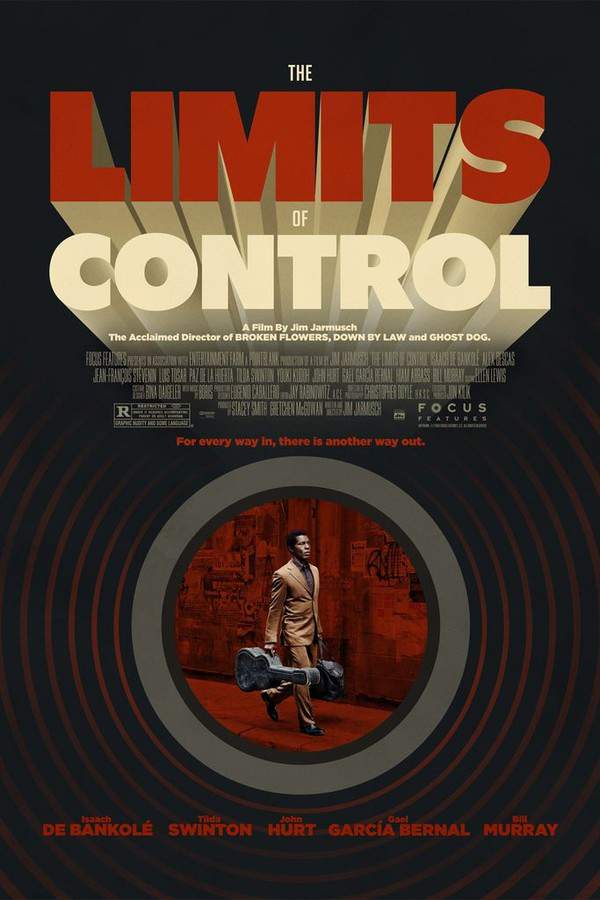
The Limits of Control (2009) movie poster

Timeline

The Limits of Control (2009) Timeline Explained – Every Event in Order

Release, runtime and language
2009 · 116 min · English
Directed by
Jim Jarmusch
Starring
Isaach De Bankolé

A mysterious outsider travels through Spain, following a series of cryptic instructions and encountering enigmatic figures. He appears driven by a specific, unspoken objective, leading him on a tense and unsettling journey. As he progresses, the lines between his mission and his own internal state become increasingly blurred, presenting a compelling exploration of obsession and the nature of reality.

On this page (7)
  1. 1 Where to watch
  2. 2 Events in order (12)
  3. 3 Timeline questions answered
  4. 4 Movie threads
  5. 5 Movies like The Limits of Control
  6. 6 Categories
  7. 7 Every angle

Where to watch

Where to Watch The Limits of Control (2009)

Where can you watch The Limits of Control? Stream, rent or buy it in the US, including on Amazon Video, Apple TV Store and Fandango At Home: current JustWatch availability with up-to-date prices.

Streaming availability powered by JustWatch

12 events in order · contains spoilers

The Limits of Control Timeline: Events in Chronological Order

Every key event of The Limits of Control (2009) in order, scene by scene, with when and where it takes place. Use it to untangle flashbacks, time jumps and parallel storylines, to refresh your memory before the sequel or to find the exact scene you are thinking of.

  1. Receiving the Briefing

    Lone Man receives an obscure briefing from Creole at a bustling airport. The enigmatic words of Creole create an atmosphere filled with intrigue, setting the stage for the secretive mission that lies ahead.

    Where
    Airport
  2. Departure to Seville

    After leaving the airport, Lone Man embarks on his twisted journey through Spain. His travels take him from Madrid to Seville, where he encounters various individuals who will each play a role in his mission.

    Where
    Madrid to Seville
  3. Café Encounters Begin

    In a series of theatrically striking encounters, Lone Man starts each meeting by ordering two espressos in a café. These rituals lead to interactions that unfold through peculiar exchanges and coded messages.

    Where
    Café
  4. The Ritualistic Question

    During his café meetings, Lone Man is consistently asked, 'You don’t speak Spanish, right?' This line is delivered with variations by each stranger, adding to the layers of mystery surrounding their interactions.

    Where
    Café
  5. Exchanges of Matchboxes

    Each stranger engages Lone Man in a curious trade of matchboxes, which contain coded messages inscribed on slips of paper. These notes become crucial guides for Lone Man's future rendezvous.

    Where
    Café
  6. Meeting the Captivating Woman

    Lone Man crosses paths with a captivating woman, who embodies boldness and invites him for physical intimacy. However, he firmly declines her advances, staying true to his moral compass.

  7. Creole's Haunting Wisdom

    The philosophical phrase from Creole, 'He who thinks he is bigger than the rest must go to the cemetery,' resonates with Lone Man. This existential theme reflects the ephemeral nature of human connections present throughout his journey.

  8. The Adventure in Almería

    Traveling to Almería, Lone Man's journey leads him to the rugged landscapes of the Tabernas desert. Through this surprising adventure, he finds himself transported by an enigmatic Mexican companion in a weathered pickup truck.

    Where
    Tabernas Desert
  9. Infiltrating the Fortified Compound

    The desolate journey culminates at a heavily fortified compound, shrouded in secrecy. Undeterred, Lone Man employs his exceptional ingenuity to infiltrate this secure area with silent stealth.

    Where
    Fortified Compound
  10. Confrontation with the Target

    Inside the compound, Lone Man confronts a mysterious figure portrayed by Bill Murray, who curiously inquires about his method of infiltration. Lone Man's unconventional response, 'I used my imagination,' showcases his creative approach.

    Where
    Target's Office
  11. Transformation on Horseback

    With his task completed, Lone Man makes his way back to Madrid on horseback, shedding his tattered suit. The transformation signifies a rebirth as he dons a sweat-stained tracksuit marked with the emblem of Cameroon.

    Where
    Desert to Madrid
  12. Discarding the Final Matchbox

    Upon emerging from the train station in Madrid, Lone Man discards one last matchbox, symbolizing the fleeting nature of his journey and the transience of human existence. This act represents a farewell to his former self.

    Where
    Train Station

Last updated: November 22, 2024 at 14:32

Was this helpful?

Timeline questions answered

The Limits of Control Timeline Explained: Your Questions Answered

When does it happen, and why in that order? The questions people ask about the chronology of The Limits of Control (2009): time jumps, flashbacks, cause and effect between scenes and the correct order of events, each answered with spoilers.

Q1

Why does Lone Man decline the woman's invitation for intimacy?

Lone Man declines because he adheres to a strict moral compass focused entirely on completing his mission. The film presents him as someone who cannot be distracted by physical desires or personal connections while carrying out his objective. This refusal reinforces his characterization as a solitary, disciplined figure driven by purpose rather than base impulses.

Foreshadowing: The woman's bold invitation mirrors the existential themes of fleeting human connection that Creole later discusses.

  • Lone Man
  • woman
  • intimacy
  • mission
  • morality
Q2

What is the purpose of the coded messages in the matchboxes?

The matchboxes contain instructions that guide Lone Man to his next rendezvous point throughout Spain. Each stranger he meets gives him a slip of paper with coded directions, functioning as a roadmap for his journey from Madrid to Seville to Almería. The messages are essential for progressing through his secretive mission.

Foreshadowing: The first matchbox is given at the initial café meeting, establishing the pattern that will repeat throughout his journey.

  • matchbox
  • coded messages
  • instructions
  • rendezvous
  • café
Q3

What is the significance of the recurring question "You don't speak Spanish, right?"

This ritualistic question is posed by each contact Lone Man meets in the cafés. It serves as a code phrase confirming his identity and establishing the secret nature of their communication. The slight variations in how the line is delivered suggest different people participating in the same mysterious network, though the question itself never receives a direct answer.

Foreshadowing: The first encounter establishes this as the standard greeting between Lone Man and his contacts.

  • Spanish
  • code phrase
  • contacts
  • café
  • ritual
Q4

How does Lone Man infiltrate the heavily fortified compound?

Lone Man uses his imagination rather than conventional force or tools. The film implies he finds an unconventional, creative way to enter that the guards did not anticipate. When Bill Murray's character asks how he got in, Lone Man simply replies, "I used my imagination," suggesting he exploited psychological blind spots or found a path no one expected.

Foreshadowing: His earlier description as possessing exceptional ingenuity foreshadows this creative approach to infiltration.

  • compound
  • infiltration
  • imagination
  • Bill Murray
  • target
Q5

What does Lone Man changing into the Cameroon tracksuit represent?

The change from his tattered suit to the Cameroon tracksuit symbolizes rebirth and transformation. The tracksuit, sweat-stained and bearing the emblem of Cameroon (the nationality of actor Isaach De Bankolé), represents Lone Man's emergence from his mysterious mission as a changed man. He discards his old identity and returns as someone renewed, though the exact meaning remains open to interpretation.

Foreshadowing: The earlier reference to transformation and the symbolic shedding of his former self hints at this visual metamorphosis.

  • Cameroon
  • tracksuit
  • transformation
  • rebirth
  • identity
Q6

What does "the guitar string silenced" refer to?

After confronting his target in the compound, Lone Man silences a guitar string, likely metaphorical or symbolic. This act suggests the completion or termination of something musical, artistic, or perhaps a metaphorical 'string' of the mission's narrative. It aligns with the film's themes of transience and the fleeting nature of human endeavors.

Foreshadowing: The earlier flamenco song in the Seville nightclub establishes music as a thematic element representing ephemeral connections.

  • guitar
  • string
  • silenced
  • target
  • completion
Q7

Why does the film show Lone Man repeating the same café ritual multiple times?

The repetitive structure, the two espressos, the Spanish question, the matchbox exchange, creates a ritualistic pacing that emphasizes the methodical, almost meditative nature of Lone Man's journey. Each encounter follows the same pattern but involves different people with different personalities (one discusses molecular details, another shares artistic crafts), showing variety within constancy. This repetition reflects the film's themes of obsession and the slow, deliberate pace of his mysterious mission.

Foreshadowing: The very first café encounter establishes this recurring pattern from the beginning.

  • café
  • ritual
  • repetition
  • espressos
  • contacts
Q8

Who is the target that Lone Man confronts in the compound?

The target is portrayed by Bill Murray but remains deliberately enigmatic. The film never explicitly reveals his identity, name, or specific importance. He occupies a position of power within the fortified compound and acts as the final objective of Lone Man's journey. His curiosity about how Lone Man infiltrated the space and his acceptance of the unconventional answer "I used my imagination" suggests a philosophical or sophisticated figure.

Foreshadowing: The buildup through multiple coded messages and the dangerous infiltration establish this as the mission's climax.

  • Bill Murray
  • target
  • compound
  • confrontation
  • identity
Q9

What is the meaning of Creole's quote about going to the cemetery?

Creole tells Lone Man, "He who thinks he is bigger than the rest must go to the cemetery. There he will see what life really is: a handful of dirt." This existential statement reflects the film's themes of mortality, humility, and the futility of human ambition. It suggests that regardless of one's perceived importance or mission, ultimately all people face the same fate, returning to earth. This idea of transience echoes throughout the film.

Foreshadowing: The quote resonates with the final act of discarding the matchbox, symbolizing the fleeting nature of existence.

  • Creole
  • cemetery
  • quote
  • existential
  • mortality
Q10

What is the significance of the pickup truck's slogan "La vida no vale nada"?

The weathered pickup truck that transports Lone Man through the Tabernas desert bears the slogan "La vida no vale nada" (Life is worth nothing). This aligns with the film's melancholic tone and existential themes, reinforcing the idea of life's futility and transience. The bleak desert setting amplifies this philosophical statement about the value of human existence.

Foreshadowing: This slogan connects thematically to Creole's cemetery quote about life being "a handful of dirt."

  • truck
  • slogan
  • life
  • desert
  • Almería
Q11

What is Lone Man's actual mission in the film?

The film deliberately obscures Lone Man's exact mission. He receives an obscure briefing at the airport, follows coded instructions, infiltrates a fortified compound, and confronts Bill Murray's character, but the specific objective remains ambiguous. The ambiguity is intentional, focusing viewers on the journey, ritual, and transformation rather than a conventional plot resolution. The mission appears to be an assassination or elimination, given the infiltration and confrontation.

Foreshadowing: Creole's initial briefing at the airport establishes that a secretive, undefined mission underlies Lone Man's journey.

  • mission
  • objective
  • briefing
  • Creole
  • purpose
Q12

Why does Lone Man discard the final matchbox at the train station?

At the film's end, Lone Man discards the last matchbox upon emerging in Madrid, symbolizing the completion and release of his journey. The matchbox represents the coded guidance that directed his path, once discarded, he is no longer bound by its instructions. This act signifies his departure from his former self and the transient nature of his mission, embracing transformation rather than remaining tied to his previous identity.

Foreshadowing: The repeated exchange of matchboxes throughout the film builds to this moment of final release.

  • matchbox
  • train station
  • discard
  • ending
  • transformation

Movie threads

More Movies Like The Limits of Control, by Mood & Story

Curated lists built around what makes The Limits of Control tick: the same mood, the same kind of story or the same emotional payoff. Each list explains why these movies belong together.

Atmospheric, Philosophical Journeys like The Limits of Control

Slow, atmospheric films that use travel as a framework for philosophical exploration. If you liked The Limits of Control and its meditative, existential journey, explore movies like it. This section features slow-paced, atmospheric stories where characters embark on quests that are more about inner transformation and philosophical inquiry than external goals. Find similar films with a lonely, cryptic, and dreamlike mood.

  • atmospheric
  • meditative
  • philosophical
  • lonely
  • dreamlike
  • cryptic
  • Tone: melancholic, contemplative
  • Pacing: slow, deliberate
Why these movies?

The story pattern: Stories in this thread typically feature a lone protagonist on a deliberate, often enigmatic journey. The plot unfolds through a series of deliberate, sometimes ritualistic encounters, with the external mission mirroring or prompting an internal philosophical exploration. The narrative is less about destination and more about the introspective process.

Why they belong together: Movies are grouped here for their shared emphasis on creating a specific, meditative atmosphere and using a journey-based structure to ponder existential themes. They connect through a similar slow pacing, a melancholic or reflective tone, and a preference for mood and ideas over conventional action or resolution.

Cryptic Loner Mission Movies like The Limits of Control

Stories about isolated individuals following mysterious, often symbolic instructions. For viewers who enjoyed the cryptic mission and lone operative in The Limits of Control. Discover similar movies featuring isolated characters on enigmatic, ritualistic assignments. These films share a methodical pace, an unsettling mood, and a focus on secrecy and coded communication, often leaving the ultimate meaning ambiguous.

  • cryptic
  • ritualistic
  • unsettling
  • mysterious
  • secretive
  • loner
  • Tone: unsettling, mysterious
  • Pacing: methodical, deliberate
Why these movies?

The story pattern: The narrative pattern involves a protagonist, often a professional or dedicated individual, receiving and following a set of vague, ritualistic instructions. The plot progresses through a series of structured encounters that build a sense of mystery and purpose, yet the true objective remains elusive, blurring the line between concrete mission and personal or symbolic transformation.

Why they belong together: These films are linked by the core archetype of the lone figure on a mysterious assignment, the use of ritualistic and coded interactions, and a narrative that prioritizes ambiguity and symbolic meaning. They share a specific mood of secrecy, unease, and intellectual engagement with a puzzle-like structure.

If you liked this

Movies Like The Limits of Control

Similar movies to The Limits of Control: the same genre, themes or kind of story. Each one comes with its own plot summary, timeline and ending explained.

Browse all movie summaries

Categories

Movie Lists Featuring The Limits of Control

The Limits of Control appears in these hand-built movie categories. Each one groups movies by a specific mood, theme or story type, with their plot summaries and endings explained.

View all movie categories

Every angle

The Limits of Control (2009) Explained: Plot, Timeline & Characters

Everything about The Limits of Control in one place: what happens in the plot summary, the timeline in chronological order, the characters and meaning and a spoiler-free summary. What's After the Movie adds the cast, box office and post-credit scenes.

Coming soon on iOS and Android

The Plot Explained Movie Summary App

Plot summaries, endings explained and timelines on your phone. Catch up on any movie in minutes, save your favorites and never miss a twist again.

Be the first to know when we launch. Your email stays private, always.

Learn more about the app