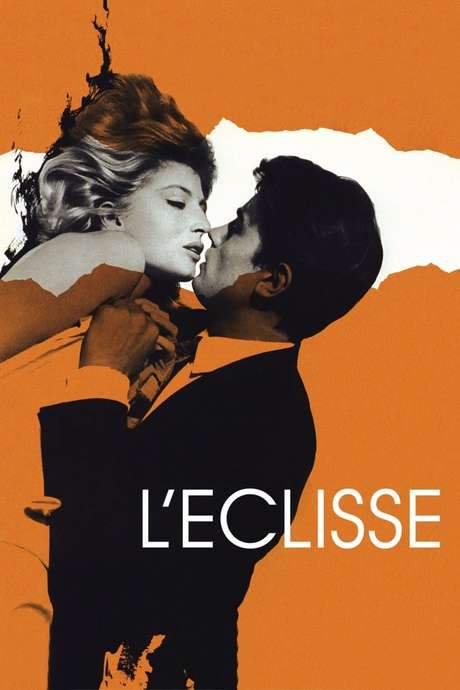
L’Eclisse

L’Eclisse

Year: 1962

Runtime: 126 mins

Language: Italian

Director: Michelangelo Antonioni

RomanceDrama

Set against Rome’s bustle, the film follows Vittoria, a literary translator, as she copes with the end of her relationship with writer Riccardo. She meets Piero, a stockbroker, on the hectic trading floor, and their romance develops amid emotional strain. An eclipse tests their commitment, exposing the ache and yearning beneath their connection.

Warning: spoilers below!

Haven’t seen L’Eclisse yet? This summary contains major spoilers. Bookmark the page, watch the movie, and come back for the full breakdown. If you're ready, scroll on and relive the story!

L’Eclisse (1962) – Full Plot Summary & Ending Explained

Read the complete plot breakdown of L’Eclisse (1962), including all key story events, major twists, and the ending explained in detail. Discover what really happened—and what it all means.

On a Monday morning in July 1961, Vittoria, a young literary translator, ends her relationship with Riccardo in his apartment in the EUR district of Rome, following a long night of conversation. Riccardo pleads for her to stay, but she tells him she no longer loves him and leaves. As she wanders the deserted streets, he catches up and walks with her through a wooded area to her apartment building, where they share their final goodbye in quiet, weary words.

[Vittoria] visits her mother at the frantic Rome Stock Exchange. A young stockbroker, Piero, overhears an inside tip, rushes to purchase the stocks, and then sells them at a large profit. He introduces himself to Vittoria; he is her mother’s stockbroker. Outside the building, Vittoria attempts to tell her mother about her recent breakup, but her mother is preoccupied with her earned profits and the thrill of the numbers flashing on the screens.

That evening, Vittoria’s mother hosts a small world that keeps turning: Anita, a neighbor, stops by to talk about the breakup, while Marta, another neighbor, calls and invites them to her nearby apartment. Marta—a white colonialist from Kenya in this story—refers to natives as “monkeys” and believes white minorities feel threatened. In a tense moment, Vittoria dons blackface and mimics an African tribal dance until Marta, unamused, asks her to stop. When Marta’s dog Zeus escapes from the apartment, the women give chase. Later, Riccardo calls for Vittoria outside her apartment, but she hides and does not answer.

The next day, Vittoria accompanies Anita and her husband on a trip to Verona. Meanwhile, back at the Rome Stock Exchange, [Piero] is busy making trades. Vittoria arrives at the Stock Exchange and learns that her mother has lost approximately 10 million lire due to a stock market crash. She encounters [Piero], who drives her to her mother’s apartment in his Alfa Romeo Giulietta sportscar. She shows him framed family pictures and her room growing up. [Piero] tries to kiss her, but she refuses. He returns to his office, where he must break the bad news to his investors.

After work, [Piero] meets with a call girl he previously arranged to meet, but sends her away upon finding that she has dyed her blonde hair a darker color. He then drives to Vittoria’s building and stands outside her apartment. Vittoria comes out to her balcony, and while they are talking, a drunk man steals his sportscar. The next morning, they meet by a lake and watch as a crane lifts the car with the drunk man’s dead body out of the water. After a long walk, they arrive at a building under construction near Vittoria’s apartment building. [Piero] again tries to kiss her, but she pulls away and heads home. That evening, Vittoria calls [Piero] but says nothing; thinking it is a prank call, he yells into the phone and slams down the receiver.

The next day, while Vittoria waits by the construction site, [Piero] arrives and tells her he has bought a new BMW to replace his Alfa Romeo. He takes her to his parents’ apartment, which is filled with paintings and sculptures. As they talk, she seems nervous and unwilling to open up to him. They eventually kiss, and after he accidentally tears her dress, she goes into a bedroom and looks at his old family pictures. [Piero] comes to the bedroom, and they have sex.

[Vittoria] and [Piero] lie on a hill. When he brings up marriage, she asserts that she does not miss it, even though she has never been married. He grows frustrated with her inability to express how she feels about him, to which she responds, “I wish I didn’t love you or that I loved you much more.” Some time later at his office, Vittoria and Piero are making out on a couch. When an alarm goes off, they prepare to part. They embrace and discuss seeing each other every day. They agree to meet that evening at 8 pm at the “usual place” outside the construction site, and Vittoria leaves. That evening, on Sunday, 10 September 1961, neither shows up.
Last Updated: October 09, 2025 at 11:25

Mobile App Preview

Coming soon on iOS and Android

The Plot Explained Mobile App

From blockbusters to hidden gems — dive into movie stories anytime, anywhere. Save your favorites, discover plots faster, and never miss a twist again.

Sign up to be the first to know when we launch. Your email stays private — always.

Explore Movie Threads

Discover curated groups of movies connected by mood, themes, and story style. Browse collections built around emotion, atmosphere, and narrative focus to easily find films that match what you feel like watching right now.

Alienating love stories with modern ennui like in L’Eclisse

Romantic stories where emotional isolation eclipses the possibility of true connection.If you liked the themes of alienation and emotional detachment in L’Eclisse, you might enjoy these other movies. This collection features similar stories about romantic disillusionment and the yearning for connection within the isolating structures of modern life.

alienatingyearningdisconnectedreflectivemelancholiclonelyexistentialbleak

Narrative Summary

These narratives often follow characters navigating relationships while grappling with a deep sense of existential ennui. The romance itself is frequently tenuous, marked by miscommunication and emotional distance, with the modern setting—be it a bustling city or a sterile environment—acting as a character that amplifies the feeling of isolation.

Why These Movies?

These films are grouped together because they share a melancholic tone and a thematic focus on the failure of connection. They feature slow, reflective pacing that allows the emotional weight of alienation to settle, often culminating in ambiguous or bittersweet endings that mirror the complexity of real-world relationships.

Slow burn character studies with heavy mood like L’Eclisse

Atmospheric films that delve into character interiority through minimal dialogue and patient observation.Find more movies that share the slow, atmospheric pacing and deep psychological focus of L’Eclisse. These films are for viewers who enjoy patient, character-driven narratives that explore themes of alienation and emotional strain through visual storytelling.

slow burnatmosphericpsychologicalcontemplativeinterioruneasyminimalistheavy

Narrative Summary

The narrative pattern is less about external events and more about the gradual unfolding of a character's psyche. Plot is secondary to atmosphere, and tension arises from internal conflict and the unspoken space between characters. The journey is one of subtle emotional shifts rather than dramatic plot twists.

Why These Movies?

They are connected by a deliberate, slow pacing that allows the audience to sit with the characters' emotions. The experience is defined by a heavy, often melancholic mood, a complex emotional weight, and a visual style that speaks as loudly as the script, creating a cohesive and introspective vibe.

Unlock the Full Story of L’Eclisse

Don't stop at just watching — explore L’Eclisse in full detail. From the complete plot summary and scene-by-scene timeline to character breakdowns, thematic analysis, and a deep dive into the ending — every page helps you truly understand what L’Eclisse is all about. Plus, discover what's next after the movie.

L’Eclisse Timeline

Track the full timeline of L’Eclisse with every major event arranged chronologically. Perfect for decoding non-linear storytelling, flashbacks, or parallel narratives with a clear scene-by-scene breakdown.

L’Eclisse Timeline

Characters, Settings & Themes in L’Eclisse

Discover the characters, locations, and core themes that shape L’Eclisse. Get insights into symbolic elements, setting significance, and deeper narrative meaning — ideal for thematic analysis and movie breakdowns.

Characters, Settings & Themes in L’Eclisse

L’Eclisse Spoiler-Free Summary

Get a quick, spoiler-free overview of L’Eclisse that covers the main plot points and key details without revealing any major twists or spoilers. Perfect for those who want to know what to expect before diving in.

L’Eclisse Spoiler-Free Summary

More About L’Eclisse

Visit What's After the Movie to explore more about L’Eclisse: box office results, cast and crew info, production details, post-credit scenes, and external links — all in one place for movie fans and researchers.

More About L’Eclisse

Similar Movies to L’Eclisse

Discover movies like L’Eclisse that share similar genres, themes, and storytelling elements. Whether you’re drawn to the atmosphere, character arcs, or plot structure, these curated recommendations will help you explore more films you’ll love.