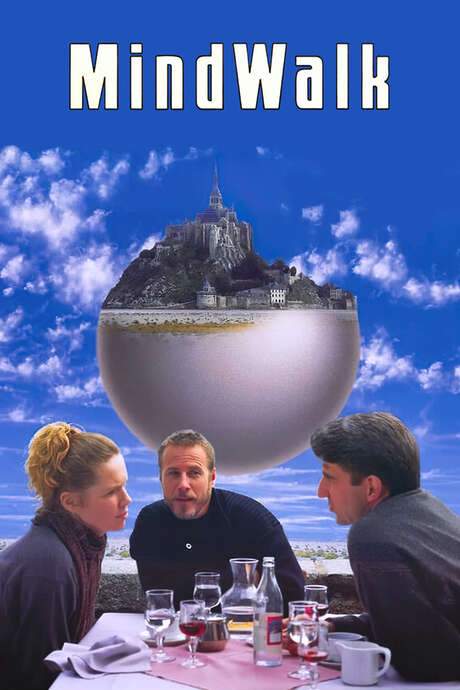
On the windswept corridors and tidal horizons around Mont Saint-Michel, the film unfolds as a long, contemplative conversation among three central figures: Sonia Hoffman, Liv Ullmann a Norwegian physicist who abandons a lucrative career after discovering that parts of her research were being used for weapons development; Jack Edwards, Sam Waterston an American politician who is trying to make sense of his recent presidential defeat; and Thomas Harriman, John Heard a poet and former political speechwriter, now disillusioned, as they wander the island’s ancient stones and shifting tides. Their dialogue takes place against the island’s quiet magic—the stone stairways, the cloisters, and the ever-present pull of the sea—creating a setting that feels at once intimate and monumental.
The film’s core engine is intellectual curiosity, not a plot-driven payload. It introduces and reverberates with systems theory and systems thinking, using them as a framework to view problems as interconnected webs rather than isolated dilemmas. Rather than offering simple solutions, the conversations map out how ideas, technologies, and social structures loop back on themselves, inviting viewers to consider how one decision can ripple through economies, ecosystems, and cultures. The philosophical cadence is measured, almost mathematical, underscoring how patterns emerge when different perspectives interact over time and space.
Alongside these conceptual threads, the work lingers on the language of science—quantum mechanics and particle physics—not as dry abstractions but as symbolic lenses through which to examine social choice, ethics, and power. The dialogue treats scientific theory as a living tool for analyzing uncertainty, causality, and the limits of prediction. By juxtaposing Sonia’s disciplined, holistic mindset with Jack’s pragmatic political sensibility and Tom’s lyrical, skeptical sensibility, the film suggests that truth may be less a fixed verdict than a spectrum of interpretations shaped by context, measurement, and experience.
Sonia Hoffman’s perspective is foregrounded as the holistic, systems-theory viewpoint. She challenges the speed and scale of modern decision-making, pressing the others to consider long chains of consequences—how a political maneuver, a technological advance, or a poetic impulse can cascade through families, communities, and nations. Her insistence on interconnections invites a broader ethics of responsibility, one that looks past short-term gains to the sturdy, sometimes stubborn, resilience of systems that endure beyond any single actor’s moment.
Jack Edwards enters the conversation as a figure of political gravity and personal recalibration. His recent defeat becomes not a terminal setback but a prompt to reframe ambition, doubt, and public service in a more reflective key. The film uses his interior recalibration to probe questions about leadership, accountability, and the limits of rhetoric when faced with ambiguity and consequence. He listens, negotiates meaning, and occasionally squares with—the tension of—Sonia’s broad vantage points and Tom’s insistence on the human heartbeat beneath politics.
Thomas Harriman, the poet, plays the role of the conscience and the counterweight. Through his calm, verbal cadence, he tests abstract theories against lived experience and the intimate ache of disillusionment. His presence grounds the discussion in the everyday, offering poetry as a method of making sense of confusion and a reminder that beauty and moral inquiry can emerge from doubt rather than dogma.
The film maintains a patient, almost elegiac tempo, letting the landscapes of Mont Saint-Michel echo the inner landscapes of its three protagonists. The walk becomes a model for philosophical inquiry: ongoing, incremental, and shaped by surroundings that are themselves ancient, imperfect, and alive with memory. The conversations unfold in a way that rewards attentive listening, revealing how a shared horizon can arise from divergent starting points.
As the core debate broadens, the characters explore possible alternative paths to social and political progress without surrendering nuance. The dialogue sketches multiple routes—technological stewardship balanced by ethical oversight, civic engagement animated by humility, and scientific curiosity tethered to humane ends—without claiming that any one route is definitive. The emphasis remains on seeing the whole rather than selecting a single correct answer, a stance that aligns with Sonia’s holistic emphasis on interdependence and the webs that connect people, ideas, and institutions.
In the film’s quiet, decisive moment, the discussion reaches a lyrical resolution rather than a pointed conclusion. The poet Tom Harriman closes the core discussion with a recitation of Pablo Neruda’s poem Enigmas (based on the Robert Bly translation), a lingering, poignant note that underscores the film’s interest in mystery as a mode of understanding rather than avoidance. The recitation acts as a bridge between intellect and emotion, inviting viewers to carry the conversation forward in their own lives, long after the final image fades.
Ultimately, the film asks viewers to consider how knowledge, power, and art shape one another across the thresholds of science, politics, and poetry. It presents a portrait of three thoughtful minds wandering through a place where history and nature intersect, using their dialogue to illuminate how systems, uncertainties, and human values interact in a world that is always in motion. The result is a meditation on responsibility, curiosity, and the many ways we seek meaning when the path ahead is not clearly illuminated, but nonetheless real and compelling.