Plot Explained Spoilers guaranteed!
Plot Explained

Browse by genre

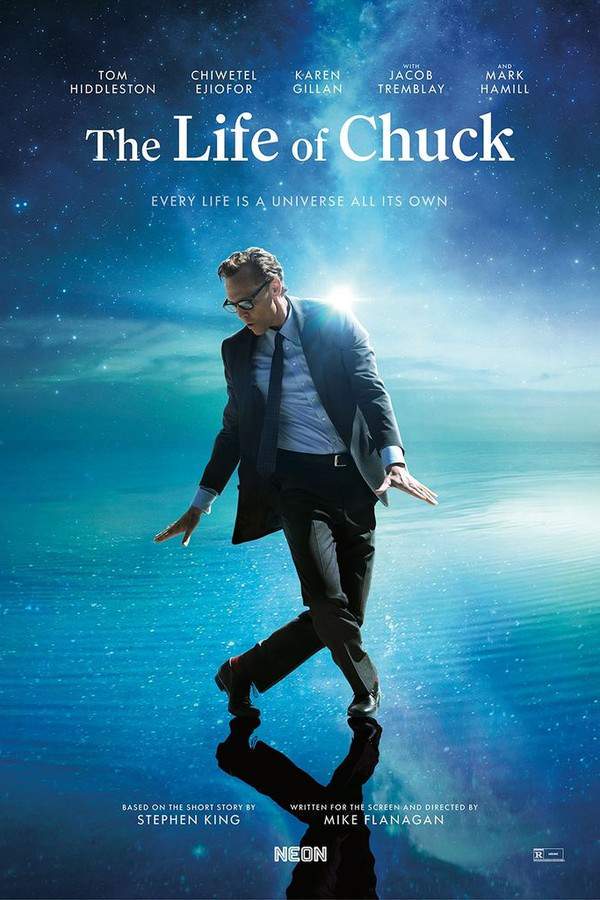
The Life of Chuck (2025) movie poster

Plot Summary

The Life of Chuck (2025) Plot Summary & Ending Explained

Release, runtime and language
2025 · 1 h 50 m · English
Echo score 73
JustWatch #388 9
Directed by
Mike Flanagan
Starring
David Dastmalchian, Jacob Tremblay, Mark Hamill, Karen Gillan, Tom Hiddleston, Chiwetel Ejiofor
Budget
$25M

Based on a Stephen King story, this film explores the life of Charles "Chuck" Krantz, an ordinary man, through three chapters. As the world faces an impending end, mysterious advertisements begin appearing, thanking Chuck for 39 years of service. Intrigued, a man named Marty Anderson questions the identity of this Chuck and why his fate seems intertwined with the end of the world. Memories, personal tragedies, and cosmic puzzles gradually intertwine to form a poignant story about life, loss, and the impact one person can have, even if the reason remains unclear.

On this page (8)
  1. 1 Where to watch
  2. 2 What happens: full plot
  3. 3 Plot questions answered
  4. 4 How it ends
  5. 5 The book behind the movie
  6. 6 Movie threads
  7. 7 Movies like The Life of Chuck
  8. 8 Every angle

Where to watch

Where to Watch The Life of Chuck (2025)

Where can you watch The Life of Chuck? Stream, rent or buy it in the US, including on Hulu, Kanopy and Amazon Video: current JustWatch availability with up-to-date prices.

Streaming availability powered by JustWatch

Full plot summary · contains spoilers

What Happens in The Life of Chuck: Full Plot Summary

The whole story of The Life of Chuck (2025) explained, from the opening scene to the final frame: every key event, every twist and what it all adds up to. Read it as a quick recap before the sequel, to check a scene you missed, or to finally understand what really happened.

The film unfolds in three acts presented in reverse chronological order, beginning with Act Three – Thanks Chuck. In the classroom of Marty Anderson, a teacher, students are alerted to news of an earthquake via their phones. Shortly after, they realize the internet has vanished, leaving them disconnected from the world. Among the parents trying to reach out is Josh, who expresses his despair over his wife's departure and the strange fact that popular sites like Pornhub are inaccessible. Meanwhile, disasters begin surfacing globally. Marty notices increasing advertisements and billboards dedicated to a man named Charles "Chuck" Krantz (Tom Hiddleston), thanking him for “39 great years.” As his ex-wife, Felicia Gordon, a nurse, overhears a radio announcement for Chuck, she and Marty start speculating whether they are facing the apocalypse. After their call, yet another commercial appears on Marty's TV in gratitude towards Chuck.

As more bizarre happenings occur, Gus Wilfong informs Marty that a sinkhole has opened nearby, hindering travel and prompting discussions about the possible end of times. In the sky, "Thanks Chuck" is etched out by an airplane. Felicia and her colleague Bri observe an unsettling number of empty hospital beds, even as monitors indicate active lifelines. Marty, unable to contact Felicia due to dwindling service, takes a stroll and meets Sam Yarbrough, an undertaker who shares cryptic thoughts about time and an impending reckoning. As day gives way to night, Marty encounters a young girl, Iris, struggling with her skating amid blacked-out street lights, before reaching Felicia’s house where they come to terms with the looming darkness. In a hospital room, Chuck is seen nearing the end beside his wife, Virginia 'Ginny' Krantz, reaffirming their love for one another just as the scene fades to black.

Act Two – Buskers Forever introduces us through the voice of the Narrator, [Nick Offerman], to a young woman named Taylor Frank. She is a street performer who plays her drums for spare change in the town square. Simultaneously, we are introduced to Janice Halliday, whose relationship has just ended tragically via a text message. Chuck is also out during this ordinary day, blissfully unaware that in six months he will succumb to a brain tumor. As Taylor plays an energetic tune, she captures Chuck's attention, prompting him to dance, which draws a captivated crowd. Eventually, he invites Janice to join him, and though initially hesitant, she too embraces the moment, showcasing their dance moves to the audience's delight. After their performance, Taylor offers to share her earnings with them, but Chuck and Janice graciously decline. They part ways but interestingly, Chuck reflects on his uncharacteristic burst of joy, unaware of the heavy fate that awaits him—losing many of life's simple pleasures.

Act One – I Contain Multitudes delves into young Chuck’s life, where he faces profound loss at a young age when his parents and unborn sister perish in a tragic car accident. He then moves in with his grandparents, Albie and Sarah, who each cope with the tragedy in contrasting ways; Albie turning to alcohol while Sarah finds solace in music, nurturing Chuck’s love for dance and classic musicals. Albie forbids Chuck from entering a mysterious locked room, claiming it holds dark secrets relating to premonitions of death. After the passing of Sarah, Albie’s addiction worsens until the day he dies from a heart attack, leaving the young boy isolated. As a teenager now played by Jacob Tremblay, Chuck discovers the hidden room and is confronted by the adult version of himself on his deathbed. This shocking vision inspires him to strive to live a life enriched with experiences, as he is reminded he “contains multitudes” of potential and passion. Throughout his journey, Chuck not only navigates personal grief but also learns the importance of embracing his unique identity and the moments that define him.
Last updated: June 11, 2025 at 15:03

Was this helpful?

Plot questions answered

The Life of Chuck Plot Explained: Your Questions Answered

The questions people ask most about The Life of Chuck (2025): what happens in the confusing scenes, why the characters do what they do, the twists, hidden details and what the ending means. Each answer contains spoilers.

Q1

Why does the movie start with the apocalypse instead of showing Chuck's life chronologically?

The film uses a reverse chronological structure deliberately. Starting with Act Three shows the apocalypse occurring as Chuck dies, which creates mystery and emotional weight. This structure allows viewers to understand the cosmic significance of Chuck's life only after learning about his journey, making the revelation that one ordinary man's life may be connected to the world's fate more impactful.

Foreshadowing: The opening earthquake and disappearances only make sense once the full scope of Chuck's story is revealed.

  • reverse chronology
  • non-linear structure
  • three acts
  • storytelling
Q2

Why are there advertisements thanking Chuck for '39 great years'?

The advertisements appear globally as disasters unfold, suggesting Chuck's life is somehow cosmically significant. The '39 years' corresponds to his age at death. The mysterious marketing implies Chuck has been unknowingly fulfilling some kind of cosmic role or purpose, and the world is somehow aware of his contribution even as he dies.

Foreshadowing: Early scenes in Marty's classroom establish the advertisements as a recurring mystery throughout Act Three.

  • advertisements
  • 39 years
  • apocalypse
  • chuck krantz
Q3

What is the significance of the locked room in Chuck's grandparents' house?

The locked room contains a premonition of Chuck's own death. His grandfather Albie kept it sealed because he foresaw death within the family and blamed himself. When teenage Chuck finally enters, he encounters a vision of his older self on a hospital deathbed, this supernatural encounter directly motivates him to embrace life fully and pursue the experiences that define his remaining years.

Foreshadowing: Albie's stern warning about the room's dark secrets early in Act One sets up this pivotal revelation.

  • locked room
  • albie
  • grandparents
  • death premonition
  • vision
Q4

How does the young Chuck encounter his older dying self?

As a teenager, Chuck discovers the hidden room his grandfather forbade him to enter. Inside, he experiences a supernatural vision of himself as an old man dying in a hospital bed. This encounter with his own mortality is the catalyst that inspires him to live boldly, pursuing dance, embracing joy, and collecting the experiences that will define his 'multitudes' of identity.

Foreshadowing: Albie's cryptic warnings about the room being connected to death premonitions foreshadow this exact moment.

  • teenage chuck
  • older chuck
  • vision
  • hospital bed
  • mortality
Q5

Why does dance play such a central role in Chuck's life?

Dance becomes Chuck's way of embracing life after his childhood trauma. His grandmother Sarah nurtures his love for movement through classic musicals, and the dance studio program 'Twirlers & Spinners' gives him confidence. The vision of his older self reinforces this, dancing represents living fully and authentically. Even as an adult, when he encounters street performer Taylor, he spontaneously dances, showing how integral this expression is to his identity.

Foreshadowing: Sarah's music and the musical films she shares with young Chuck plant the seed for his lifelong connection to dance.

  • dance
  • chuck
  • dancing
  • twirlers spinners
  • sarah
Q6

What is the connection between Chuck's death and the worldwide apocalypse?

The film implies Chuck's death triggers or coincides with the world's end, though the exact nature remains mysterious. As Chuck dies in the hospital surrounded by his wife Ginny, disasters intensify globally, earthquakes, internet loss, and the 'Thanks Chuck' messages appearing everywhere. This suggests Chuck's 39 years of 'service' may have been unknowingly holding something back, or his life force was somehow cosmically tied to the world's existence.

Foreshadowing: The advertisements thanking Chuck escalate in frequency and intensity as his condition deteriorates.

  • chuck death
  • apocalypse
  • end of world
  • connection
Q7

Who is Marty Anderson and how is he connected to Chuck?

Marty Anderson is a teacher who becomes curious about Chuck after seeing the mysterious advertisements. He investigates who Chuck is while navigating the unfolding apocalypse. Though their connection isn't fully explained, Marty represents the outside perspective trying to understand Chuck's significance. He dates Felicia Gordon, who works as a nurse at the same hospital where Chuck is dying, physically linking the parallel storylines.

Foreshadowing: Marty notices the first 'Thanks Chuck' advertisement in his classroom as the disasters begin.

  • marty anderson
  • felicia gordon
  • teacher
  • investigation
Q8

What do the empty hospital beds with active monitors signify?

Felicia and her coworker Bri notice rows of empty hospital beds, yet the monitors still show active vital signs, suggesting people are there but invisible or disappearing. This eerie phenomenon occurs as the apocalypse unfolds, hinting at a reality-breaking event where people are being erased or taken as the world ends. It reinforces the film's mysterious, cosmic approach to the apocalypse.

Foreshadowing: This occurs during Act Three as other supernatural events like the sinkholes and blackouts intensify.

  • empty hospital beds
  • monitors
  • disappearances
  • felicia
Q9

What does 'I Contain Multitudes' mean in the context of Chuck's story?

The title references Walt Whitman's poem 'Song of Myself.' It represents Chuck's journey to embrace all aspects of his identity, the dancer, the lover, the grieving orphan, the ordinary man. After seeing his dying self, Chuck commits to living fully and accepting the many dimensions of who he can be. The phrase encapsulates the film's theme that one life contains infinite possibilities and experiences.

Foreshadowing: Chuck's vision of his older self tells him he 'contains multitudes,' directly quoting the phrase that becomes his life philosophy.

  • i contain multitudes
  • title meaning
  • identity
  • whitman
Q10

Why does the 'Buskers Forever' act feel so joyful when the rest of the film is somber?

This contrast is intentional and reinforces the film's bittersweet tone. The Buskers Forever act shows Chuck during his healthy adult years, before his brain tumor develops. His spontaneous dance with street performer Taylor represents the joy and spontaneity he chose to embrace after his mortality vision. This uplifting moment provides emotional relief while also heightening the tragedy of knowing he'll die young.

Foreshadowing: The act begins with the Narrator introducing it as a contrast to the apocalyptic events, signaling this is a flashback to happier times.

  • buskers forever
  • taylor
  • dance
  • joy
  • bittersweet
Q11

How do Chuck's childhood losses shape his adult life?

Chuck loses his parents and unborn sister in a car accident as a young child. This foundational trauma forces him to live with his grandparents Albie and Sarah, who each cope differently, Albie with alcoholism, Sarah with music. This early loss drives Chuck's later determination to embrace life fully, as he understands how quickly everything can be taken away. The tragedy also connects to the film's themes of mortality and finding meaning in finite time.

Foreshadowing: Young Chuck's initial withdrawal after the accident sets up his later transformation through dance and joy.

  • parents death
  • car accident
  • childhood trauma
  • albie
  • sarah
Q12

What is the undertaker Sam Yarbrough's role in the story?

Sam Yarbrough is an undertaker Marty encounters during the blackout. He speaks cryptically about time and a coming 'reckoning,' suggesting he understands the cosmic significance of the unfolding events. Sam represents those who recognize that the apocalypse is tied to something larger than random disaster, his ominous wisdom aligns with the film's mysterious, metaphysical elements.

Foreshadowing: Sam's dialogue about time and reckoning hints at the deeper connection between Chuck and the world's fate.

  • sam yarbrough
  • undertaker
  • apocalypse
  • cosmic

Ending explained

What Happens at the End of The Life of Chuck?

How The Life of Chuck (2025) ends, in short: the final scene, the last twist and what it means for the characters. The full ending explained, with every spoiler, lives on its own page.

Read the full ending explained

Chuck’s story comes full circle when the film reveals that the earlier scenes of his life were not entirely "real," but part of a mental universe built in his mind. The movie starts with a shot of Chuck as an adult in a hospital, seemingly nearing death, which initially feels like the ending. However, through a series of revelations, it becomes clear that this image is actually a projection of his consciousness, a universe constructed from memories, hopes, and fears. The true purpose of the film is to explore how Chuck chose to live his life, focusing on the joy and connections he made along the way, rather than the moment of death itself.

A key piece of the puzzle is the scene in his childhood, where he is orphaned after a tragic accident, and his grandfather warns him about the ghosts of what’s to come. This moment, which appears early in the story, is now understood to be part of the universe inside Chuck’s mind. The "apocalyptic" ending, where the universe is destroyed in a fiery end, symbolizes the collapse of that internal universe, but it is not a literal event. Instead, it signifies the realization that Chuck’s life was always about how he lived, not how it would end.

Continue reading the ending (1 more paragraphs)

The film emphasizes that Chuck’s death—the moment we saw at the start—is actually a culmination of his internal, mental universe, not a literal physical death. The scene with his wife and son visiting him in his final moments is the only part that appears to be real, grounding the story in the reality of his relationships. The story's structure, moving backwards through different periods of his life, highlights that the real focus is on living meaningfully—cherishing joyful moments like dancing and aiming to leave a positive impact—rather than fearing death. Ultimately, the movie shows that life is about how we live it, not when or how it ends. The ending’s inverted timeline underlines this core message: that our inner universe is shaped by our choices, and true fulfillment comes from embracing life in all its fleeting beauty.**

The Life of Chuck ending explained in full

Movie threads

More Movies Like The Life of Chuck, by Mood & Story

Curated lists built around what makes The Life of Chuck tick: the same mood, the same kind of story or the same emotional payoff. Each list explains why these movies belong together.

Movies with Reverse Chronology like The Life of Chuck

Stories that unfold backwards to find meaning in memories and endings. Find more films like The Life of Chuck that tell their stories in reverse. These movies use non-linear structures to explore themes of memory, legacy, and the bittersweet nature of looking back on a life. If you enjoyed the unique narrative puzzle of Chuck's life, you'll appreciate these similar complex dramas.

  • nonlinear
  • melancholic
  • contemplative
  • nostalgic
  • poignant
  • reflective
  • Tone: bittersweet, melancholic, contemplative
  • Pacing: variable, reflective
Why these movies?

The story pattern: Stories in this thread begin at or near the end of a character's journey or life, gradually moving backwards in time to uncover the pivotal moments that led to the final outcome. This structure forces reflection on cause and effect, memory, and the subjective nature of a life's meaning.

Why they belong together: These films are grouped by their unique structural approach, which inherently creates a melancholic and contemplative mood. They share a focus on piecing together a puzzle of a life, balancing the sadness of a known conclusion with the joy and pain of rediscovered memories.

Cosmic Mysteries with Intimate Drama like The Life of Chuck

Where the quiet tragedies of a single life resonate on a universal scale. Explore movies similar to The Life of Chuck that merge epic, unexplained events with personal human stories. If you liked how Chuck's life connected to the end of the world, you'll find more films here where cosmic scale mysteries illuminate the profound drama of individual lives, grief, and legacy.

  • contemplative
  • mysterious
  • poignant
  • dreamlike
  • somber
  • melancholic
  • Tone: bittersweet, mysterious, poignant
  • Pacing: variable, slow burn
Why these movies?

The story pattern: The narrative pattern involves two parallel threads: a large, often unresolved cosmic or apocalyptic event, and a focused, character-driven drama about loss, memory, or identity. The connection between the two is often metaphorical or emotional, using the vast unknown to explore the depths of the human heart.

Why they belong together: These movies are connected by their unique tonal blend, balancing awe and mystery with profound intimacy. They create a specific feeling where personal sadness is given weight by a larger, unexplainable context, resulting in a contemplative and emotionally resonant experience.

If you liked this

Movies Like The Life of Chuck

Similar movies to The Life of Chuck: the same genre, themes or kind of story. Each one comes with its own plot summary, timeline and ending explained.

Browse all movie summaries

Every angle

The Life of Chuck (2025) Explained: Plot, Ending, Timeline & Characters

Everything about The Life of Chuck in one place: what happens in the plot summary, the timeline in chronological order, the characters and meaning, the ending explained and a spoiler-free summary. What's After the Movie adds the cast, box office and post-credit scenes.

Coming soon on iOS and Android

The Plot Explained Movie Summary App

Plot summaries, endings explained and timelines on your phone. Catch up on any movie in minutes, save your favorites and never miss a twist again.

Be the first to know when we launch. Your email stays private, always.

Learn more about the app