Plot Explained Spoilers guaranteed!
Plot Explained

Browse by genre

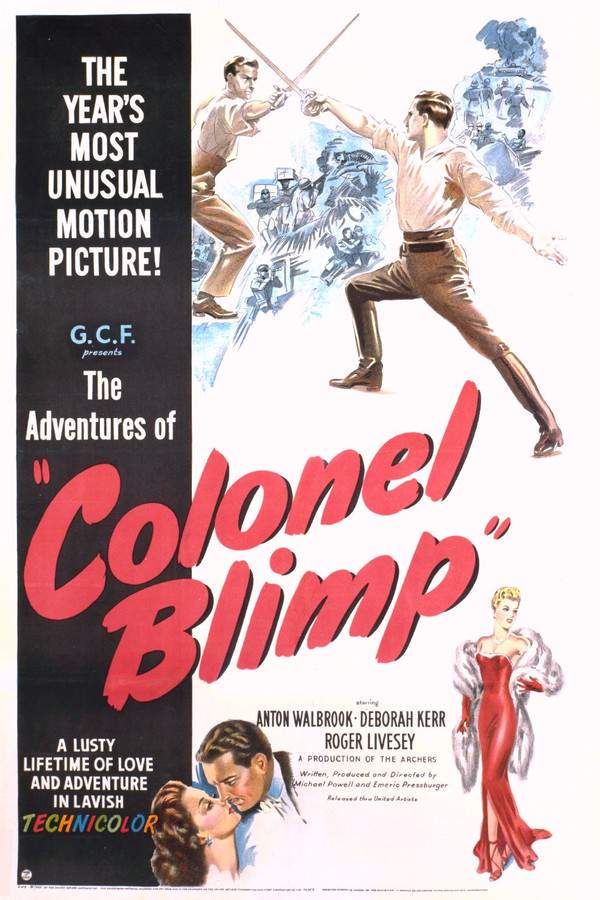
The Life and Death of Colonel Blimp (1945) (1945) movie poster

Plot Summary

The Life and Death of Colonel Blimp (1945) (1945) Plot Summary Explained

Release, runtime and language
1945 · 163 min · English
JustWatch #15,427 1
Directed by
Emeric Pressburger, Michael Powell
Starring
Deborah Kerr, Anton Walbrook, Roger Livesey

The film chronicles the extraordinary life of Clive Candy, a British officer whose unwavering principles are challenged across three wars and through evolving times. His journey involves complex romantic relationships and explores themes of aging, enduring friendship, and the struggle against obsolescence. It's a poignant look at a man's life and legacy against a backdrop of significant historical change.

On this page (6)
  1. 1 Where to watch
  2. 2 What happens: full plot
  3. 3 Plot questions answered
  4. 4 Movie threads
  5. 5 Movies like The Life and Death of Colonel Blimp (1945)
  6. 6 Every angle

Where to watch

Where to Watch The Life and Death of Colonel Blimp (1945) (1945)

Where can you watch The Life and Death of Colonel Blimp (1945)? Stream, rent or buy it in the US, including on Artiflix, HBO Max and Darkroom: current JustWatch availability with up-to-date prices.

Streaming availability powered by JustWatch

Full plot summary · contains spoilers

What Happens in The Life and Death of Colonel Blimp (1945): Full Plot Summary

The whole story of The Life and Death of Colonel Blimp (1945) (1945) explained, from the opening scene to the final frame: every key event, every twist and what it all adds up to. Read it as a quick recap before the sequel, to check a scene you missed, or to finally understand what really happened.

Major-General Clive Wynne-Candy serves as a senior commander in the British Home Guard amidst the chaos of World War II. The story unfolds with a rather unexpected twist when he is "captured" during a training exercise by British Army troops, led by Lieutenant "Spud" Wilson, despite Clive's fervent protest that > "War starts at midnight!" In the ensuing scuffle, they both tumble into a bathing pool, transitioning into an extensive flashback that reveals Clive's past adventures.

The tale takes us back to 1902, where Clive is on leave from his service in the Second Boer War, a tenure that has earned him the prestigious Victoria Cross. During his time off, he receives a troubling letter from Edith Hunter, who is stationed in Berlin. She shares her concerns regarding a German named Kaunitz, who is propagating anti-British sentiments, and urges the British embassy to intervene. Defiantly, Clive decides to travel to Berlin despite his superiors' refusal. There, he meets Edith, and a confrontation with Kaunitz leads to a duel between Clive and Theo Kretschmar-Schuldorff, chosen by fate through lot drawing. Ultimately, they both sustain injuries but develop a friendship during their recovery. Although Edith harbors feelings for Clive, she becomes engaged to Theo while Clive is left to grapple with his emotions.

As time progresses into November 1918, Clive, now a brigadier general, reflects on the end of World War I, feeling that "right is might" has prevailed. In France, he encounters nurse Barbara Wynne, who bears an uncanny resemblance to Edith. Despite a significant age gap of 20 years, Clive courts and marries Barbara, with Murdoch serving as their butler. The narrative continues with Clive seeking out Theo in a prisoner-of-war camp, where an awkward reunion occurs. Theo, harboring skepticism about the Allies' treatment of Germany, must confront the complexities of their past friendship.

Fast forward to November 1939, we find Theo reminiscing about his estrangement from his children, who had joined the Nazis. Regret washes over Clive as he confesses to Theo about his unspoken love for Edith, realizing he only comprehended his feelings too late. When Clive is reinstated as a major-general tasked with delivering a radio address regarding Dunkirk, Theo encourages him to embrace a more aggressive stance towards the war. The internal conflict becomes palpable as Clive grapples with the morality of winning through desperate means.

Though briefly retired again, Clive's spirit is reignited by Theo and Angela "Johnny" Cannon’s encouragement to invest his efforts into the Home Guard. His dedication earns him national recognition, yet personal tragedy strikes when his home is destroyed during the Blitz, claiming Murdoch's life. Reeling from this loss, Clive takes refuge in his club, where a moment of reflection triggers memories of his past. Realizing he has not changed despite the destruction surrounding him, Clive salutes the new guard as the story weaves through themes of love, loss, and the necessity of adaptation in face of warfare.
Last updated: November 16, 2024 at 17:56

Was this helpful?

Plot questions answered

The Life and Death of Colonel Blimp (1945) Plot Explained: Your Questions Answered

The questions people ask most about The Life and Death of Colonel Blimp (1945) (1945): what happens in the confusing scenes, why the characters do what they do, the twists, hidden details and what the ending means. Each answer contains spoilers.

Q1

Why is Major-General Candy captured during the Home Guard training exercise?

The capture occurs during a WWII Home Guard training exercise when British Army troops led by Lieutenant Spud Wilson storm the headquarters. Clive protests loudly that "War starts at midnight!" but is overpowered in the scuffle. The incident is largely play-acting and meant to show the chaos and generation gap between the seasoned career officer and the enthusiastic but inexperienced young volunteers. It serves as a comedic opening that transitions into the serious flashback narrative.

  • home guard
  • training exercise
  • capture
  • wwii
  • british army
Q2

Why does Clive fight a duel in Berlin?

After traveling to Berlin against his superiors' orders to help Edith Hunter with her concerns about anti-British propaganda spread by a German named Kaunitz, Clive confronts him directly. A duel is arranged between Clive and Theo Kretschmar-Schuldorff, selected through lot drawing. Both men sustain injuries during the fight, but they unexpectedly develop a friendship while recovering together in the hospital.

  • duel
  • berlin
  • theo
  • kaunitz
  • edith hunter
Q3

Why does Edith choose Theo over Clive?

Although Edith harbors deep feelings for Clive, she becomes engaged to Theo while Clive is still recovering from his duel injuries. The film doesn't explicitly state her reasoning, but Edith had been stationed in Berlin longer and had developed a relationship with Theo during that time. Her practical choice reflects the era's social expectations and perhaps her recognition that Theo was more immediately available while Clive remained uncertain about his own feelings.

  • edith
  • theo
  • engagement
  • love triangle
  • berlin
Q4

Why does Barbara Wynne resemble Edith Hunter?

Barbara Wynne, a nurse Clive meets in France during WWI, bears an striking resemblance to Edith Hunter. The film presents this as a deliberate narrative parallel, suggesting Clive is drawn to a similar type or that fate is repeating itself. Clive acknowledges this similarity, and their marriage despite the 20-year age gap indicates he may be unconsciously seeking a connection to his past and lost love.

Foreshadowing: Edith's earlier role as a nurse in Berlin foreshadows Clive's attraction to Barbara in a similar professional role.

  • barbara wynne
  • edith hunter
  • resemblance
  • nurse
  • wwi
Q5

Why does Clive confess his love for Edith to Theo in 1939?

In November 1939, during a reunion with Theo, Clive is deeply affected by Theo's estrangement from his children who joined the Nazis. This triggers Clive's own regret about unexpressed feelings. He admits to Theo that he loved Edith and only realized his feelings too late. The confession comes from a moment of mutual vulnerability between the two old friends reflecting on their failed relationships and lost time.

  • clive
  • edith
  • theo
  • confession
  • love
  • 1939
Q6

What happened to Theo's children who joined the Nazis?

Theo's children joined the Nazi party, creating a painful estrangement between father and children. By 1939, Theo lives separated from his family, remorseful about their political alignment. This tragedy represents the broader fracturing of European families and friendships through the rise of fascism, adding emotional weight to Theo's character and his friendship with Clive despite their opposing national loyalties.

  • theo
  • nazi
  • children
  • estrangement
  • family
Q7

Why is Clive asked to deliver the radio address about Dunkirk?

After being reinstated as a major-general during WWII, Clive is tasked with delivering a radio broadcast about the Dunkirk evacuation. His reputation as a respected senior officer and his traditional views on warfare make him a logical choice for official wartime messaging. Theo encourages him to take a more aggressive stance, but Clive grapples with the moral implications of desperate wartime measures.

  • dunkirk
  • radio address
  • major general
  • wwii
  • theo
Q8

How does Murdoch die and why is it significant?

During the Blitz, Clive's home is destroyed by German bombing, and his loyal butler Murdoch is killed in the attack. Murdoch had served the Candy household for decades, and his death represents the personal human cost of war hitting close to home for Clive. This tragedy drives Clive to seek refuge at his club and triggers his final introspective reckoning with his life and values.

  • murdoch
  • blitz
  • death
  • butler
  • house destroyed
Q9

What does Clive realize about himself at the end of the film?

After Murdoch's death and reflecting on his entire life spanning three wars, Clive realizes that despite all the external changes, the wars, the deaths, the destruction, his fundamental character and beliefs have remained unchanged. He has not adapted or evolved with the times. This realization is bittersweet: he achieves national recognition but understands he belongs to a passing era, which is why his final salute to the new guard is both patriotic and tinged with personal obsolescence.

  • clive
  • realization
  • self reflection
  • change
  • obsolescence
Q10

What does Clive's salute to the new guard mean?

Clive's salute to the new guard at the film's end represents his acceptance of the passing of his generation and the necessity for younger soldiers to carry on. It symbolizes both his continued loyalty to Britain and his recognition that he must step aside for the next generation. The salute is poignant because Clive has just realized he hasn't changed, yet he acknowledges the world's continued evolution requires new blood to meet new challenges.

  • salute
  • new guard
  • ending
  • symbolism
  • generation
Q11

Why does the film start with WWII then jump back to 1902?

The nonlinear structure begins with Clive's 1940s Home Guard capture, which triggers a extended flashback spanning 1902 to the present. This structure emphasizes the cyclical nature of war and how Clive's past experiences shape his present character. The jarring transition from the comedic training exercise to the serious Boer War flashback also illustrates how past and present collide for Clive, whose identity is defined by decades of military service.

  • flashback
  • structure
  • 1902
  • nonlinear
  • boer war
Q12

What is the significance of Clive's Victoria Cross?

Clive earned his Victoria Cross during the Second Boer War (1900-1902), establishing him as a decorated war hero at the film's starting point. This honor establishes his credentials as an idealist who believed "right is might" and shapes his entire identity as a British officer. The VC represents his unshakeable belief in honorable warfare and moral superiority, which the film subsequently challenges through his experiences across three wars.

  • victoria cross
  • boer war
  • hero
  • honor
  • beliefs

Movie threads

More Movies Like The Life and Death of Colonel Blimp (1945), by Mood & Story

Curated lists built around what makes The Life and Death of Colonel Blimp (1945) tick: the same mood, the same kind of story or the same emotional payoff. Each list explains why these movies belong together.

Life-spanning epics like The Life and Death of Colonel Blimp (1945)

Films that chronicle a person's life across decades, exploring growth, loss, and historical change. Discover movies like The Life and Death of Colonel Blimp that follow a character's entire journey. If you loved seeing Clive Candy's life unfold across wars and romance, you'll appreciate these similar epic dramas and historical sagas focused on personal legacy.

  • epic
  • nostalgic
  • reflective
  • poignant
  • somber
  • wistful
  • Tone: melancholic, nostalgic, reflective
  • Pacing: slow, epic, character-driven
Why these movies?

The story pattern: Narratives in this thread are structured around a character's life, often using flashbacks or distinct time periods to show their evolution. The central conflict is often between the individual's core values and the relentless march of time and societal change, culminating in a reflection on their entire legacy.

Why they belong together: Movies are grouped here for their shared focus on a single, extensive life journey. They possess a melancholic, nostalgic tone, a slow, deliberate pacing suited to contemplation, and a heavy emotional weight derived from witnessing a lifetime of joys and sorrows.

Movies about bittersweet friendships like The Life and Death of Colonel Blimp (1945)

Stories centered on complex, lifelong friendships tested by time, war, and unspoken love. Find films similar to The Life and Death of Colonel Blimp that explore the nuances of enduring friendship. If you were moved by the complex bond between Clive and Theo, you'll enjoy these other dramatic stories about loyalty, rivalry, and love tested by time.

  • poignant
  • bittersweet
  • heartfelt
  • somber
  • romantic
  • wistful
  • Tone: melancholic, poignant, heartfelt
  • Pacing: steady, character-driven
Why these movies?

The story pattern: The narrative revolves around a central friendship, often charting its course from initial meeting through various trials—frequently against a backdrop of war or social upheaval. The plot explores the tensions between duty, love, and friendship, leading to a resolution that is moving, respectful of the bond, but rarely purely happy.

Why they belong together: These movies are united by their primary focus on a profound, enduring friendship as the key relationship. They share a melancholic and poignant mood, medium intensity that allows for deep emotional exploration, and a bittersweet ending feel that honors the complexity of human connections.

If you liked this

Movies Like The Life and Death of Colonel Blimp (1945)

Similar movies to The Life and Death of Colonel Blimp (1945): the same genre, themes or kind of story. Each one comes with its own plot summary, timeline and ending explained.

Browse all movie summaries

Every angle

The Life and Death of Colonel Blimp (1945) (1945) Explained: Plot, Timeline & Characters

Everything about The Life and Death of Colonel Blimp (1945) in one place: what happens in the plot summary, the timeline in chronological order, the characters and meaning and a spoiler-free summary. What's After the Movie adds the cast, box office and post-credit scenes.

Coming soon on iOS and Android

The Plot Explained Movie Summary App

Plot summaries, endings explained and timelines on your phone. Catch up on any movie in minutes, save your favorites and never miss a twist again.

Be the first to know when we launch. Your email stays private, always.

Learn more about the app