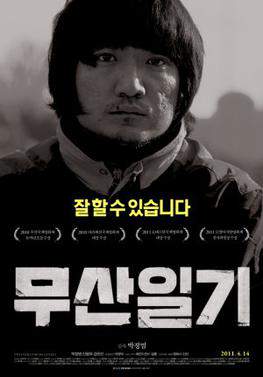
The film's intriguing tale focuses on Seung-chul, a silent and resilient refugee from North Korea, trying to navigate life in Seoul after escaping his home country. He shares an apartment with Kyung-chul, a crafty individual known as a "broker" who assists refugees in sending money back home. While they share harrowing backstories, their responses to adversity are starkly different. Seung-chul embodies timidity and subservience, bearing life’s trials and insults with remarkable stoicism. On the other hand, Kyung-chul lacks moral scruples, engaging in petty crimes and often pushing Seung-chul further into despair.
Seung-chul begins his arduous journey by accepting menial positions, notably pasting ads for adult entertainment venues in his vicinity. This job becomes increasingly perilous, as he faces frequent harassment from local thugs. In search of a more stable livelihood, he applies for several employment opportunities, but each time he presents his citizen registration number—a constant reminder of his North Korean roots—he faces rejection. Eventually, he manages to land a night shift at a karaoke bar where he encounters Young-sook, the owner's daughter and a familiar face from his church. However, she insists on keeping her professional life separate from their personal interactions, aware that her job invites scorn from their shared congregation. Seung-chul agrees to keep this a secret, unaware that this decision will lead to significant challenges ahead.
In a later episode at the karaoke bar, the female staff overhears Seung-chul singing hymns, prompting them to offer him advice to enhance his vocal performance. However, the atmosphere shifts when Young-sook unexpectedly confronts him, furious over his choice of songs in the presence of women from the bar. Seung-chul explains that he lacks knowledge of popular South Korean music and avoids North Korean folk songs due to cultural sensitivities. Misunderstanding his explanation, Young-sook accuses him of deceit, resulting in her abruptly terminating his employment.
As Seung-chul finds himself amidst a solemn prayer meeting, accompanied by Detective Park, the shadows of his troubled past begin to emerge. Until this crucial moment, Seung-chul's history remained largely hidden, with the numbers on his ID card hinting at his harrowing journey as a North Korean defector. With the innate pressure of his suppressed past now rising to the forefront, his story receives the attention it deserves.
Having grown up in the poverty-stricken North Hamgyong province, Seung-chul experienced childhood filled with acute malnutrition and unthinkable hardships. A seemingly innocent dispute overfood with a friend resulted in a life-altering tragedy when he learned of his friend’s tragic demise the following day, leaving Seung-chul enveloped in guilt and self-reproach. The heavy burden of his perceived guilt lingered until a pastor's comforting words provided a flicker of solace.
Tragically, this moment of redemption is fleeting. Detective Park's harsh rebuke as he leaves the prayer meeting shatters Seung-chul's fragile peace. "Who would want to be friends with a killer?" he spat, plunging Seung-chul into tears of humiliation. The once downtrodden karaoke singer leaves, carrying the painful realization that his dark history forever stains his current existence.
In this vulnerable state, Young-sook, who had been present at the prayer session, approaches him with compassion in her eyes. She expresses regret for not knowing more about Seung-chul's tumultuous background, offering to reinstate him at the karaoke bar and expressing her desire to forge a friendship with him. Though moved by her kindness, Seung-chul remains emotionally guarded, his feelings locked away beneath a sturdy facade.
Upon returning to his apartment, Seung-chul is faced with an unsettling revelation: his dear dog, Baek-gu, is missing. Kyung-chul's callous attempt to sell the dog, only to abandon it later due to its mixed lineage, has left it vulnerable on the busy streets. In a desperate bid to reunite with his loyal friend, Seung-chul scours the neighborhood until he finds Baek-gu rummaging through a trash bag. Their touching reunion becomes a poignant testament to the loyalty that endures even in adverse conditions.
As night descends again, Kyung-chul’s genuine regret is evident when he pressurizes Seung-chul to help him retrieve a stash of "sincere" cash hidden in Baek-gu's space. Though reluctant, Seung-chul concedes, emphasizing that their friendship is irreparably damaged and this will be his final act of goodwill. Unfortunately, upon entering his dwelling, Seung-chul is cornered by a gang of Kyung-chul’s associates demanding his whereabouts, insisting they need his cooperation for debt collection. Firm and unwavering, Seung-chul chooses silence over compliance.
The next day, he finds solace at church, where Young-sook graciously invites him to join her in the choir; an offer he reluctantly accepts. That evening, while performing his duties at the karaoke bar, Seung-chul leaves Baek-gu outside, deeming his home too dangerous due to Kyung-chul's schemes. Tragically, in a brief moment of distraction, Seung-chul discovers his beloved dog's lifeless body, cruelly struck down by an impatient driver on the road, cementing the harsh realities of his tumultuous journey.