#34,2531 Year: 2021
Runtime: 130 min
Language: Italian
Director: Paolo Sorrentino
Echo Score: 80Budget: $13M
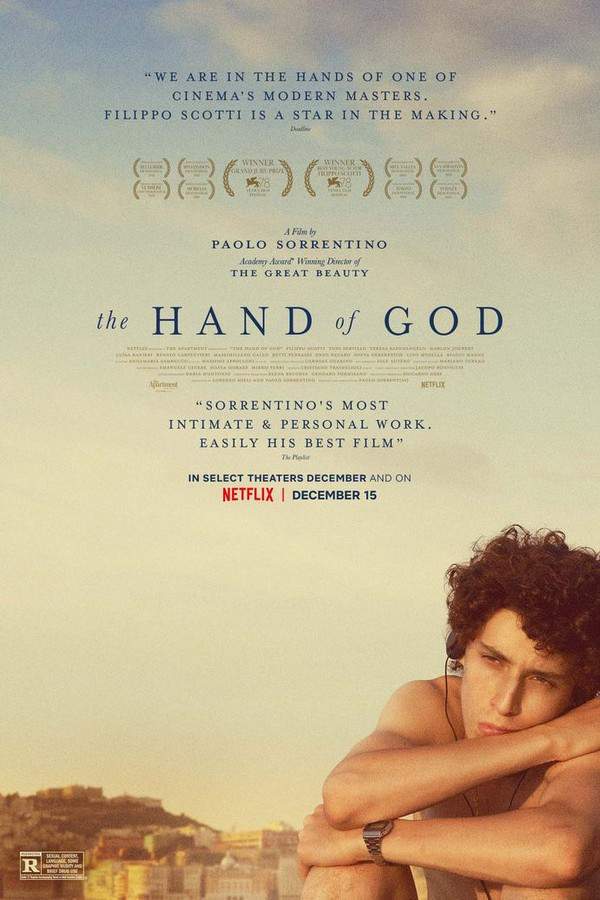
In 1980s Naples, the life of young Fabietto Schisa is profoundly impacted by the arrival of football superstar Diego Maradona. Amidst a backdrop of both joy and tragedy, unexpected events shape his destiny. This deeply personal film from Academy Award-winning director Paolo Sorrentino explores themes of family, identity, and the role of chance, blending sports, cinema, love, and loss in a poignant and evocative portrait of a young man’s coming-of-age.
Find where to stream, rent, or buy The Hand of God (2021) in the US with current JustWatch availability, up-to-date pricing, and platform listings for subscription, rental, and digital purchase options.
Warning: spoilers below!
Haven’t seen The Hand of God yet? This summary contains major spoilers. Bookmark the page, watch the movie, and come back for the full breakdown. If you're ready, scroll on and relive the story!
Trace every key event in The Hand of God (2021) with our detailed, chronological timeline. Perfect for unpacking nonlinear stories, spotting hidden connections, and understanding how each scene builds toward the film’s climax. Whether you're revisiting or decoding for the first time, this timeline gives you the full picture.
Last updated: November 16, 2024 at 16:05
Find frequently asked questions about the The Hand of God (2021) timeline, including chronological order, nonlinear jumps, cause-and-effect links, and scene sequence clarifications. This timeline FAQ helps explain when key events happen, how moments connect, and why the story unfolds in that specific order.
Fabietto decided to forego the family getaway to Roccaraso because he wanted to witness Maradona play live in the Napoli-Empoli match. This choice haunts him later when his parents die at the villa, leaving him with profound survivor's guilt over having chosen football over family.
Earlier scenes establish Fabietto's fascination with Maradona as a source of joy amid family tensions, making his choice feel both understandable and tragic in hindsight.
Saverio and Maria died from carbon monoxide poisoning while staying at their newly purchased villa in Roccaraso. The leak occurred unexpectedly, trapping them while Fabietto was at the match witnessing Maradona's brilliance.
After the tragedy, Uncle Alfredo consoles the grieving Fabietto with the belief that he was divinely spared from death that night. This phrase becomes central to Fabietto's journey as he searches for meaning in his survival and tries to understand why he was the one who lived.
The phrase echoes Maradona's nickname and the film's title, suggesting themes of fate and divine intervention running throughout the narrative.
Patrizia was admitted to the psychiatric institution after years of suffering abuse from her husband. During a visit with Fabietto, she reveals her traumatic past including a miraculous pregnancy she believed was granted by Saint Gennaro, followed by a miscarriage caused by further abuse. She chose hospitalization as refuge from her trapped circumstances.
Patrizia's struggles were introduced earlier in the film as one of the family crises disrupting their otherwise peaceful life.
The munaciello is a Neapolitan folklore figure, a small ghost or mischievous spirit. Fabietto encounters one at a lonely train station as he departs for Rome. This supernatural moment connects to Aunt Patrizia's earlier story and evokes the affectionate whistle his parents used to call him, symbolizing their lingering presence as he leaves Naples.
Aunt Patrizia mentions the munaciello in her psychiatric ward confession, foreshadowing its later appearance as a bridge between her trauma and Fabietto's transition.
Fabietto decides to move to Rome to pursue his dream of studying cinematography, inspired by a film and actress that captivate him. However, director Antonio Capuano warns him against using relocation as mere escape from pain, urging him instead to embrace Naples' stories. Despite this warning, Fabietto leaves, seeking both artistic growth and a fresh start after his parents' death.
Fabietto's interest in cinema develops gradually throughout the film, sparked by Marchino's acting ambitions and his own artistic awakening.
Marchino's acting aspirations crumble after his failed audition with Federico Fellini. This devastating disappointment sends him into retreat from reality, and his friendship with Fabietto begins to falter as Marchino withdraws from the world.
The timeline establishes this as a pivotal moment that marks Marchino's descent into disillusionment.
The Baroness Focale is an older woman with whom Fabietto has his first sexual encounter. She offers him a sympathetic ear to discuss his struggles, providing a compassionate presence during his emotional turmoil following his parents' death.
Armando is a smuggler involved in Neapolitan crime operations. Despite his criminal background, Fabietto forms a genuine friendship with him, finding mutual understanding as both grapple with their respective adversities and search for their place in Naples.
Daniela reveals a shocking family secret to Fabietto: she has a half-brother born from their father's affair. This revelation adds to the web of family betrayals and infidelity already established through Saverio's own infidelity, further complicating Fabietto's relationships and sense of identity.
Saverio's earlier infidelity with another woman establishes the pattern of hidden family secrets that Daniela later exposes.
During a harsh critique of actress Yulia, director Antonio Capuano overhears Fabietto's confession about wanting to study cinema in Rome. Capuano warns him against using relocation as a remedy for pain, urging instead to embrace the stories of Naples. This warning highlights the film's theme of facing grief rather than running from it.
The warning reflects the broader thematic tension in the film between escape and confrontation with loss.
Discover curated groups of movies connected by mood, themes, and story style. Browse collections built around emotion, atmosphere, and narrative focus to easily find films that match what you feel like watching right now.
Stories where sudden loss irrevocably shapes a young person's journey to find themselves.If you appreciated the poignant blend of personal tragedy and self-discovery in The Hand of God, you'll find similar resonant stories here. These films explore how young protagonists navigate profound loss while forging their own path, often with a melancholic and nostalgic tone.
These narratives typically follow a linear path centered on a young protagonist. A sudden, life-altering event—often the death of a family member—shatters their world, forcing them to confront grief, survivor's guilt, and the meaning of their own existence. The journey is internal, focusing on reflection and slow emotional processing rather than external action, culminating in a departure or decision that is hopeful yet forever marked by the loss.
Movies are grouped here for their shared focus on the heavy emotional weight of grief intertwined with the coming-of-age arc. They possess a melancholic tone, slow, reflective pacing, and a central theme of how tragedy can be a catalyst for artistic or personal destiny.
Evocative films that use a specific era and location as a character in a personal story.For viewers who loved the rich, nostalgic atmosphere of 1980s Naples in The Hand of God, this thread collects films where the setting is a central character. These movies use a specific time and place to enhance deeply personal stories of family, memory, and identity.
The narrative is often episodic or memory-driven, weaving together family dynamics, local culture, and significant historical or pop culture events of the era. The plot may feel loose, serving as a vehicle to explore the textures, sounds, and feelings of a bygone time. Character arcs are intimate and interwoven with the environment, creating a deeply sensory and evocative experience.
These films are connected by their primary emphasis on atmosphere and setting. They share a dreamlike, nostalgic mood, a moderate pacing that allows for immersion, and a complexity that comes from capturing the multifaceted nature of a specific cultural moment and its impact on personal lives.
Don't stop at just watching - explore The Hand of God in full detail. From the complete plot summary and scene-by-scene timeline to character breakdowns, thematic analysis, and a deep dive into the ending - every page helps you truly understand what The Hand of God is all about. Plus, discover what's next after the movie.
Read a complete plot summary of The Hand of God, including all key story points, character arcs, and turning points. This in-depth recap is ideal for understanding the narrative structure or reviewing what happened in the movie.
Discover the characters, locations, and core themes that shape The Hand of God. Get insights into symbolic elements, setting significance, and deeper narrative meaning - ideal for thematic analysis and movie breakdowns.
What really happened at the end of The Hand of God? This detailed ending explained page breaks down final scenes, hidden clues, and alternate interpretations with expert analysis and viewer theories.