Plot Explained Spoilers guaranteed!
Plot Explained

Browse by genre

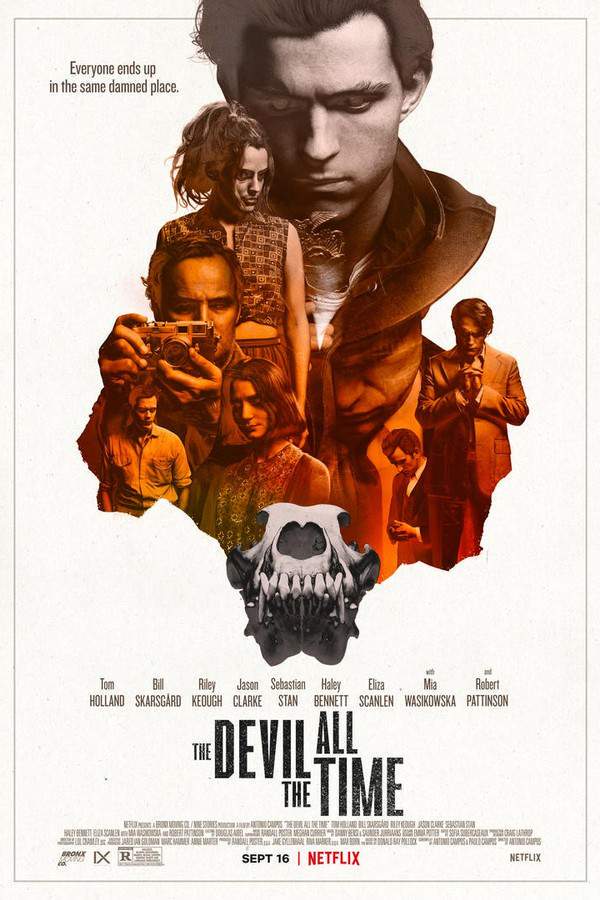
The Devil All the Time (2020) movie poster

Ending Explained

The Devil All the Time (2020) Ending Explained – Final Scene & Meaning

Release, runtime and language
2020 · 138 min · English
Echo score 80
Loading streaming availability…
Directed by
Antonio Campos
Starring
Chris Evans, Sebastian Stan, Tom Holland, Bill Skarsgård, Robert Pattinson, Mia Wasikowska

Set against a backdrop of post-World War II America through the 1960s, the story follows several characters whose lives intersect in a web of violence, faith, and darkness. Willard Russell, a troubled war veteran, grapples with the loss of his wife, Charlotte, to cancer. Meanwhile, a couple, Carl and Sandy Henderson, embark on a spree of serial killings targeting young women. A corrupt pastor, Roy, and his accomplice, Theodore, are desperately trying to evade the law. At the heart of this turmoil is Arvin Russell, Willard and Charlotte’s son, whose life is profoundly affected by the events unfolding around him.

On this page (8)
  1. 1 Where to watch
  2. 2 What happens at the end
  3. 3 Final events in order
  4. 4 Ending questions answered
  5. 5 The book behind the movie
  6. 6 Movie threads
  7. 7 Movies like The Devil All the Time
  8. 8 Every angle
Loading streaming availability…

Ending explained · contains spoilers

What Happens at the End of The Devil All the Time?

How The Devil All the Time (2020) ends, what the final scene means, which earlier moments set it up and how to read the ending if the film leaves it open. The full ending explained, with every spoiler.

The film's ending leaves us with a sense of grim closure, but also a hint of unresolved tension. Arvin, having taken justice into his own hands by killing Preston Teagardin and other characters involved in wrongdoings, appears to have freed himself from the cycle of violence that has haunted his life. As he prepares to leave Knockemstiff, the sense is that he believes he's done what needed to be done to cleanse the town of its evil. However, the closing scene, where Arvin considers his future—possibly heading to join the Vietnam War following a radio broadcast—suggests that this cycle may continue elsewhere. It hints that violence and darkness are perpetual forces, capable of passing from one person to another, as symbolized by the recurring themes of sin and corruption in the town.

The presence of the serial killers Carl and Sandy reinforces this idea: even outside Knockemstiff, evil persists in different forms, and darkness isn't confined to one place. Their macabre deeds—posing victims for photographs after death—highlight how corruption can permeate seemingly unrelated worlds, and that evil often lurks just beneath the surface of everyday life. By weaving their stories into the fabric of the film, the story emphasizes that nobody is truly innocent or heroic; instead, each character is simply trying to find meaning or salvation in a corrupt world.

Ultimately, the film leaves viewers with a complex picture: that violence and evil are woven into human nature, and the struggle to escape or defeat these forces might be an ongoing, perhaps unwinnable, battle. The ending suggests a cautious hope—that individuals like Arvin might find a moment of peace—yet also underscores the sobering reality that the darkness in human hearts continues to burn, ready to resurface in another form, somewhere down the line.

Last updated: June 25, 2025 at 08:58

Was this helpful?

The last 4 events

How The Devil All the Time Ends: The Final Events in Order

The last events of The Devil All the Time (2020) in chronological order, the run-up to the ending explained above. The complete timeline has all 14 events, scene by scene.

Open the full timeline
  1. Final Showdown

    As Arvin seeks refuge from the aftermath of his actions, he finds himself hitchhiking once again. However, fate intertwines his path with Carl and Sandy, whose sinister nature compels Arvin to defend himself, resulting in a deadly confrontation where he kills both of them.

    When
    1965
    Where
    Unknown location
  2. Discovering the Evidence

    In the aftermath of the confrontation, Arvin discovers a stash of photographs in Carl and Sandy's glove compartment, revealing the horrifying rituals and murders they committed. This revelation adds weight to the grim legacy he is inadvertently a part of.

    When
    1965
    Where
    Inside Carl and Sandy's vehicle
  3. Sheriff's Pursuit

    With the local sheriff, Lee Bodecker, now aware of the murders, he seeks to dispose of evidence linked to Sandy's demise. When Arvin returns to his hometown, a tense encounter unfolds in the woods, culminating in a deadly clash, leaving Arvin confronted with the consequences of his actions.

    When
    1965
    Where
    Woods near Knockemstiff
  4. The Uncertain Future

    As the film draws to a close, Arvin reflects on his tumultuous journey and grapples with his identity. Torn between becoming a devoted husband or being drawn into the military during the Vietnam War, he contemplates the weight of the past and the unpredictability of his future.

    When
    1965
    Where
    Unknown location

Ending questions answered

The Devil All the Time Ending: Your Questions Answered

The questions people ask most about the ending of The Devil All the Time (2020): what the final scene means, how the twist works, what happens to each character and how to read the ending. Each answer contains spoilers.

Q1

Does Arvin Russell die at the end of the movie

Arvin Russell does not die in the ending. After taking justice into his own hands by killing Preston Teagardin and other corrupt characters, Arvin survives and prepares to leave Knockemstiff. The final scene shows him listening to a radio broadcast about the Vietnam War, suggesting he may join the military as his next path forward.

Foreshadowing: Earlier in the film, Arvin's father Willard Russell serves in World War II, establishing a pattern of men from this family going to war.

  • arvin russell
  • fate
  • death
  • ending
  • preston teagardin
Q2

Why does Arvin kill Preston Teagardin in the ending

Arvin kills Preston Teagardin because Preston sexually exploited and likely caused the death of his sister Lenora. After discovering Preston's predatory behavior and its consequences, Arvin confronts and murders him as an act of personal justice, eliminating the man responsible for his sister's suffering.

Foreshadowing: Lenora's vulnerability and Preston's predatory behavior toward young women are established earlier in the film.

  • preston teagardin
  • arvin kill
  • murder
  • lenora
  • justice
Q3

What does Arvin's decision to go to Vietnam signify in the ending

Arvin's potential decision to join the Vietnam War suggests that the cycle of violence and darkness will continue elsewhere, just in a different form. The film implies that Arvin is trapped in a pattern where he must fight or destroy evil wherever he goes, and leaving Knockemstiff does not grant him escape from this burden.

Foreshadowing: The film opens with Arvin's father Willard returning from World War II, traumatized by violence, establishing war as a recurring force in the family's story.

  • vietnam war
  • arvin
  • leaving
  • cycle of violence
  • future
Q4

What happens to Carl and Sandy Henderson at the end

Carl and Sandy Henderson, the serial killer couple, are killed off-screen before the film's final scenes. Their fate is revealed indirectly through news reports that mention their capture and execution, though the film does not show their deaths directly. Their story serves to reinforce that evil exists beyond Knockemstiff and persists in various forms.

Foreshadowing: Their pattern of killing and photographing victims is established early, showing they operate with impunity for a time.

  • carl henderson
  • sandy henderson
  • serial killers
  • fate
  • death
Q5

Does the cycle of violence end in Knockemstiff

The cycle of violence does not truly end in Knockemstiff. While Arvin eliminates the immediate evil figures, Preston Teagardin, Roy, and Theodore, the film suggests this is only a temporary cleansing. The ending implies that violence and corruption are perpetual human conditions, and darkness will simply manifest in new forms, whether in Vietnam or elsewhere.

Foreshadowing: The film's repeated emphasis on sin, corruption, and the generational transmission of trauma foreshadows that no single act of violence can break the cycle.

  • cycle of violence
  • knockemstiff
  • evil
  • ending
  • theme
Q6

What is the meaning of The Devil All the Time's ending

The ending conveys that violence and evil are woven into human nature, making the struggle to escape or defeat these forces an ongoing, possibly unwinnable battle. It offers a cautious hope, Arvin finds a moment of peace by cleansing his hometown, while also delivering a sobering reality that darkness in human hearts continues to burn and will resurface in new forms.

Foreshadowing: The recurring themes of faith corrupted into violence and the interconnected web of sin running through every character foreshadow this bleak interpretation.

  • meaning
  • ending
  • theme
  • evil
  • violence
  • interpretation
Q7

What happens to Lenora Russell at the end

Lenora Russell dies before the film's ending. She becomes pregnant as a result of her relationship with Preston Teagardin, and the film implies she either commits suicide or dies from complications related to her pregnancy and mental state. Her death is the catalyst that drives Arvin to seek revenge against Preston.

Foreshadowing: Lenora's vulnerable emotional state and Preston's manipulative behavior are established before her fate is revealed.

  • lenora russell
  • fate
  • death
  • preston teagardin
Q8

Why does Arvin leave Knockemstiff at the end

Arvin leaves Knockemstiff because he believes he has done what was necessary to cleanse the town of its evil. With Preston Teagardin, Roy, and Theodore all dead, Arvin feels his mission is complete. However, the ending suggests he is simply moving his burden of violence to a new location, as he contemplates joining the Vietnam War.

Foreshadowing: Willard Russell's earlier attempts to protect his family from the town's corruption by moving suggest this pattern of flight is established in the family.

  • arvin
  • leave
  • knockemstiff
  • depart
  • vietnam
Q9

Does evil win at the end of The Devil All the Time

Evil does not completely win, but neither does good definitively triumph. The film presents a morally ambiguous outcome where Arvin achieves temporary justice by killing the corrupt figures in Knockemstiff, yet the underlying message suggests evil is an inescapable part of human nature. The ending offers cautious hope rather than complete victory or defeat.

Foreshadowing: The film's pervasive darkness and the lack of truly heroic characters foreshadow this morally complex resolution.

  • evil
  • good
  • moral
  • ending
  • victory
  • resolution
Q10

What happens to Roy Copeland at the end

Roy Copeland, the corrupt pastor, is killed by Arvin Russell in the ending. After witnessing Arvin kill Theodore, Roy attempts to escape but is ultimately confronted and murdered by Arvin as part of his mission to rid Knockemstiff of the evil figures who have corrupted the town.

Foreshadowing: Roy's involvement in criminal activities with Theodore and his exploitation of his congregation are established throughout the film.

  • roy copeland
  • fate
  • death
  • killed
  • ending

Movie threads

More Movies Like The Devil All the Time, by Mood & Story

Curated lists built around what makes The Devil All the Time tick: the same mood, the same kind of story or the same emotional payoff. Each list explains why these movies belong together.

Southern Gothic movies like The Devil All the Time

Multi-generational tales of corrupted faith and violence in rural America. If you liked the grim, rural setting and themes of corrupted faith in The Devil All the Time, explore other movies in the Southern Gothic tradition. These stories often feature bleak atmospheres, morally ambiguous characters, and a deep sense of place where violence and spirituality tragically intertwine.

  • grim
  • sinister
  • oppressive
  • melancholic
  • fatalistic
  • gothic
  • Tone: dark, grim, sinister
  • Pacing: variable, character-driven
Why these movies?

The story pattern: These narratives often unfold across generations, revealing how past sins irrevocably shape the present. They frequently employ an ensemble cast whose fates are grimly intertwined, leading to violent, often ambiguous conclusions. The plot is driven by characters wrestling with extreme beliefs and desperate circumstances in isolated communities.

Why they belong together: They are grouped by their shared oppressive, rural atmosphere, focus on themes like flawed religiosity and generational curses, and a narrative structure that favors interwoven, tragic character arcs over a single protagonist's journey.
Fatalistic crime webs like The Devil All the Time

Stories where disparate lives collide in a grim, predetermined dance of violence. For viewers who appreciated the complex, interlocking narratives and sense of grim destiny in The Devil All the Time, this section features movies where multiple character arcs tragically collide. These films share a high-stakes, heavy emotional weight and a pacing that builds tension through seemingly disconnected storylines.

  • anxious
  • fatalistic
  • tense
  • desperate
  • grim
  • complex narrative
  • Tone: dark, tense, fatalistic
  • Pacing: variable, building tension
Why these movies?

The story pattern: The narrative pattern involves following several distinct characters or storylines that initially appear separate. Through a series of cause-and-effect events, often spanning different timeframes, these threads gradually intertwine, building towards a violent and emotionally heavy climax. The structure emphasizes the unpredictability and fragility of life, where a single event can set off a chain reaction of tragedy.

Why they belong together: These films are grouped by their complex, multi-perspective narrative structure, a pervasive tone of fatalism, and a shared theme that violence begets violence in an inescapable cycle. The viewing experience is defined by tracking how small actions lead to catastrophic, interconnected consequences.

If you liked this

Movies Like The Devil All the Time

Similar movies to The Devil All the Time: the same genre, themes or kind of story. Each one comes with its own plot summary, timeline and ending explained.

Browse all movie summaries

Every angle

The Devil All the Time (2020) Explained: Plot, Ending, Timeline & Characters

Everything about The Devil All the Time in one place: what happens in the plot summary, the timeline in chronological order, the characters and meaning, the ending explained and a spoiler-free summary. What's After the Movie adds the cast, box office and post-credit scenes.

Coming soon on iOS and Android

The Plot Explained Movie Summary App

Plot summaries, endings explained and timelines on your phone. Catch up on any movie in minutes, save your favorites and never miss a twist again.

Be the first to know when we launch. Your email stays private, always.

Learn more about the app