Plot Explained Spoilers guaranteed!
Plot Explained

Browse by genre

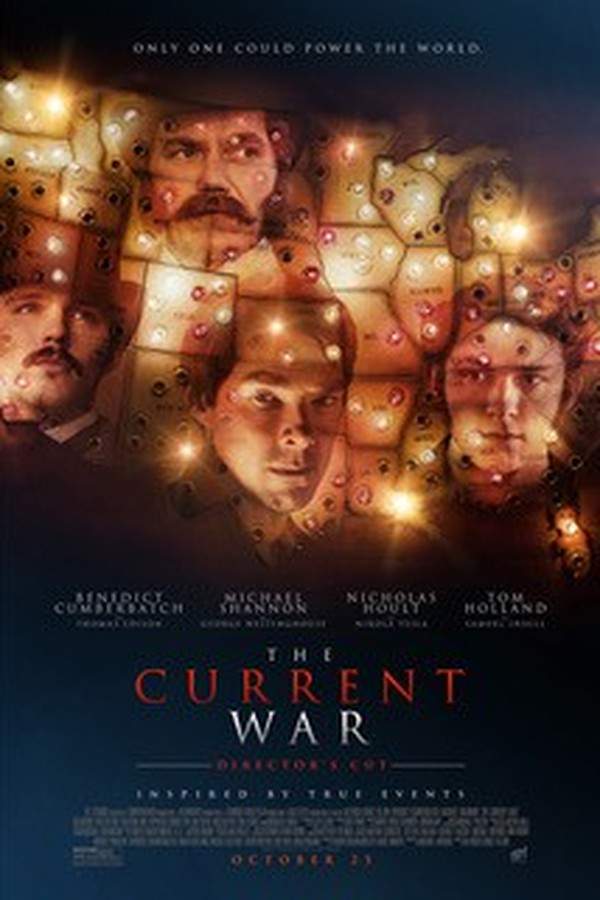
The Current War (2017) movie poster

Timeline

The Current War (2017) Timeline Explained – Every Event in Order

Release, runtime and language
2017 · 108 mins · English
Loading streaming availability…
Directed by
Alfonso Gomez-Rejon
Starring
Michael Yates, Tom Sweet, Benedict Cumberbatch, Tom Holland, Michael Shannon, Nicholas Hoult

Power changes everything Electricity titans Thomas Edison and George Westinghouse compete to create a sustainable system and market it to the American people.

On this page (6)
  1. 1 Where to watch
  2. 2 Events in order (15)
  3. 3 Timeline questions answered
  4. 4 Movie threads
  5. 5 Movies like The Current War
  6. 6 Every angle
Loading streaming availability…

15 events in order · contains spoilers

The Current War Timeline: Events in Chronological Order

Every key event of The Current War (2017) in order, scene by scene, with when and where it takes place. Use it to untangle flashbacks, time jumps and parallel storylines, to refresh your memory before the sequel or to find the exact scene you are thinking of.

  1. Edison applies for a lightbulb patent

    Thomas Edison presents his design for a lightbulb and seeks a patent, highlighting its purpose and features. As he does this, a large field of glowing bulbs is revealed, symbolizing his invention's potential. Numerous men gather in the woods to see this spectacle, emphasizing the groundbreaking nature of his work.

    When
    1880
    Where
    New Jersey (assumed)
  2. Edison meets with financiers and officials

    On a train heading to meet J.P. Morgan and the President with his family, Edison discusses his plans and technical innovations like the phonograph. He also considers expanding his electric company, showing his ambitions to electrify Manhattan and beyond.

    When
    1880
    Where
    On train (route to New York)
  3. Morgan agrees to fund Edison

    J.P. Morgan commits $500,000 to Edison, enabling him to establish a Manhattan office and expand his electrical infrastructure. Edison begins working intensely with his team to bring electricity to Manhattan, marking a major step in his project.

    When
    1880
    Where
    Manhattan
  4. Edison pioneers electrical lighting in Manhattan

    Edison successfully supplies electricity to a few buildings in Manhattan during an inaugural demonstration. The event draws attention, with Nikolai Tesla observing the scene, hinting at upcoming technological rivalries.

    When
    1880s
    Where
    Manhattan
  5. Westinghouse proposes AC system

    Westinghouse criticizes Edison’s direct current system for its limited reach and high cost, proposing an alternative alternating current (AC) system using transformers. He plans to demonstrate that AC can supply power over much greater distances more efficiently.

    When
    Early 1880s
    Where
    Westinghouse mansion
  6. Tesla joins Edison Electric

    Tesla is hired by Edison and tasked with developing innovations, including an improved motor, with strict deadlines. Despite his talents, Tesla works under tight constraints and begins to challenge Edison’s direct current approach.

    When
    1880s
    Where
    Edison Electric
  7. Mary’s health deteriorates

    Edison’s wife Mary becomes seriously ill, and her condition worsens. Edison focuses on his work, recording her voice on the phonograph as she speaks, trying to preserve her memory before she passes away.

    When
    Early 1880s
    Where
    Edison home
  8. Mary passes away

    Mary Edison dies, leaving Edison devastated. He finds comfort in listening to her voice recording, which reminds him of their life together, as he faces the grief of losing his wife.

    When
    Early 1880s
    Where
    Edison home
  9. Electrocution demonstration and electric chair

    Edison attempts to demonstrate the dangers of AC current by electrocuting a horse in a public show, promoting the idea that AC is lethal. Subsequently, Edison develops the electric chair, viewing it as a humane execution method, tying it to his anti-AC campaign.

    When
    1880s
    Where
    Horse park (public demonstration)
  10. Rivalry with Westinghouse heats up

    Edison and Westinghouse become embroiled in a public battle over electrical systems, with smear campaigns and accusations. Edison claims Westinghouse’s AC is dangerous, while Westinghouse defends his system as more practical and economical.

    When
    Late 1880s
    Where
    Newspapers and courts
  11. Westinghouse wins the 1893 World’s Fair bid

    The organizers choose Westinghouse’s AC system to light the Chicago World’s Fair after considering safety and cost. Edison accepts the defeat, acknowledging Westinghouse’s superior technology for this event, though he deeply regrets the loss.

    When
    1893
    Where
    Chicago
  12. Edison’s involvement with the electric chair exposed

    The electric chair, which Edison helped develop as a supposedly humane execution device, is tested on a man who confesses to murder. The method fails to be humane, reflecting negatively on Edison’s stance against AC’s safety.

    When
    1890s
    Where
    Prison
  13. Merger and rebranding to General Electric

    J.P. Morgan proposes merging Edison’s company with others, creating General Electric. Edison, feeling betrayed, reacts fiercely to the change in company ownership and the loss of his control, marking a significant turning point in his career.

    When
    1892
    Where
    New York
  14. Outcome of the 1893 World’s Fair

    Westinghouse lights the fair using his AC system, showing its safety and efficiency. Edison, meanwhile, witnesses the event and finds a sense of victorious achievement in his earlier inventions, despite losing the bid.

    When
    1893
    Where
    Chicago World’s Fair
  15. Edison’s reflection and future projects

    After the fair, Edison acknowledges Westinghouse’s success and hints that his new inventions, like the kinetograph, will surpass his past works. He foresees a future where his innovations will be remembered, apart from his electrical battles.

    When
    Post-1893
    Where
    Edison’s laboratory

Last updated: April 24, 2026 at 12:37

Was this helpful?

Timeline questions answered

The Current War Timeline Explained: Your Questions Answered

When does it happen, and why in that order? The questions people ask about the chronology of The Current War (2017): time jumps, flashbacks, cause and effect between scenes and the correct order of events, each answered with spoilers.

Q1

Why did Edison publicly electrocute a horse?

Edison electrocuted a horse to demonstrate the dangers of Alternating Current (AC), which Westinghouse was promoting. He wanted to convince the public that AC was lethal and that his Direct Current (DC) system was safer. This was part of his smear campaign against Westinghouse's competing electrical system, in which he even called it 'Westinghouse, the horse.'

Foreshadowing: Earlier in the film, Edison dismisses AC as dangerous without proof, hinting at his willingness to use extreme methods to protect his business interests.

  • edison
  • ac current
  • horse electrocution
  • westinghouse
  • demonstration
Q2

Why did Tesla leave Edison Electric?

Tesla left Edison Electric after disagreements with the company. Although Tesla demonstrated that AC was far more efficient than Edison's DC system, Edison refused to switch technologies because he was confident in his own DC patent. Tesla was also working under tight deadlines and felt his expertise wasn't being valued, so he eventually parted ways with the company.

Foreshadowing: Tesla observes Edison's Manhattan lighting demonstration from the crowd, showing his initial curiosity about Edison's work before joining.

  • nikola tesla
  • edison electric
  • alternating current
  • resignation
  • technology dispute
Q3

What happened to Mary Edison?

Mary Edison became seriously ill during the early 1880s. Despite her declining health, Edison remained fixated on his work, dismissing her illnesses as minor. She eventually collapsed and was diagnosed with a serious condition. She later passed away, leaving Edison devastated. He found comfort in listening to a phonograph recording he had secretly made of her voice.

Foreshadowing: Mary speaks into the phonograph expressing her desire for Edison to build a fence, subtly hinting at her longing for normalcy and his neglect.

  • mary edison
  • death
  • illness
  • phonograph recording
  • tragedy
Q4

Why did Westinghouse win the 1893 World's Fair contract?

Westinghouse won the contract to light the 1893 World's Columbian Exposition in Chicago because his AC system was more efficient and cost-effective for transmitting electricity over long distances. Although Edison's team raised concerns about AC's safety, the organizers chose Westinghouse's proposal. His lighting system dazzled visitors and proved AC could power entire cities safely.

Foreshadowing: Westinghouse had earlier proposed using transformers to transmit AC electricity over greater distances at lower costs, which the fair organizers recognized as superior.

  • westinghouse
  • worlds fair 1893
  • chicago
  • ac current
  • lighting contract
Q5

What was Edison's connection to the electric chair?

Edison developed the electric chair as a supposedly humane execution method, though he was personally opposed to taking life. When approached by someone interested in using electricity for executions, he was pressured into participating in the demonstration. The electric chair later proved problematic during actual executions, highlighting the ethical dilemmas tied to technological progress.

Foreshadowing: Edison's public electrocution demonstrations established his willingness to use AC as a weapon, foreshadowing his involvement with lethal applications.

  • edison
  • electric chair
  • execution
  • capital punishment
  • ethical controversy
Q6

Why did Edison's company become General Electric?

J.P. Morgan proposed merging Edison's company with others to form General Electric in 1892. Edison felt betrayed and fiercely opposed the merger because it meant losing control of his company. Morgan's plan left Edison with only a symbolic board position, despite his foundational role in the company's success.

Foreshadowing: Earlier, Morgan had invested heavily in Edison, giving him the funding to expand, which established the financial power dynamics that later led to the merger.

  • general electric
  • jp morgan
  • merger
  • edison company
  • corporate takeover
Q7

What was the conflict between Edison and Westinghouse about?

The rivalry centered on competing electrical systems: Edison championed Direct Current (DC), while Westinghouse promoted Alternating Current (AC). Edison believed DC was safer and more reliable, while Westinghouse argued AC could transmit power over much greater distances at lower costs. The conflict escalated into public smear campaigns, patent disputes, and ethical controversies like Edison's electrocution demonstrations.

Foreshadowing: The film opens with Edison presenting his lightbulb patent, establishing his dominance before Westinghouse emerges as a challenger.

  • edison
  • westinghouse
  • dc current
  • ac current
  • electrical rivalry
  • patents
Q8

Did Edison and Westinghouse reconcile at the end?

At the 1893 World's Fair, Edison acknowledged Westinghouse's success and admitted his own inventions had changed the world. They developed mutual respect despite their bitter rivalry. Edison recognized that Westinghouse's system would illuminate the future's brightest moments, and they parted ways with an understanding of each other's extraordinary contributions to technology.

Foreshadowing: Throughout the film, both men demonstrate genuine passion for innovation, hinting at a shared respect underneath their competition.

  • edison
  • westinghouse
  • reconciliation
  • respect
  • worlds fair
  • resolution
Q9

What did Edison work on after the electricity battle?

After losing the World's Fair contract, Edison hinted that his next project would eclipse his electrical work: the kinetograph, or motion picture camera. He reflected that this new invention would eventually surpass everything he had accomplished with electricity, foreshadowing his pivot toward film technology.

Foreshadowing: Edison had earlier developed the phonograph, showing his versatility in invention beyond electricity.

  • edison
  • kinetograph
  • motion picture
  • future invention
  • film camera
Q10

Why did Tesla team up with Westinghouse?

Tesla and Westinghouse formed an alliance to develop revolutionary motors and power systems for the 1893 World's Fair after Tesla left Edison Electric. Their partnership combined Tesla's technical expertise with Westinghouse's resources and AC technology, allowing them to successfully demonstrate AC's potential on a large scale.

Foreshadowing: Tesla had earlier explained the advantages of AC to Edison, showing his commitment to the technology before finding a supportive partner.

  • tesla
  • westinghouse
  • alliance
  • partnership
  • worlds fair
  • motor development

Movie threads

More Movies Like The Current War, by Mood & Story

Curated lists built around what makes The Current War tick: the same mood, the same kind of story or the same emotional payoff. Each list explains why these movies belong together.

History-Changing Rivalries like The Current War

High-stakes true stories of brilliant minds clashing over a future they are inventing. If you liked the tense conflict between Edison and Westinghouse in The Current War, explore more movies about foundational rivalries. These films depict true stories of brilliant minds clashing over inventions and ideas that would ultimately define the modern world.

  • competitive
  • driven
  • historic
  • gripping
  • thought-provoking
  • somber
  • Tone: tense, driven, reflective
  • Pacing: steady, methodical
Why these movies?

The story pattern: These films typically follow a historical, fact-based conflict between two or more key figures with competing visions. The plot is built around legal disputes, public demonstrations, and corporate maneuvering, culminating in a legacy that is often bittersweet, with one vision winning out but the personal costs being high.

Why they belong together: Movies are grouped here for their focus on real-world rivalries that spurred technological or scientific revolutions. They share a tense tone driven by intellectual conflict, a steady pace that builds to a historical climax, and a thematic exploration of the human cost of innovation.

Movies about the Cost of Ambition like The Current War

Stories where grand achievements are shadowed by profound personal loss and sacrifice. If the bittersweet ending and themes of personal loss in The Current War resonated with you, discover similar films. These stories show the heavy price of ambition, where professional triumphs are intertwined with grief, ethical dilemmas, and personal sacrifices.

  • melancholic
  • reflective
  • somber
  • driven
  • gripping
  • emotional
  • Tone: bittersweet, melancholic, reflective
  • Pacing: steady, character-driven
Why these movies?

The story pattern: The narrative pattern follows a protagonist driven by a powerful goal. As they climb towards success, the story interweaves scenes of professional triumph with moments of personal failure or tragedy, such as the loss of a loved one or the erosion of morals. The ending acknowledges the achievement but is colored by the sacrifices made.

Why they belong together: These films are connected by their central theme: the trade-off between professional success and personal well-being. They share a melancholic, reflective mood, a medium emotional weight, and a bittersweet conclusion that leaves the audience contemplating the true price of greatness.

If you liked this

Movies Like The Current War

Similar movies to The Current War: the same genre, themes or kind of story. Each one comes with its own plot summary, timeline and ending explained.

Browse all movie summaries

Every angle

The Current War (2017) Explained: Plot, Timeline & Characters

Everything about The Current War in one place: what happens in the plot summary, the timeline in chronological order, the characters and meaning and a spoiler-free summary. What's After the Movie adds the cast, box office and post-credit scenes.

Coming soon on iOS and Android

The Plot Explained Movie Summary App

Plot summaries, endings explained and timelines on your phone. Catch up on any movie in minutes, save your favorites and never miss a twist again.

Be the first to know when we launch. Your email stays private, always.

Learn more about the app