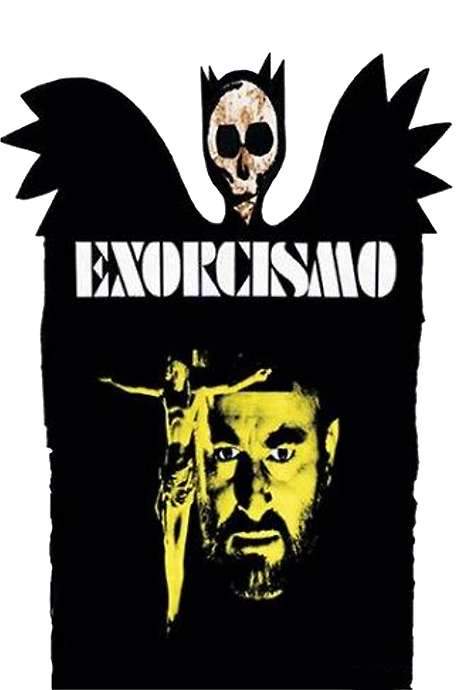
Playing himself after filming the final scene of his latest movie, Coffin Joe creator Jose Mojica Marins sits down for an on-camera interview about the next project he hopes to bring to life, which he plans to title "The Demon Exorcist." The interviewer probes the true existence of Coffin Joe, and Marins bluntly responds with a chilling assertion: > "Coffin Joe does not exist." A camera light suddenly explodes, shattering the moment and hinting at the film’s blend of reality and occult menace.
Marins heads off to the country home of Álvaro to set down the script for his next work, hoping the change of scenery will spark the story. He is greeted by Álvaro’s father, Mr. Julio, who tends the garden, and welcomed into the house by Álvaro, his wife Lúcia, and their three daughters: Betinha, Luciana, and Vilma, who is soon to be married to her fiancé Carlos.
From the outset, the atmosphere around the house grows uneasy. Winds whip across the grounds, horses become skittish, and that night Mr. Julio abruptly tears off his shirt, speaking in a fevered voice of a debt that must be paid. Marins investigates a locked hallway and is assaulted by fluttering books as the lights flicker and die. Betinha reports tarantulas and a snake in the Christmas tree, while a distant, eerie image appears—a mysterious woman with a white cat, surrounded by occult figurines and a framed portrait of Coffin Joe behind her.
Lucia confesses a startling scheme: Vilma is promised to Eugenio, the son of Satan, and Vilma is in fact the witch’s daughter. Lucia had secured Vilma as a newborn via a ruse tied to her husband’s infertility, planning to raise Vilma only to hand her over for this dark union. The recent disturbances are the witch’s retaliation against Vilma’s engagement to Carlos. Carlos survives a mysterious car accident, and Lucia faints, fearing that dark forces are at work. A ritualistic image follows—the witch biting the head off a rooster as a sacrificial gesture—before Marins returns to his room, haunted by Vilma’s moans from the next door.
Vilma wanders into the room in a trance, and Marins confronts her as she strikes him and leaves him dazed. He awakens to a room overshadowed by a black mass in progress: the red-cloaked, hooded figures of Luciana, Mr. Julio, and the witch circle a lit space while Vilma and Eugenio stand together, and the screams of torture fill the air. Then Coffin Joe appears, his presence a grisly reminder of the creature Marins has imagined made flesh. The figure climbs a staircase of human bodies to witness the wedding, where rings are placed on Carlos and Vilma’s fingers and the vows are spoken amidst a rising tide of pain and blood.
What follows is a sequence of vivid, graphic rites—torture, dismemberment, and live cannibalism—that push the room’s boundaries between ritual and horror. Marins is driven from the chamber as the ceremony continues, but his intervention returns when the youngest daughter, Betinha, is dragged toward sacrifice. He wields a fallen crucifix and proclaims his faith, effectively expelling Coffin Joe’s influence from the family and triggering a struggle that ends with a transparent image of Coffin Joe leaving Marins’ body and the witch’s power dissolving, along with Eugenio’s demise.
Marins awakens once more in his room, safe but changed. He checks on the household: Mr. Julio prepares Christmas dinner, Vilma and Carlos embrace, and Betinha and Luciana exchange gifts as carols drift through the home. The film closes on Betinha’s face, its expression solemn as the camera lingers, and in her eye the reflection of Coffin Joe smiles—an eerie, final reminder that the line between creator, creation, and supernatural menace remains disturbingly blurred.