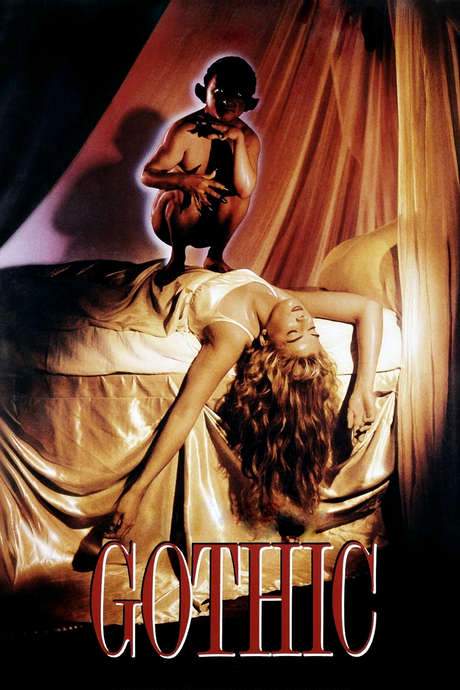
Gothic

Gothic

Year: 1986

Runtime: 88 mins

Language: English

HorrorHorror

On an isolated estate by Lake Geneva, Lord Byron receives Percy and Mary Shelley. Joined by Byron’s lover Claire Clairmont, they experiment with hallucinogens and devise a night of macabre storytelling. As the evening unfolds, the horrors they summon blur the line between illusion and reality, making it impossible to tell specter from fact.

Warning: spoilers below!

Haven’t seen Gothic yet? This summary contains major spoilers. Bookmark the page, watch the movie, and come back for the full breakdown. If you're ready, scroll on and relive the story!

Gothic (1986) – Full Plot Summary & Ending Explained

Read the complete plot breakdown of Gothic (1986), including all key story events, major twists, and the ending explained in detail. Discover what really happened—and what it all means.

Through her stepsister Claire Clairmont, Myriam Cyr and her future husband Julian Sands come to know Gabriel Byrne as Lord Byron. During the summer of 1816, Byron invites them to stay for a while at Villa Diodati in Switzerland, where they meet Byron’s physician friend, Timothy Spall as Dr. Polidori. On 16 June, while a storm rages outside, the five occupy themselves with a game of hide-and-seek, letting the tension between flirtation, fear, and curiosity simmer beneath the surface. Later in a parlor, Percy Shelley articulates a fascination with science, while Polidori shares his own speculations about sleepwalking and nightmares, drawing a faint line between the rational and the uncanny.

Byron introduces the group to Phantasmagoria, a collection of horror tales he bought in Geneva, and the trio take turns reading aloud excerpts. This shared reading becomes the spark for a late-night séance conducted around a human skull, a moment that unsettles Claire and triggers memories Mary recalls from their childhood—instances of unexplained phenomena where doors slammed and beds shook without a clear cause. After the séance, Claire is coaxed upstairs to rest, leaving the others to interrogate what they’ve just unleashed.

That night, Mary witnesses a shadowy figure outside the window and, when Percy steps away to investigate a barn door’s creak, he encounters something grotesque. Inside the house, Mary confronts Byron in the billiard room about his treatment of Claire, revealing that Claire is pregnant with his child. The exchange becomes heated, and the couple’s argument escalates into a physical confrontation. Later, Byron’s behavior toward Claire grows more intimate, and the group’s fraught alliance cracks under the weight of desire, fear, jealousy, and moral ambiguity.

The tension intensifies as Claire experiences a troubling episode—Byron’s intimate act with her coincides with her miscarriage. While Mary consoles Percy, who has grown increasingly paranoid, a disturbing odor of decay haunts him. A mysterious incident occurs at the foot of the stairs: Polidori appears by the banister, bleeding from a neck wound, claiming he was bitten by a vampire in his room. Byron suspects self-inflicted wounds, while Shelley and Mary wrestle with the possibility that something supernatural has entered their circle. Shelley voices a chilling belief that the group’s collective fear gave birth to something… and Polidori fears damnation for his homosexuality, even contemplating suicide, though Byron intervenes to stop him.

The atmosphere grows more nightmarish when Claire vanishes from her bed and is found by Shelley, whose horror is compounded when Claire’s body seems to metamorphose in astonishing ways. Mary attempts to flee the house but crashes through a glass door in the process. Shelley posits that the presence haunting them feeds on their fear, while Polidori’s difficulty with the group’s moral boundaries adds another layer of dread. A failed attempt to hang himself in the barn marks a turning point, as he witnesses a figure fleeing on horseback.

In a bid to exorcise the fear, Byron and Shelley try to recreate the séance, while Mary questions the possibility of meaning within the supernatural and beyond the limits of atheistic belief. The trio descends to the basement, where Claire lies nude and covered in mud. Byron attempts to proceed with the séance, but Mary refuses. The atmosphere erupts as Mary crushes the skull and lunges at Byron with a shard; Shelley intervenes, pulling them back from violence and turns their attention to a disturbing vision in which Mary imagines her dead son William in a coffin and a miscarriage reappearing as a nightmare. The moment spirals into a chaotic frenzy, and Mary staggers away, only to be stopped by Shelley as dawn returns. By morning, she reappears in the garden with Byron, Shelley, and Claire, their relationships irrevocably altered by what occurred.

In the contemporary era, tourists visit the Villa, and a voice-over lays out the grim fates of that fateful night: Mary’s son William died three years later, followed by Shelley’s drowning in 1822, and Byron’s death two years after that, with Polidori’s suicide in London. Out of Mary’s prior miscarriage arose the fierce impulse to resurrect her child in literature, giving birth to Frankenstein. From Polidori’s tangled feelings and fascination with vampires emerged The Vampyre, a legacy born from the shadows of that single, revelatory night. The film threads together life, love, fear, and creativity, showing how a moment of fear and imagination at a Swiss villa would echo through centuries of storytelling.
Last Updated: October 09, 2025 at 14:15

Mobile App Preview

Coming soon on iOS and Android

The Plot Explained Mobile App

From blockbusters to hidden gems — dive into movie stories anytime, anywhere. Save your favorites, discover plots faster, and never miss a twist again.

Sign up to be the first to know when we launch. Your email stays private — always.

Explore Movie Threads

Discover curated groups of movies connected by mood, themes, and story style. Browse collections built around emotion, atmosphere, and narrative focus to easily find films that match what you feel like watching right now.

Psychological gothic terror like in Gothic

Stories where internal fears manifest into claustrophobic, nightmarish realities.If you enjoyed the mind-bending horror of Gothic, you'll find similar experiences here. These films explore the terrifying intersection of psychological breakdown and supernatural phenomena, often within confined, atmospheric settings. Discover movies like Gothic where reality is a fragile concept.

psychologicalclaustrophobichallucinatorygothiceerienightmarishanxiousoppressive

Narrative Summary

Narratives in this thread typically isolate characters, often artists or intellectuals, in a single location. Through a catalyst like drugs, grief, or suggestion, their deepest fears are externalized, creating a haunting that is as much internal as external. The plot revolves around the struggle to discern truth from hallucination as the environment becomes a prison for the mind.

Why These Movies?

These movies are grouped by their shared focus on psychological unraveling within a gothic, claustrophobic framework. They prioritize mood over jump scares, building an overwhelming sense of dread through atmosphere, intense internal conflict, and the blurring of reality.

Dark stories of artistic creation like in Gothic

Tormented artists who birth masterpieces from a crucible of personal suffering.Explore movies like Gothic that delve into the painful process of artistic creation. These narratives show how great art can be born from nights of terror, psychological torment, and personal tragedy. Find similar films about the heavy price paid for a creative legacy.

tormentedcreativemelancholichistoricalintensebittersweettragicpsychological

Narrative Summary

The narrative follows a creator or group of creators as they enter a period of intense, often destructive, collaboration or isolation. Their artistic pursuit forces them to grapple with dark themes—mortality, desire, madness—mirroring the content of the art they are trying to create. The journey is transformative but leaves permanent scars, resulting in a bittersweet legacy.

Why These Movies?

These films are united by the theme of art emerging from profound suffering. They share a heavy emotional weight, a dark tone, and a focus on the psychological cost of genius. The ending is rarely purely happy, instead acknowledging the sacrifice inherent in the creative act.

Unlock the Full Story of Gothic

Don't stop at just watching — explore Gothic in full detail. From the complete plot summary and scene-by-scene timeline to character breakdowns, thematic analysis, and a deep dive into the ending — every page helps you truly understand what Gothic is all about. Plus, discover what's next after the movie.

Gothic Timeline

Track the full timeline of Gothic with every major event arranged chronologically. Perfect for decoding non-linear storytelling, flashbacks, or parallel narratives with a clear scene-by-scene breakdown.

Gothic Timeline

Characters, Settings & Themes in Gothic

Discover the characters, locations, and core themes that shape Gothic. Get insights into symbolic elements, setting significance, and deeper narrative meaning — ideal for thematic analysis and movie breakdowns.

Characters, Settings & Themes in Gothic

Gothic Spoiler-Free Summary

Get a quick, spoiler-free overview of Gothic that covers the main plot points and key details without revealing any major twists or spoilers. Perfect for those who want to know what to expect before diving in.

Gothic Spoiler-Free Summary

More About Gothic

Visit What's After the Movie to explore more about Gothic: box office results, cast and crew info, production details, post-credit scenes, and external links — all in one place for movie fans and researchers.

More About Gothic

Similar Movies to Gothic

Discover movies like Gothic that share similar genres, themes, and storytelling elements. Whether you’re drawn to the atmosphere, character arcs, or plot structure, these curated recommendations will help you explore more films you’ll love.